Metal Roofing on Ranch and Traditional Southern Homes
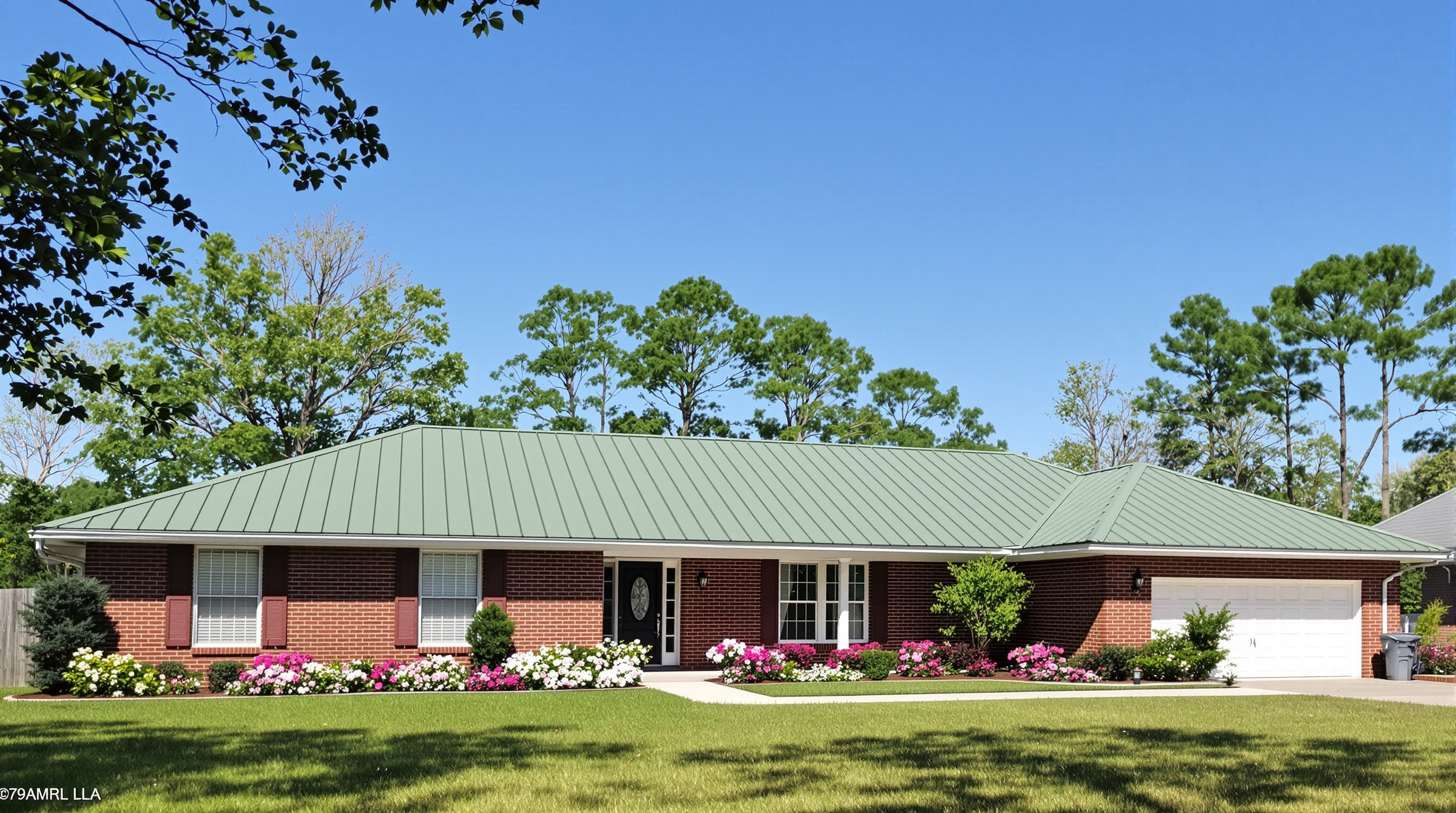
The short version: Ranch homes and traditional Southern houses — colonials, Craftsmans, Tudor-influenced designs — look best with metal roofs that complement their masonry and siding rather than competing with it. Earth tones in standing seam are the most popular choice, but metal shingles and stone-coated steel offer alternatives that blend seamlessly with traditional architecture. The low, wide roof profile of a ranch home makes the roofing material highly visible, so getting the color and profile right is especially important.
Why Ranch Homes Are Ideal Candidates for Metal Roofing
Ranch homes have the most visible roof of any architectural style. The single-story, low-slung profile means the roof comprises 40-50% of what you see from the street. On a two-story colonial, the walls dominate and the roof is partially hidden by the roofline angle. On a ranch, the roof is front and center — which means the roofing material, color, and condition have an outsized impact on curb appeal.
This visibility cuts both ways. A beautiful metal roof on a ranch home transforms the entire property. An ugly or mismatched metal roof on a ranch home is impossible to ignore. Color selection and panel profile matter more on a ranch than on almost any other home style.
Practical benefits stack up too. Ranch homes have simple roof geometries — typically a hip roof or a combination hip-and-gable — with few valleys, dormers, or complex intersections. Simple geometry means lower installation costs, fewer potential leak points, and cleaner panel runs. A metal roof on a ranch home is one of the most cost-effective and visually impactful home improvements available.
Panel Profile Options for Ranch and Traditional Homes
Standing Seam
The premium choice. Standing seam's clean lines and fastener-free surface work well on ranch homes, particularly those with mid-century or transitional architecture. The vertical seam lines add visual interest to the long, horizontal roof planes of ranch homes without introducing busyness.
Best applications: Updated ranch homes, transitional ranch-colonial hybrids, and ranch homes with modern interior renovations where the exterior needs to signal "upgraded" to match the interior investment.
Seam height consideration: On ranch homes, a moderate seam height (1-1.5 inches) reads as proportional. Tall seams (2 inches) designed for modern or commercial buildings can look oversized on a modest ranch profile.
Metal Shingles
The traditional-compatible choice. Metal shingles are stamped metal panels that mimic the appearance of slate, cedar shake, or tile. From the street, they look like a traditional roofing material — but they deliver the lifespan, wind resistance, and fire protection of metal. For ranch homes in traditional neighborhoods where standing seam might look too modern, metal shingles bridge the gap.
Best applications: Ranch homes with brick facades, colonials, Craftsman-style homes, and any traditional home where the neighborhood aesthetic leans conservative.
Stone-Coated Steel
The stealth metal roof. Stone-coated steel panels have a GalvalumeGalvalumeA steel coating consisting of 55% aluminum, 43.4% zinc, and 1.6% silicon by weight. Developed by Bethlehem Steel in 1972 and now the industry-standard substrate for painted metal roofing.Nearly all premium residential metal roof panels ship on a Galvalume substrate. Unpainted Galvalume should not be used within 1,500 feet of saltwater without a painted finish on top.Why it matters: Galvalume outlasts galvanized steel by 2-4x in atmospheric corrosion tests. The aluminum component provides barrier protection while zinc offers sacrificial (galvanic) protection at cut edges and scratches.Learn more → steel core coated with ceramic granules that give them the texture and appearance of concrete tile, clay tile, or wood shake. Most observers cannot tell them apart from the traditional material they mimic. They weigh 1.5-2.5 lb/sq ft — far less than clay tile (9-12 lb/sq ft) — so they do not require structural reinforcement.
Best applications: Ranch homes in neighborhoods with tile-roof covenants, Mediterranean-influenced ranch homes, and any situation where the homeowner wants metal roof performance without the metal roof appearance.
Exposed-Fastener Panels
Budget-friendly but visible. On a ranch home's highly visible, low-pitch roof, the screw pattern of exposed-fastener panels is prominently on display. R-panel and PBR panels can read as commercial or agricultural from the street. 5V-crimp is more architecturally refined and works on rustic or rural ranch homes. If budget is the primary concern, 5V-crimp in a complementary color is the most aesthetically acceptable exposed-fastener option for ranch homes.
Standing seam looks too modern for a traditional ranch home.
Reality: Standing-seam metal roofing has been used on traditional homes since the 1700s — it predates ranch-style architecture by 200 years. Thomas Jefferson's Monticello had a standing-seam metal roof. The perception that standing seam is 'modern' comes from its recent popularity on contemporary homes, but it is equally at home on traditional architecture when the right seam height, color, and detailing are chosen.
Color Guide for Ranch and Traditional Homes
Ranch homes and traditional Southern houses typically have warm exterior palettes — red or buff brick, earth-toned siding, natural stone accents — that call for roof colors in the warm neutral family. Cool colors (slate blue, bright silver) can work on ranch homes with cool-toned exteriors but are less common.
Burnished Slate
The most versatile ranch roof color. Burnished Slate is a warm dark gray with brown undertones that coordinates with virtually every brick color, siding material, and trim tone found on Gulf Coast ranch homes. It is dark enough to provide visual weight but neutral enough to avoid color competition with the brick or siding. If you can only consider one color, start here.
Clay and Sandstone
Earth tones that match the landscape. Clay and Sandstone are medium-warm tones that blend into the Gulf Coast's natural palette of sandy soils, marsh grass, and warm sunlight. They pair well with tan and buff brick, cream siding, and natural stone. These colors reflect moderate solar energy (40-55% reflectance) and fade slowly thanks to UV-stable iron oxide pigments.
Weathered Bronze and Dark Bronze
Warm metallics for upscale ranch homes. Bronze tones suggest copper patina and add a sense of quality and permanence. Weathered Bronze is lighter and more golden; Dark Bronze is deeper and more grounded. Both work with red brick, natural stone, and wood siding. These are popular choices on ranch homes that have been renovated to a higher finish level.
Hartford Green
The traditional Southern choice. Hartford Green (a deep, muted green) has been a standard roof color on Southern homes for generations. It works on ranch homes surrounded by mature landscaping and in wooded settings. Pair it with cream or white trim for classic contrast. Avoid Hartford Green on homes with red brick — the red-green combination reads as dated.
Cocoa Brown
For homes with warm stone or stucco. Cocoa Brown is a medium-dark warm brown that works particularly well with limestone, sandstone, and warm-toned stucco. On ranch homes with prominent stone facades, Cocoa Brown ties the roof into the stone's color family without matching it exactly.
Charcoal
For updated traditional homes. Charcoal crosses the line between traditional and transitional — it works on ranch homes that have been modernized with new windows, updated siding, and contemporary landscaping. It provides more visual weight than earth tones and reads as crisp and intentional. Charcoal works with both warm and cool exterior palettes, making it a safe choice when the exterior has mixed-temperature materials.
A 1970s brick ranch home in Mobile, Alabama has orange-red brick, cream trim, and dark brown shutters. The homeowner wants a metal roof that complements the brick without looking too modern. What is the best option?
Working with Low-Pitch Ranch Roofs
Most ranch homes have a 4/12 to 6/12 roof pitch. This moderate pitch is well within the operating range of all metal roofing systems — standing seam, metal shingles, stone-coated steel, and exposed-fastener panels all work at these slopes. However, the low pitch has visual implications.
More roof is visible. On a steep-pitch home, you see the roof at an angle that compresses its apparent area. On a low-pitch ranch, the roof reads as a broad, flat plane from the street. This means the panel profile and color have maximum visual impact — every detail is on display.
Panel direction matters. Standing-seam panels running parallel to the eave (horizontal orientation) emphasize the long, horizontal character of ranch architecture. Panels running from eave to ridge (standard vertical orientation) create vertical lines that add height to the low profile. Most ranch homes look best with standard vertical panel runs, which add a sense of lift to the horizontal composition.
Oil canning is more visible. Oil canningGalvalumeA steel coating consisting of 55% aluminum, 43.4% zinc, and 1.6% silicon by weight. Developed by Bethlehem Steel in 1972 and now the industry-standard substrate for painted metal roofing.Nearly all premium residential metal roof panels ship on a Galvalume substrate. Unpainted Galvalume should not be used within 1,500 feet of saltwater without a painted finish on top.Why it matters: Galvalume outlasts galvanized steel by 2-4x in atmospheric corrosion tests. The aluminum component provides barrier protection while zinc offers sacrificial (galvanic) protection at cut edges and scratches.Learn more → — the waviness that can appear in flat portions of metal panels — is more noticeable on low-pitch roofs because you are looking at the panels almost face-on. Using striations (minor ribs pressed into the flat of the panel) or choosing panels with pencil ribs reduces visible oil canning. Thicker gauge steel (24-gauge24-gauge steelSteel substrate measuring 0.0239 inches (0.607 mm) thick. The heaviest gauge commonly used in residential metal roofing.Lower gauge number = thicker metal. 24-gauge is roughly 25% thicker than 26-gauge. Required by some standing-seam manufacturers for warranty coverage in hurricane zones.Why it matters: Thicker steel resists denting from hail and foot traffic, reduces oil canning, and holds fasteners more securely. It costs 15-20% more than 26-gauge but lasts longer in high-wind and coastal environments.Learn more → instead of 26-gauge26-gauge steelSteel substrate measuring 0.0179 inches (0.455 mm) thick. The most common gauge for residential metal roofing across all panel types.26-gauge is the default spec from most residential metal roofing manufacturers. Thinner than 24-gauge but significantly sturdier than 29-gauge.Why it matters: Balances cost and performance for most residential applications. Adequate for standing seam and exposed-fastener panels in moderate wind zones, though 24-gauge is preferred where wind or hail risk is high.Learn more →) also helps.
Traditional Southern Sub-Styles
Colonial and Colonial Revival
Characteristics: Symmetrical facade, central entry with columns or pediment, multi-pane windows, steep-pitch gable or hip roof, brick or clapboard siding.
Roof recommendation: Standing seam in Dark Bronze, Burnished Slate, or Charcoal. Metal shingles in a slate pattern are also an excellent match. The formal symmetry of colonial architecture pairs well with the regular, precise seam lines of standing seam. Avoid bright or attention-grabbing roof colors — the colonial aesthetic is about restrained elegance.
Craftsman and Bungalow
Characteristics: Low-pitch gable roof with wide eave overhangs, exposed rafter tails, tapered columns on stone piers, mixed materials (stone, wood, shingle siding), earth-toned palette.
Roof recommendation: Standing seam or metal shingles in Weathered Bronze, Cocoa Brown, or Hartford Green. The Craftsman's celebration of natural materials and warm tones calls for roof colors in the same family. Metal shingles in a shake pattern work particularly well on Craftsman bungalows because they complement the textured, layered exterior aesthetic.
Split-Level and Raised Ranch
Characteristics: Multiple roof levels at offset heights, mix of horizontal siding and brick or stone, front-facing garage at lower level.
Roof recommendation: Standing seam in a single color across all roof levels for visual unification. The multiple roof planes of a split-level home can look chaotic with a busy or pattern-heavy roofing material. Standing seam's clean uniformity pulls the composition together. Burnished Slate, Charcoal, and Dark Bronze all work well.
Trim, Gutter, and Detail Coordination
On ranch homes, the gutter line is at eye level. Unlike taller homes where gutters are too high to scrutinize, ranch home gutters are right in the line of sight. Matching the gutter color to the roof color or the trim color is essential — mismatched gutters are immediately obvious on a ranch home.
Fascia and soffit treatment can make or break the transition from roof to wall. If the ranch home has exposed rafter tails (common on Craftsman-influenced ranch homes), the metal roof's drip edge should be minimal and not obscure the rafter ends. If the fascia is boxed, the gutter can sit flush against it for a clean, integrated look.
Downspouts should match the gutters. On a ranch home where the downspouts run against the siding, matching downspout color to siding color (rather than gutter color) can make them less visually intrusive. On a brick ranch, downspouts in a neutral tone that bridges the roof and brick work best.
Frequently Asked Questions
What metal roof looks best on a ranch-style home?
Standing seam in earth tones (Burnished Slate, Clay, Weathered Bronze, Dark Bronze) works best on most ranch-style homes. Metal shingles and stone-coated steel are also excellent options where the homeowner wants metal performance without the standing-seam look.
Can a metal roof work on a low-pitch ranch home?
Yes. Most ranch homes have a 4/12 to 6/12 roof pitch, well within the range for all metal roofing systems. The low pitch actually makes metal roofing a smart choice because the roof is highly visible from the street, so color and profile have maximum curb-appeal impact.
Does a metal roof increase the value of a ranch home?
Yes. Studies show metal roofs increase resale value by 1-6% compared to asphalt shingles. Ranch homes benefit particularly because their large, visible roof surfaces make the roofing material a dominant visual element that buyers notice immediately.