Metal Roofing on Modern and Contemporary Homes
The short version: Modern architecture and standing-seam metal roofing are a natural match. The clean lines, fastener-free surfaces, and monochromatic palette of standing seam align perfectly with modern design principles. Matte Black, Charcoal, Dark Bronze, and Zinc Gray are the dominant color choices. Mechanical-lock profiles with tall seams create the strongest visual statement. On the Gulf Coast, pair dark colors with cool-pigment PVDF coatingsPVDF (polyvinylidene fluoride)A resin-based paint system containing 70% PVDF resin (by weight of total resin solids). The highest-performance paint coating available for metal roofing. Kynar 500 and Hylar 5000 are the two licensed PVDF formulations.A true PVDF coating must contain at least 70% PVDF resin. Some manufacturers use 50% blends and market them misleadingly. Always confirm the 70% specification.Why it matters: PVDF coatings resist chalking, fading, and chemical degradation far longer than SMP or acrylic. Expect 30-40 years of color retention in full Gulf Coast sun. This is what separates a premium metal roof from a budget one.Learn more → and robust attic insulation to manage heat absorption.
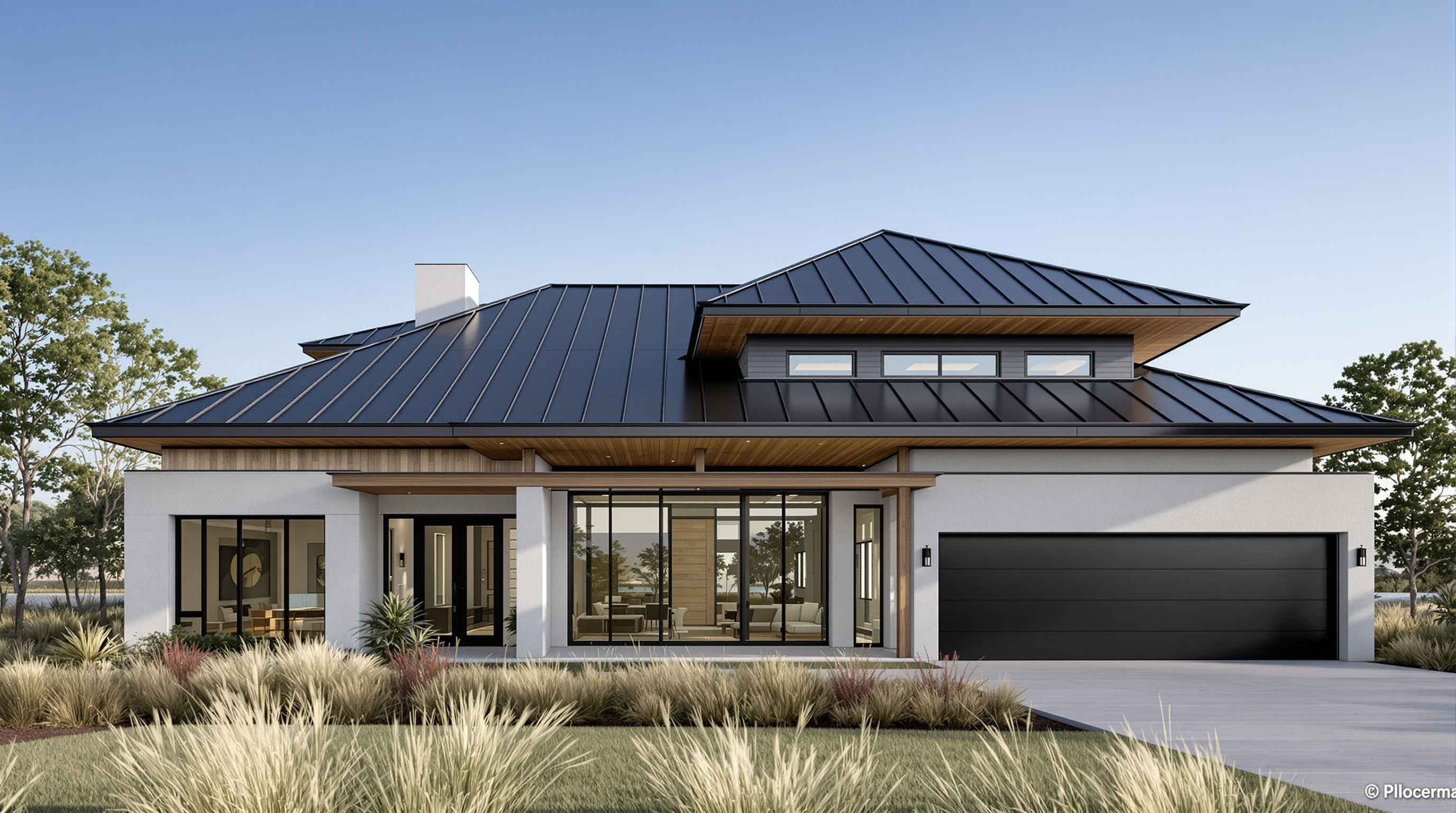
Why Modern Architecture Loves Standing Seam
Modern architecture is built on principles that standing-seam metal roofing embodies. Clean lines. Smooth surfaces. Honest materials. Minimal ornamentation. The standing-seam profile — long, uninterrupted panels with crisp raised seams and no visible fasteners — delivers all of this in a single roofing system.
Architects specify standing seam on modern homes for several reasons:
- Visual continuity. Standing-seam panels can run the full length of a roof slope without horizontal seams or lap joints. The uninterrupted surface creates a monolithic plane that reinforces the clean geometry of modern design.
- Precision detailing. The seam lines create a regular, geometric pattern that complements the precision of modern architecture. The shadow cast by each seam shifts throughout the day, adding subtle depth without ornamental complexity.
- Material honesty. Modern design values materials that look like what they are. A standing-seam metal roof reads as metal — it does not pretend to be slate, tile, or wood shake. This authenticity aligns with the modern ethos.
- Low-slope capability. Modern homes frequently incorporate low-slope roof sections, butterfly roofs, and shed roofs that require a roofing material capable of performing at minimal pitch. Standing seam can handle these geometries. Our standing seam guide covers the full system specification.
Use our roof color and style visualizer to preview standing seam profiles in different colors on modern home styles. See our metal roof gallery for real examples of modern metal roofs.
Panel Profile Selection for Modern Homes
Mechanical-Lock Standing Seam
The architect's choice. Mechanical-lock panels are field-seamed using a hand or electric seaming tool that folds the panel seams together, creating a tight, permanent connection. The seam heights are typically 1.5-2 inches, which creates strong, defined shadow lines that read as a deliberate design element.
Advantages for modern homes: Tightest seam engagement, highest wind-uplift ratings, best appearance on low-slope applications, and the most architecturally precise look. Mechanical-lock is the standard specified by architects for high-design residential and commercial projects.
Consideration: Mechanical-lock installation requires specialized tools and experienced crews. Labor costs are 15-25% higher than snap-lock, and fewer contractors are qualified to install it properly.
Snap-Lock Standing Seam
A practical alternative. Snap-lock panels click together during installation without seaming tools. Seam heights are typically 1-1.75 inches. The resulting seam profile is slightly less crisp than mechanical-lock but still provides a clean, fastener-free appearance.
Advantages for modern homes: Lower installation cost, wider contractor availability, still delivers the clean standing-seam aesthetic. For most residential modern homes on moderate slopes (3/12 and above), snap-lock performs identically to mechanical-lock in both appearance and weather performance.
Where snap-lock falls short: On very low slopes (below 2/12), the seam engagement may not be tight enough to prevent water intrusion. Mechanical-lock is preferred for low-slope applications because the double-folded seam creates a more reliable water barrier.
Only mechanical-lock standing seam looks modern enough for architect-designed homes.
Reality: Premium snap-lock profiles from major manufacturers are visually indistinguishable from mechanical-lock at normal viewing distances. The seam lines and panel surfaces look identical. The difference is in the seam engagement method, which affects wind uplift and low-slope performance but not appearance. Many architect-designed modern homes use snap-lock standing seam successfully. Choose mechanical-lock when the slope demands it or when maximum wind resistance is critical.
Color Palette for Modern Metal Roofs
Modern architecture operates in a restrained color language. The palette is typically monochromatic or near-monochromatic, with contrast coming from texture, material, and light-and-shadow play rather than from color variety. The roof is part of this unified envelope — not a separate element with its own color identity.
Matte Black
The most dramatic choice. Matte Black standing seam creates a bold, graphic roof plane that anchors the home's geometry. It works best against white, light gray, or natural wood-clad walls where the contrast is intentional and complete. On the Gulf Coast, Matte Black absorbs maximum heat — surface temperatures can reach 185-190 degrees Fahrenheit on summer afternoons. Pair with cool-pigment PVDF coatingPVDF (polyvinylidene fluoride)A resin-based paint system containing 70% PVDF resin (by weight of total resin solids). The highest-performance paint coating available for metal roofing. Kynar 500 and Hylar 5000 are the two licensed PVDF formulations.A true PVDF coating must contain at least 70% PVDF resin. Some manufacturers use 50% blends and market them misleadingly. Always confirm the 70% specification.Why it matters: PVDF coatings resist chalking, fading, and chemical degradation far longer than SMP or acrylic. Expect 30-40 years of color retention in full Gulf Coast sun. This is what separates a premium metal roof from a budget one.Learn more →, a radiant barrier, and R-38+ insulation.
Charcoal
Black's pragmatic sibling. Charcoal delivers 80% of the visual impact with meaningfully less heat absorption. The surface runs 10-15 degrees cooler than Matte Black, which translates to measurable cooling-cost savings on the Gulf Coast. Charcoal works in the same design contexts as black but reads as slightly softer and more approachable. For modern homes with gray or dark siding, Charcoal creates a tonal roof-to-wall relationship rather than the stark contrast of black.
Dark Bronze
Warmth without color. Dark Bronze introduces a subtle warm undertone that softens the hard edges of modern design. It pairs naturally with natural wood cladding (cedar, cypress, ipe), Corten steel accents, and warm-gray stucco. Dark Bronze is the choice when you want the roof to feel organic and grounded rather than graphic and stark.
Zinc Gray
Industrial precision. Zinc Gray evokes the raw materiality of zinc standing-seam roofing used on European modernist buildings. It is cooler-toned than Dark Bronze and warmer than Charcoal — a true neutral. Zinc Gray works on homes with exposed concrete, steel frames, and glass curtain walls. It says "this is a material" without demanding attention.
Galvalume Silver / Bright Metal
For bold industrial-modern designs. Unpainted GalvalumeGalvalumeA steel coating consisting of 55% aluminum, 43.4% zinc, and 1.6% silicon by weight. Developed by Bethlehem Steel in 1972 and now the industry-standard substrate for painted metal roofing.Nearly all premium residential metal roof panels ship on a Galvalume substrate. Unpainted Galvalume should not be used within 1,500 feet of saltwater without a painted finish on top.Why it matters: Galvalume outlasts galvanized steel by 2-4x in atmospheric corrosion tests. The aluminum component provides barrier protection while zinc offers sacrificial (galvanic) protection at cut edges and scratches.Learn more → or bright aluminum has a reflective, industrial character that works on homes designed to celebrate raw materials. The metallic surface changes character throughout the day as light angles shift. This is not a safe, neutral choice — it is a design commitment that makes the roof a feature element.
Low-Slope and Mixed-Slope Solutions
Modern homes frequently combine multiple roof geometries — shed roofs, butterfly roofs, flat sections, and clerestory windows — that create varying slopes within a single structure. Standing seam handles this complexity well, but minimum slope requirements must be respected.
Minimum Slope Requirements
- Snap-lock standing seam: Minimum 1/2:12 (about 2.4 degrees). Some manufacturers approve 3/12 minimum for standard installations.
- Mechanical-lock standing seam: Minimum 1/4:12 (about 1.2 degrees) with sealant in the seam. This is the lowest slope at which metal panels can reliably shed water.
- Below 1/4:12: Membrane roofing (TPO, PVC, or EPDM) is required. Standing seam cannot perform on flat or near-flat surfaces where water ponds.
Metal-to-Membrane Transitions
Where a standing-seam roof section meets a flat membrane section, the transition detail is critical. The metal panels typically terminate at a raised curb or parapet, with the membrane extending up and over the curb and counter-flashing covering the joint. This transition must be designed by the architect and executed precisely by experienced installers — water will find any gap.
Color coordination at transitions: Dark membrane roofing (charcoal or black TPO/PVC) visually connects with dark standing-seam panels. If the membrane is visible from certain angles, matching the color creates a seamless appearance. If the membrane is hidden behind a parapet, color does not matter.
Design Details for Modern Metal Roofs
Seam Spacing
Standard standing-seam panels are 12-18 inches wide, but narrower panels (10-12 inches) create a tighter seam rhythm that reads as more precise and intentional on modern homes. Wider panels (16-18 inches) create a calmer, more expansive roof surface. The choice depends on the scale of the home and the architect's intent.
Edge Detailing
Modern homes demand clean edge terminations. The traditional drip edge and exposed fascia approach looks too busy on minimalist architecture. Instead, modern metal roofs often use concealed gutter systems (built into the eave), flush fascia details, or panels that wrap over the eave edge for a knife-edge termination. These details are more expensive to execute but essential for the clean lines modern design requires.
Penetration Minimization
Every vent pipe, HVAC penetration, and skylight interrupts the clean roof plane. Modern homes minimize visible penetrations by using ridge ventilation instead of individual roof vents, routing HVAC equipment to ground level or through walls, and using tubular skylights or clerestory windows instead of traditional dome skylights. If penetrations are unavoidable, flashing should match the roof color exactly for maximum visual integration.
Parapet and Wall Cap Details
Many modern homes have parapet walls that conceal the roof edge. The metal roof panels terminate at the back side of the parapet, and a parapet cap (coping) in matching or contrasting metal covers the top. Aluminum or pre-finished steel coping in the same color as the roof creates a monolithic appearance. Contrasting coping (bright silver against a charcoal roof) can be used as a deliberate design accent.
An architect is designing a modern home in Gulf Shores, Alabama with a 1/4:12 slope shed roof section. What standing-seam type should be specified?
Energy Considerations for Dark Modern Roofs
Modern homes on the Gulf Coast face a tension between aesthetics and thermal performance. The dark colors that define modern architecture absorb significant solar heat. But modern homes also tend to have better building envelopes than older construction — tighter air sealing, more insulation, higher-performance windows — which mitigates the roof-color heat penalty.
Strategies for dark-roof modern homes on the Gulf Coast:
- Cool-pigment PVDF coatings on all dark-colored panels. Cool pigments reflect infrared radiation even in black and charcoal, reducing surface temperature by 20-30 degrees.
- Above-deck insulation (rigid foam board between the deck and metal panels) creates a thermal break that reduces heat transfer to the attic space. This is more common in modern construction than in traditional framing.
- Conditioned attic spaces (spray foam insulation at the rafter line instead of the attic floor) are common in modern homes with vaulted ceilings. This approach eliminates the hot attic entirely, making roof color less relevant to interior comfort.
- Ventilated rainscreen assemblies create an air gap between the metal panels and the roof deck. Hot air convects upward through the gap and exits at the ridge, reducing heat transfer to the deck. This is the Cadillac approach — expensive but extremely effective.
Frequently Asked Questions
What metal roof works best on a modern home?
Standing seam, almost without exception. Its clean, fastener-free surface and crisp seam lines align with minimalist modern design. Mechanical-lock profiles with tall seams (1.5-2 inches) create the strongest visual impact. Snap-lock profiles work well on moderate slopes (3/12 and above).
Can you put a metal roof on a flat or low-slope modern home?
Yes, with limitations. Mechanical-lock standing seam can go down to 1/4:12 pitch with sealant in the seams. Below that, membrane roofing is required. Many modern homes mix flat sections (membrane) with sloped sections (standing seam).
What is the best metal roof color for a modern home?
Dark neutrals dominate: Matte Black, Charcoal, Dark Bronze, and Zinc Gray. For an industrial look, natural Galvalume Silver or metallic finishes work well. Bright or saturated colors are rarely used on modern homes because they conflict with the restrained palette that defines the style.