Metal Roofing on Southern Farmhouse-Style Homes
The short version: Metal roofing is not just appropriate on Southern farmhouses — it is the original roofing material. Both standing seam and 5V-crimp are historically authentic choices. The modern farmhouse trend has pushed Matte Black and Charcoal standing seam into the spotlight, but Galvalume Silver and Barn Red remain the most historically grounded options. For Gulf Coast farmhouses, pair your panel choice with a PVDF coatingPVDF (polyvinylidene fluoride)A resin-based paint system containing 70% PVDF resin (by weight of total resin solids). The highest-performance paint coating available for metal roofing. Kynar 500 and Hylar 5000 are the two licensed PVDF formulations.A true PVDF coating must contain at least 70% PVDF resin. Some manufacturers use 50% blends and market them misleadingly. Always confirm the 70% specification.Why it matters: PVDF coatings resist chalking, fading, and chemical degradation far longer than SMP or acrylic. Expect 30-40 years of color retention in full Gulf Coast sun. This is what separates a premium metal roof from a budget one.Learn more → for long-term color retention in intense Southern sun.
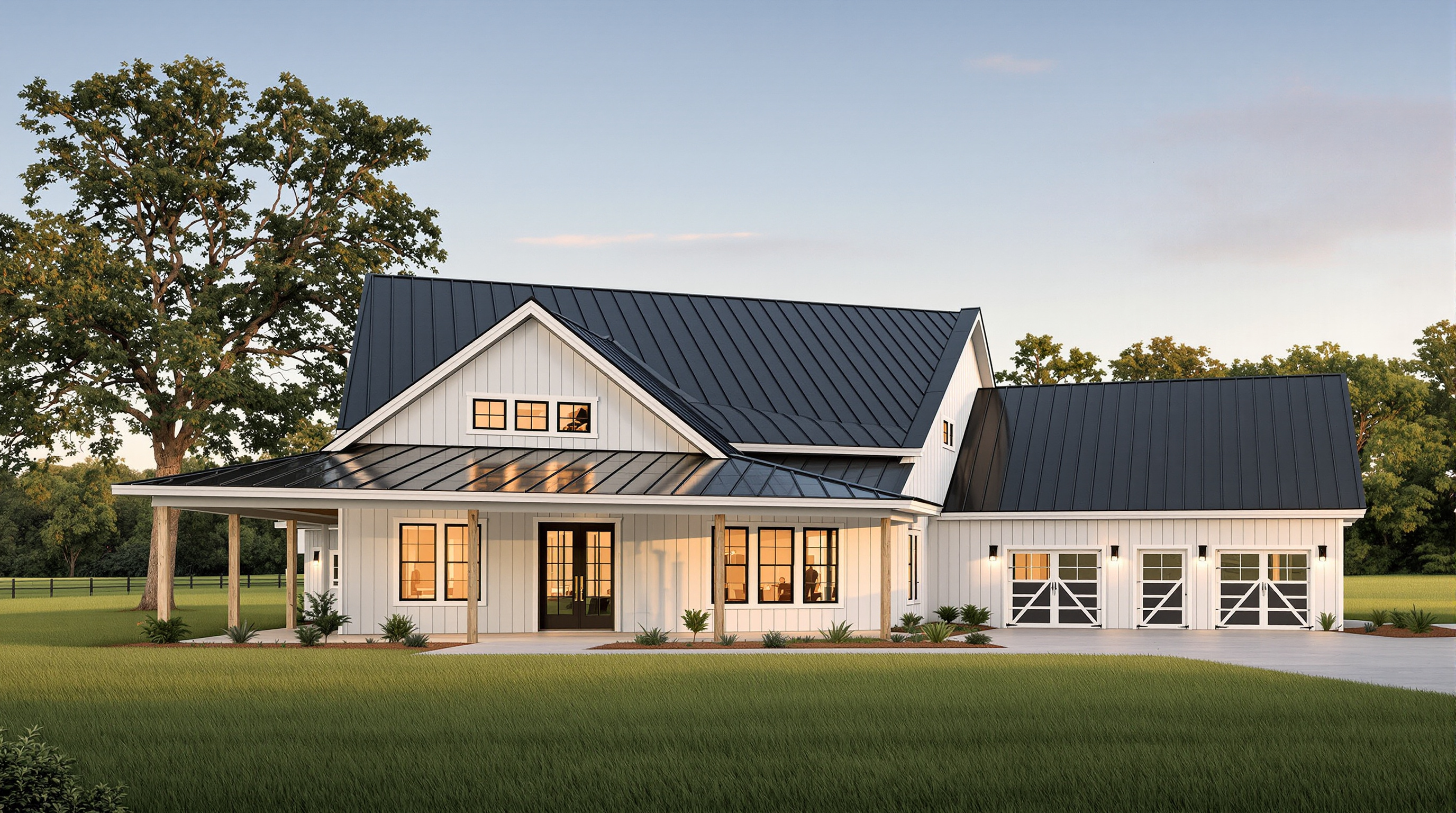
Metal Roofing and the Farmhouse: A 150-Year Partnership
Metal roofing has been integral to Southern farmhouse architecture since the Civil War era. When galvanized steel became commercially available in the 1860s-1870s, it quickly replaced wooden shingles on farm structures across the South. The reasons were practical: metal was fireproof (critical for homes near barns and field-burning), shed rain reliably on steep gable roofs, lasted longer than wood in the humid Southern climate, and required almost no maintenance.
By the early 1900s, a galvanized metal roof — usually corrugated or 5V-crimp — was the default on Southern farmhouses from Texas to the Carolinas. That tradition continued through the mid-20th century before asphalt shingles took over in the postwar suburban building boom. Today's farmhouse metal roof revival is not inventing something new — it is returning to what always belonged there.
Traditional vs Modern Farmhouse: Two Different Roof Languages
Traditional Southern Farmhouse
Architectural markers: Steep gable roof (8/12 to 12/12 pitch), wide covered porches, lap siding or board-and-batten siding, symmetrical or dogtrot floor plan, detached kitchen or breezeway, simple window proportions without elaborate trim.
Roof approach: The traditional farmhouse is about simplicity, function, and quiet character. The metal roof should look like it has always been there — not like a design statement. Galvalume Silver is the most historically authentic color because it mimics the appearance of the original galvanized steel or terne metal that these homes wore for decades. Barn Red is the other classic choice, connecting the farmhouse roof visually to the agricultural buildings that define the property.
Panel profile: 5V-crimp is the most period-appropriate panel for traditional farmhouses. Its shallow V-shaped ribs create a subtle, rhythmic texture that complements the simple lines of farmhouse architecture. Corrugated panels work on outbuildings and informal structures but can look too agricultural on a polished farmhouse restoration. Preview these options on your home with our roof color and style visualizer. See our metal roof gallery for real farmhouse examples.
Standing seam is also appropriate and was used on finer farmhouses in the 19th and early 20th centuries. If you choose standing seam for a traditional farmhouse, opt for a snap-lock profile with moderate seam height (1 to 1.5 inches) rather than a tall mechanical-lock seam — the shorter seam reads as more traditional.
Modern Farmhouse
Architectural markers: Board-and-batten siding (often in dark or moody tones), mixed gable and shed roof sections, black window frames, oversized barn-style doors, open floor plan with vaulted ceilings, industrial-inspired light fixtures.
Roof approach: The modern farmhouse uses the metal roof as a deliberate design element. The dominant trend is Matte Black or Charcoal standing seam with crisp seam lines that contrast against white or light-colored siding. The roof reads as graphic and intentional rather than rustic and understated.
Panel profile: Standing seam, almost without exception. The modern farmhouse aesthetic demands the clean, fastener-free surface that standing seam provides. Mechanical-lock profiles with taller seams (1.5-2 inches) create the strong shadow lines that define this look.
A farmhouse has to have a corrugated metal roof to look authentic.
Reality: Corrugated panels were common on barns and outbuildings, but most farmhouses — even modest ones — used 5V-crimp or standing-seam panels. Corrugated metal reads as utilitarian and is rarely appropriate on the main residence unless you are going for an intentionally raw, industrial-farmhouse aesthetic. For a polished farmhouse look, standing seam or 5V-crimp is more historically and architecturally correct.
Color Guide for Farmhouse Metal Roofs
Galvalume Silver
The authentic choice. Unpainted GalvalumeGalvalumeA steel coating consisting of 55% aluminum, 43.4% zinc, and 1.6% silicon by weight. Developed by Bethlehem Steel in 1972 and now the industry-standard substrate for painted metal roofing.Nearly all premium residential metal roof panels ship on a Galvalume substrate. Unpainted Galvalume should not be used within 1,500 feet of saltwater without a painted finish on top.Why it matters: Galvalume outlasts galvanized steel by 2-4x in atmospheric corrosion tests. The aluminum component provides barrier protection while zinc offers sacrificial (galvanic) protection at cut edges and scratches.Learn more → has a matte metallic silver appearance that ages to a subtle patina over decades. It is the closest modern equivalent to the terne metal or galvanized steel that original farmhouses wore. Galvalume Silver works equally well on white, cream, gray, and natural wood exteriors. It reflects heat well and never fades because there is no paint to degrade.
Caveat: Unpainted Galvalume is not recommended within 1,500 feet of saltwater. In the severe coastal zone, use painted aluminum or painted Galvalume instead.
Matte Black
The modern farmhouse signature. Matte Black standing seam against white board-and-batten siding is the defining image of the modern farmhouse movement. The contrast is dramatic and photographs beautifully. On the Gulf Coast, Matte Black absorbs significant heat — pair it with cool-pigment PVDF coatingPVDF (polyvinylidene fluoride)A resin-based paint system containing 70% PVDF resin (by weight of total resin solids). The highest-performance paint coating available for metal roofing. Kynar 500 and Hylar 5000 are the two licensed PVDF formulations.A true PVDF coating must contain at least 70% PVDF resin. Some manufacturers use 50% blends and market them misleadingly. Always confirm the 70% specification.Why it matters: PVDF coatings resist chalking, fading, and chemical degradation far longer than SMP or acrylic. Expect 30-40 years of color retention in full Gulf Coast sun. This is what separates a premium metal roof from a budget one.Learn more →, a radiant barrier, and R-38+ insulation to manage the thermal load.
Charcoal
Black's more practical cousin. Charcoal delivers 80% of the visual impact of Matte Black with meaningfully less heat absorption. The surface temperature difference between Charcoal and Matte Black on a summer afternoon can be 10-15 degrees Fahrenheit — not trivial on the Gulf Coast. Charcoal is often the smarter choice when you want the dark, moody farmhouse look but want to keep energy bills in check.
Barn Red
The classic. Barn Red metal roofing connects the farmhouse to its agricultural roots. On white or cream-colored siding, a red roof makes a confident, traditional statement. On the Gulf Coast, use PVDF-coated red — red pigments are the most fade-prone, and an SMPSMP (silicone-modified polyester)A mid-tier paint system for metal roofing that adds silicone to a polyester base for improved UV and chalk resistance compared to standard polyester. Less durable than PVDF.SMP is the standard coating on most exposed-fastener panels (R-panel, PBR, 5V-crimp). If a contractor quotes a standing-seam roof with SMP paint, ask why they are not using PVDF.Why it matters: SMP costs 15-25% less than PVDF and performs well for 15-20 years. Acceptable for budget-conscious projects, but expect earlier fading and chalking in intense Gulf Coast sun.Learn more → coating in red will show visible fading within 8-12 years in intense Southern sun.
Hartford Green / Forest Green
The quiet farmhouse color. Green metal roofs have a long history on Southern rural homes. Hartford Green and Forest Green pair well with cream, tan, and natural wood siding. These colors sit comfortably in wooded settings and on properties with mature landscaping. Avoid bright or vivid greens — stick to muted, forest tones for farmhouse authenticity.
Burnished Slate
For the refined farmhouse. Burnished Slate is a warm dark gray with brown undertones that reads as sophisticated without being trendy. It works on both traditional and modern farmhouses and coordinates well with warm-toned siding, natural stone, and aged wood accents.
A homeowner is renovating an 1890s dogtrot farmhouse in rural Alabama with original board-and-batten siding. Which metal roof would be most historically appropriate?
Roof Details That Make or Break the Farmhouse Look
Panel profile and color are the big decisions, but the small details determine whether the roof feels authentic or forced.
Ridge and Hip Treatment
Traditional: A ridge cap (Z-bar or formed cap) in the same material and color as the panels. Simple, functional, invisible. This is the default for traditional farmhouses.
Modern: A standing-seam ridge detail with panels running over the ridge creates a cleaner, more continuous look. This requires more skilled installation but delivers the uninterrupted roof plane that modern farmhouse designs call for.
Eave and Rake Detailing
Traditional farmhouses had simple eave returns or open rafter tails. If your farmhouse has exposed rafter tails, the metal drip edge should be clean and minimal — do not cover the rafter tails with a deep fascia box that hides the structural expression.
Modern farmhouses typically have boxed eaves with clean fascia lines. The metal roof's drip edge and gutter attachment should align with the fascia plane for a flush, integrated look.
Porch Roof Transitions
Farmhouse porches are defining features, and the roof-to-porch transition is critical. On traditional farmhouses, the porch roof is often a lower-slope extension of the main roof, with the metal panels continuing down from the main roof over the porch. On modern farmhouses, the porch roof may be a separate shed roof that meets the main wall, requiring careful flashing and panel termination.
Cupolas, Dormers, and Ventilation
Working cupolas and ridge ventilation are farmhouse hallmarks. If your farmhouse has a cupola, the metal roof flashing around it should be the same material and color as the panels. Mismatched flashing metals (copper flashing on a Galvalume roof, for example) create galvanic corrosion risk and visual disconnection.
Energy Considerations for Farmhouse Metal Roofs
Many Southern farmhouses lack modern insulation. Original farmhouses often have open attics with minimal or no insulation, balloon-frame walls with no cavity insulation, and single-pane windows. In these homes, roof color has an outsized impact on interior comfort because there is little thermal resistance between the roof and the living space.
If you are reroofing a farmhouse with limited insulation: A light-colored metal roof (Galvalume Silver, Light Stone, or a light earth tone) can reduce summer attic temperatures by 20-40 degrees compared to a dark roof. This directly reduces cooling loads and improves comfort. If you insist on a dark roof, install a radiant barrier on the underside of the roof deck during the reroofing project — it is an inexpensive upgrade ($0.30-0.50 per square foot) that blocks 90-97% of radiant heat transfer from the dark surface.
If you are building new or have already insulated: Color choice is primarily aesthetic. With R-38+ attic insulation, a radiant barrier, and proper ventilation, the energy difference between Galvalume Silver and Matte Black shrinks to $50-100 per year on a typical Gulf Coast farmhouse.
Coordinating the Full Farmhouse Exterior
White house + dark roof is the modern farmhouse default, but it is not the only option. Traditional Southern farmhouses came in a range of exterior palettes:
- White siding + Galvalume Silver roof — the most historically authentic Southern farmhouse look
- White siding + Matte Black or Charcoal roof — the modern farmhouse look, dramatic and photogenic
- White siding + Barn Red roof — traditional rural character, ties the house to agricultural outbuildings
- Cream or butter-yellow siding + Forest Green roof — warm Southern country palette, works in wooded settings
- Gray or sage siding + Charcoal roof — subdued modern farmhouse, less common but sophisticated
- Natural wood siding + Galvalume Silver or Dark Bronze roof — rustic farmhouse, works on cabin-farmhouse hybrids
Porch ceilings: The classic Southern haint blue (a soft blue-green) porch ceiling pairs beautifully with any farmhouse roof color. If you are going for a modern farmhouse look, consider a natural wood or painted white porch ceiling instead.
Frequently Asked Questions
What type of metal roof goes on a farmhouse?
Both standing seam and 5V-crimp are historically appropriate for Southern farmhouse-style homes. Traditional farmhouses used corrugated or 5V-crimp panels. Modern farmhouse builds typically use standing seam for its cleaner lines and lower maintenance. Galvalume Silver, Barn Red, Charcoal, and Matte Black are the most popular farmhouse roof colors.
What color metal roof looks best on a white farmhouse?
Matte Black, Charcoal, Galvalume Silver, and Barn Red are the top choices. Matte Black creates the modern farmhouse look. Galvalume Silver is the most historically authentic. Charcoal offers a middle ground. Barn Red delivers the classic red-barn vernacular.
Is a metal roof on a farmhouse historically accurate?
Absolutely. Metal roofing has been the dominant roofing material on Southern farmhouses since the mid-1800s. A metal roof on a farmhouse is not a modern trend — it is a return to the original design language.