Stone-Coated Steel Roofing: What It Is and Where It Fits
The short version: Stone-coated steel roofing is a Galvalume steelGalvalumeA steel coating consisting of 55% aluminum, 43.4% zinc, and 1.6% silicon by weight. Developed by Bethlehem Steel in 1972 and now the industry-standard substrate for painted metal roofing.Nearly all premium residential metal roof panels ship on a Galvalume substrate. Unpainted Galvalume should not be used within 1,500 feet of saltwater without a painted finish on top.Why it matters: Galvalume outlasts galvanized steel by 2-4x in atmospheric corrosion tests. The aluminum component provides barrier protection while zinc offers sacrificial (galvanic) protection at cut edges and scratches.Learn more → panel covered with ceramic stone granulesCeramic granulesCrusite or basalt stone chips bonded to a steel substrate with acrylic adhesive. Used on stone-coated steel roofing to mimic the look of asphalt shingles, clay tile, or wood shake.Some granule loss is normal over time, especially in the first year. Excessive loss indicates a bonding defect. Premium stone-coated steel products carry 50-year warranties on granule adhesion.Why it matters: Granules provide UV protection, color, and a textured appearance. They also dampen rain noise better than smooth metal. Granule adhesion quality varies by manufacturer; look for products tested to ASTM D3462.Learn more → that make it look like clay tile, concrete tile, wood shake, or slate. It weighs 1.5-2.5 lb/sq ft (vs 9-12 lb for clay tile), resists 120-150+ mph winds, and lasts 40-70 years. It costs $8-15/sq ft installed — less than the materials it mimics, more than basic metal panels. It makes the most sense on homes where the owner wants the traditional look of tile or slate with the performance and light weight of metal.
How Stone-Coated Steel Works
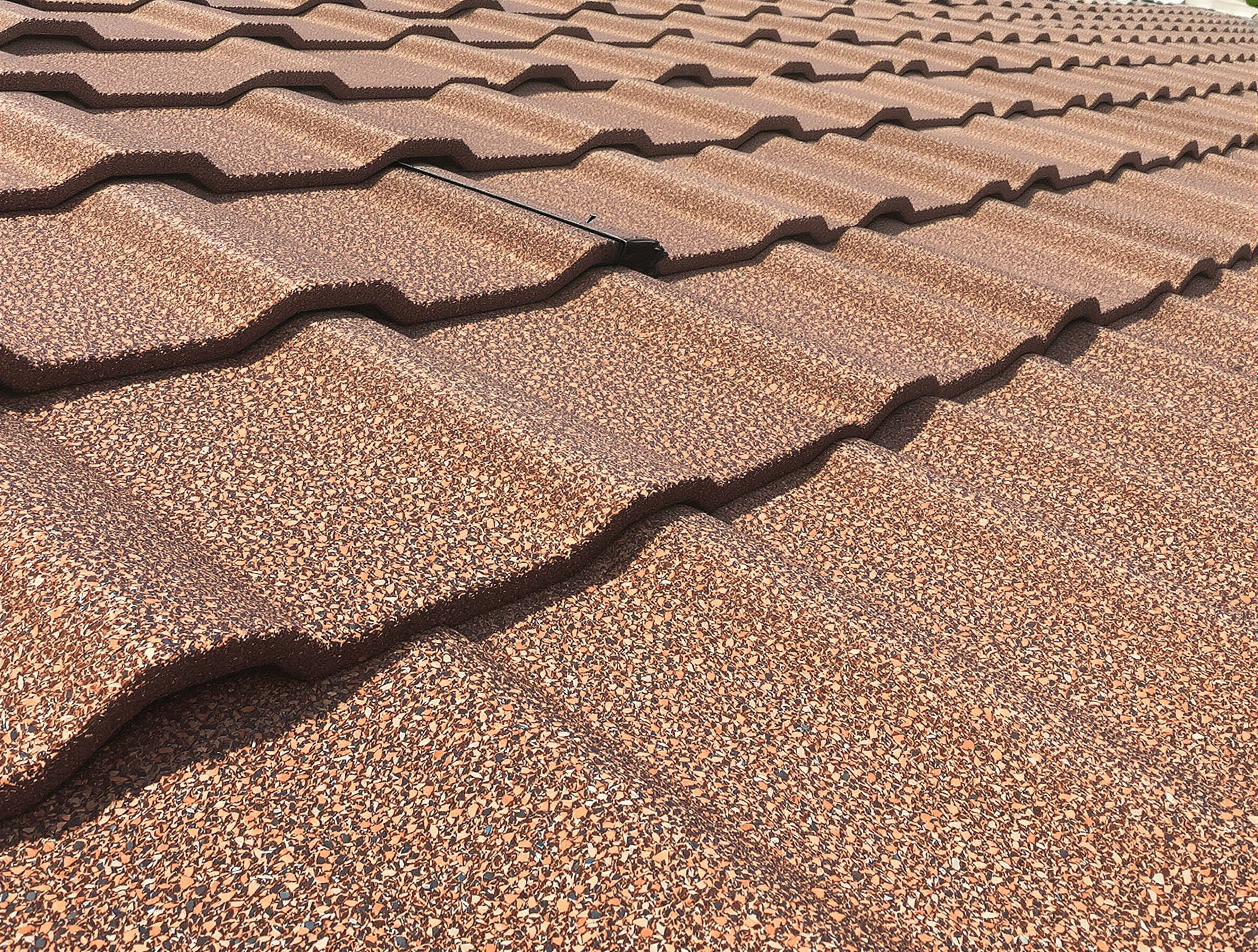
The system has four layers, each with a specific function:
- Steel core: A GalvalumeGalvalumeA steel coating consisting of 55% aluminum, 43.4% zinc, and 1.6% silicon by weight. Developed by Bethlehem Steel in 1972 and now the industry-standard substrate for painted metal roofing.Nearly all premium residential metal roof panels ship on a Galvalume substrate. Unpainted Galvalume should not be used within 1,500 feet of saltwater without a painted finish on top.Why it matters: Galvalume outlasts galvanized steel by 2-4x in atmospheric corrosion tests. The aluminum component provides barrier protection while zinc offers sacrificial (galvanic) protection at cut edges and scratches.Learn more → (55% aluminum / 43.4% zinc / 1.6% silicon) steel substrate, typically 26-gauge. This provides the structural strength, fire resistance, and corrosion protection. The Galvalume coating protects the steel from rust even if the outer layers are damaged.
- Acrylic adhesive layer: A weather-resistant acrylic resin applied to the steel surface. This adhesive bonds the stone granules to the metal core. The quality and thickness of this adhesive layer determines how well the granules stay bonded over decades of thermal cycling and UV exposure.
- Ceramic stone granules: Natural stone chips (typically basalt or granite) coated with a ceramic firing process that locks in color. The ceramic coating on the granules is similar to the glazing on ceramic tile — it is extremely UV-stable and does not fade the way painted coatings do. The granules provide the texture, color, and appearance of traditional roofing materials.
- Clear acrylic overglaze: A transparent acrylic topcoat that seals the granule layer and provides additional weather resistance. This overglaze also helps the surface shed water and resist algae and mildew growth in the humid Gulf Coast climate.
Profile Styles Available
Stone-coated steel comes in four main profile styles, each mimicking a different traditional roofing material:
Barrel Tile Profile
Mimics: Spanish clay tile or concrete S-tile. The curved barrel shape creates deep shadow lines and a distinctly Mediterranean or Spanish Colonial aesthetic. This is the most popular stone-coated steel profile in Florida and along the Gulf Coast.
Best on: Mediterranean, Spanish Colonial, Tuscan, and Florida Vernacular architecture. Also works on upscale ranch homes in neighborhoods where tile roofs are common. Use our roof color and style visualizer to preview stone-coated steel profiles on different home styles. See our stone-coated steel cost guide for detailed pricing.
Shake Profile
Mimics: Hand-split cedar shake. The irregular, textured surface replicates the rustic warmth of natural wood shake. From the street, most people cannot tell the difference.
Best on: Craftsman bungalows, mountain lodge-style homes, and rustic or transitional homes where wood shake would be the natural choice but fire risk, maintenance, or longevity concerns rule it out.
Shingle Profile
Mimics: Architectural asphalt shingles or flat slate. The flatter profile with defined shadow lines creates a clean, traditional look that blends into neighborhoods where shingle roofs are the norm.
Best on: Colonial, ranch, Cape Cod, and any traditional home style where the homeowner wants metal performance without a metal appearance. This is the "stealth" option — most observers will not realize it is a metal roof.
Slate Profile
Mimics: Natural slate tile. The stamped texture replicates the layered, irregular edges of quarried slate. Available in multi-tone blends that mimic the color variation of natural slate.
Best on: Tudor, Colonial Revival, European-influenced homes, and upscale traditional homes where natural slate would be ideal but the weight, cost, or fragility is prohibitive.
Where Stone-Coated Steel Makes the Most Sense
Stone-coated steel occupies a specific niche in the metal roofing market. It is not the right choice for every home, but in certain situations, it is the best choice. Here is where it fits:
Tile-Look Neighborhoods
The strongest use case. In Gulf Coast communities where concrete or clay tile is the dominant roof type — common in Florida, parts of Coastal Alabama, and some Texas Gulf Coast developments — replacing a heavy tile roof with stone-coated steel gives you the same appearance at one-fifth the weight. No structural reinforcement needed, which saves $3,000-8,000 on a typical reroofing project.
HOA-Restricted Communities
Some HOAs require a tile or shingle appearance. Standing-seam metal roofing may be prohibited because it does not match the neighborhood aesthetic. Stone-coated steel passes HOA approval because it looks like tile or shingle from the street. It is the only metal roofing option in many deed-restricted communities.
Re-Roofing Over Existing Materials
Stone-coated steel is light enough to install over existing asphalt shingles (where building codes allow over-roofing), eliminating tear-off costs. At 1.5-2.5 lb/sq ft, stone-coated steel adds minimal load to the structure. By contrast, installing concrete tile over existing shingles would exceed the structural capacity of most residential roof frames.
Hurricane and High-Wind Zones
Stone-coated steel's interlocking panel design and concealed fasteners create a wind-resistant assembly that outperforms individual tiles or shingles. The four-way interlock — panels lock together at top, bottom, left, and right — means wind cannot pry up individual units. Most systems carry Miami-Dade NOA (Notice of Acceptance) approval and are rated for 120-150+ mph winds.
Stone-coated steel granules fall off over time and leave bald patches.
Reality: Granule adhesion has improved dramatically since early stone-coated steel products. Current manufacturing processes use high-performance acrylic adhesives that maintain bond integrity for 30-40+ years. Some granule loss is normal in the first year (loose granules from manufacturing) and after severe hail impacts, but wholesale granule loss is a sign of a defective product or installation, not a characteristic of the category. Reputable manufacturers warranty against granule adhesion failure for 50 years.
Stone-Coated Steel vs Other Roofing Systems
vs Standing Seam
Stone-coated steel trades standing seam's clean, modern aesthetic for a traditional appearance. Standing seam is the better choice when you want a visible metal roof. Stone-coated steel is the better choice when you want metal roof performance hidden behind a tile, shake, or shingle appearance. Standing seam has a slight edge in wind uplift at the very highest ratings and requires no granule maintenance. For a detailed comparison, see our Standing Seam vs Stone-Coated Steel guide.
vs Clay and Concrete Tile
This is where stone-coated steel shines. Clay tile weighs 9-12 lb/sq ft and requires structural reinforcement on most residential frames. Concrete tile weighs 8-10 lb/sq ft. Stone-coated steel delivers a similar appearance at 1.5-2.5 lb/sq ft — no structural upgrades needed. Clay tile costs $15-25/sq ft installed; stone-coated steel costs $8-15/sq ft. Clay tile is brittle and cracks under foot traffic or hail; stone-coated steel is resilient. The only advantage clay tile holds is UV color permanence — though stone-coated steel's ceramic granules come very close.
vs Asphalt Shingles
Stone-coated steel costs 2-3x more upfront than architectural asphalt shingles ($4-7/sq ft installed). But stone-coated steel lasts 40-70 years versus 15-25 years for asphalt. On a 50-year time horizon, stone-coated steel requires one installation while asphalt requires two or three — making stone-coated steel cheaper on total cost of ownership. Stone-coated steel also provides superior wind resistance (120-150+ mph vs 60-110 mph for shingles) and Class 4 hail impact resistance.
A homeowner in a Gulf Coast HOA community has a failing concrete tile roof. The HOA requires a 'tile appearance' roof. What is their best replacement option?
Installation Considerations on the Gulf Coast
Stone-coated steel installation differs significantly from standing seam or exposed-fastener installation. The panels are smaller (typically 50" x 13"), interlock on all four edges, and attach with concealed nails or clips rather than screws or seaming tools. The skill set is closer to tile installation than to metal panel installation.
Contractor selection matters. Not all metal roofing contractors have stone-coated steel experience. The interlocking system, flashing details, hip and ridge treatment, and valley installation all follow manufacturer-specific procedures that differ from conventional metal roofing. Ask for stone-coated steel references specifically — do not assume that a standing-seam contractor can install stone-coated steel equally well.
Underlayment requirements: Stone-coated steel is typically installed over a self-adhering (peel-and-stick) underlayment or high-quality synthetic underlayment, on top of solid decking. Battens may be required depending on the profile and manufacturer. The underlayment is the secondary water barrier — if any panel seal is compromised, the underlayment protects the deck.
Ventilation: The profile shape of stone-coated steel tiles creates a natural air gap between the panel and the deck, allowing some ventilation. This air gap also provides a modest thermal break. Proper ridge and eave ventilation is still required for attic temperature management, but the built-in air gap gives stone-coated steel a slight thermal advantage over flat-profile metal panels installed directly on decking.
Maintenance and Long-Term Performance
Stone-coated steel is a low-maintenance roofing system, but it is not zero-maintenance. Annual inspection is wise, especially after hurricane season.
- Granule inspection: Check for bare spots where granules may have been displaced by hail or foot traffic. Small bare areas can be touched up with manufacturer-supplied granule repair kits.
- Debris clearing: The textured surface of stone-coated steel can accumulate leaf debris and pine needles in valleys and at panel interlocks. Clear debris annually to prevent moisture retention and algae growth.
- Algae and mildew: In the humid Gulf Coast climate, algae and mildew can grow on the textured granule surface. Most stone-coated steel panels include algae-resistant treatments, but periodic cleaning with a soft brush and diluted bleach solution may be needed every 3-5 years.
- Walking on the roof: Walk on stone-coated steel carefully, stepping on the lower third of each tile where the panel is supported by the tile below. Stepping on the upper portion can dent or crack the panel. This is a significant difference from standing seam, which can generally be walked on anywhere.
Frequently Asked Questions
What is stone-coated steel roofing?
Stone-coated steel is a metal roofing system with a Galvalume steelGalvalumeA steel coating consisting of 55% aluminum, 43.4% zinc, and 1.6% silicon by weight. Developed by Bethlehem Steel in 1972 and now the industry-standard substrate for painted metal roofing.Nearly all premium residential metal roof panels ship on a Galvalume substrate. Unpainted Galvalume should not be used within 1,500 feet of saltwater without a painted finish on top.Why it matters: Galvalume outlasts galvanized steel by 2-4x in atmospheric corrosion tests. The aluminum component provides barrier protection while zinc offers sacrificial (galvanic) protection at cut edges and scratches.Learn more → core covered with ceramic stone granulesCeramic granulesCrusite or basalt stone chips bonded to a steel substrate with acrylic adhesive. Used on stone-coated steel roofing to mimic the look of asphalt shingles, clay tile, or wood shake.Some granule loss is normal over time, especially in the first year. Excessive loss indicates a bonding defect. Premium stone-coated steel products carry 50-year warranties on granule adhesion.Why it matters: Granules provide UV protection, color, and a textured appearance. They also dampen rain noise better than smooth metal. Granule adhesion quality varies by manufacturer; look for products tested to ASTM D3462.Learn more → that replicate the appearance of clay tile, concrete tile, wood shake, or slate. It weighs 1.5-2.5 lb/sq ft and lasts 40-70 years.
How long does a stone-coated steel roof last?
40-70 years with proper installation. Most manufacturers offer 50-year transferable warranties. The ceramic granules resist UV fading far longer than painted metal coatings, and the steel core is protected from corrosion by the Galvalume coating and the granule layer above it.
How much does stone-coated steel roofing cost?
$8-15 per square foot installed, or $16,000-30,000 for a typical 2,000 square foot Gulf Coast home. That is less than clay tile ($15-25/sq ft) but more than exposed-fastener metal ($4-8/sq ft).
Is stone-coated steel good for hurricane zones?
Yes. The four-way interlocking design and concealed fasteners create a wind-resistant assembly rated for 120-150+ mph winds. Most systems carry Miami-Dade NOA approval for use in the Florida High-Velocity Hurricane Zone.