Standing Seam Metal Roofing: The Complete Guide
Standing seam is a metal roof system where panels connect at raised seams using concealed clipsConcealed clipA metal bracket that fastens to the roof deck and holds a standing-seam panel in place without penetrating the panel surface. The clip is hidden beneath the seam after panels are joined.Clip type (fixed vs. floating), material (stainless steel vs. galvanized), and spacing (12-24 inches on center) directly affect wind-uplift performance. Closer clip spacing = higher uplift rating.Why it matters: Clips allow panels to expand and contract with temperature changes (a 20-foot steel panel can move 1/4 inch across a 100°F swing). Without clips, thermal cycling causes oil canning, buckling, and fastener stress.Learn more → — no screws penetrate the weathering surface. The seams stand 1 to 1.5 inches above the panel face, locking together to create a continuous weather barrier. Because every fastener is hidden beneath the seam, standing seam eliminates the single biggest failure point on metal roofs: exposed screws that back out, lose their seal, and leak. Installed cost runs $8-14 per square foot on the Gulf Coast, with a typical service life of 40-70 years depending on substrate and coating.
How Standing Seam Works
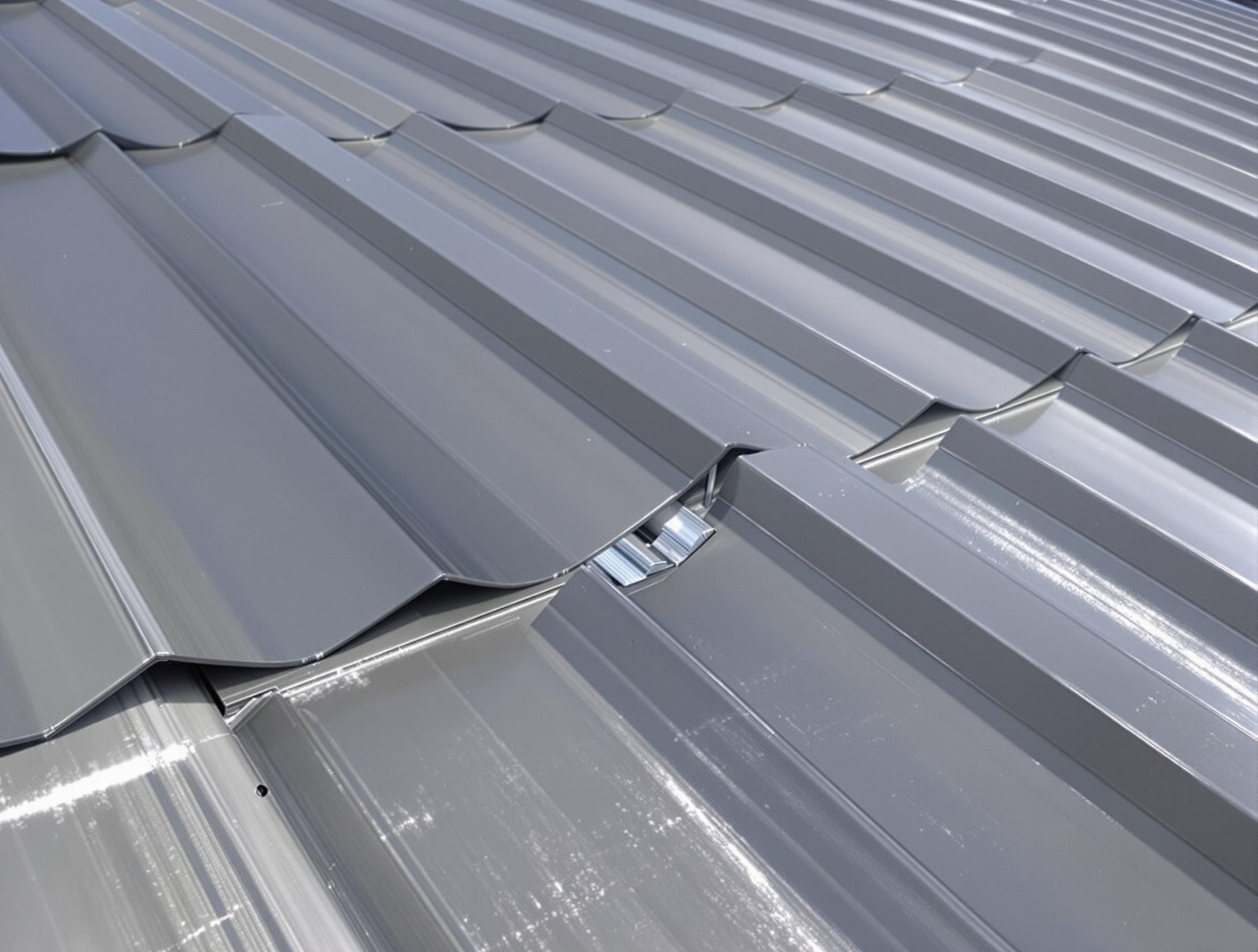
The defining feature of standing seam is the concealed attachment system. Every metal roof has to connect to the building somehow. On exposed-fastenerExposed-fastener metal roofA metal roof system where panels are secured by screws driven through the panel face into the roof deck or purlins. The screw heads and neoprene washers remain visible on the surface.R-panel, PBR panel, corrugated, and 5V-crimp are all exposed-fastener systems. Common on agricultural buildings, shops, and budget residential roofs. A good choice when cost is the priority and the homeowner understands the maintenance commitment.Why it matters: Lower cost than standing seam (typically 30-50% less installed), but the exposed screws are a long-term maintenance liability. Neoprene washers degrade in UV light and can allow leaks within 15-20 years if not replaced.Learn more → panels, screws go straight through the metal into the deck or purlins — hundreds of penetrations across the roof surface. On standing seam, the attachment happens underneath.
Here is the sequence. A concealed clipRoof clip (standing-seam clip)A metal bracket that secures standing-seam panels to the roof deck without penetrating the panel face. Types include fixed clips (anchored rigidly) and floating clips (allow panel movement for thermal expansion).Most residential standing-seam systems use floating clips with one fixed clip per panel run to anchor movement. The clip must match the panel profile; clips are not interchangeable between manufacturers.Why it matters: Clip type and spacing are the primary determinants of standing-seam wind-uplift performance. Reducing clip spacing from 24 inches to 12 inches on center can nearly double uplift resistance. Stainless-steel clips are recommended for coastal installations.Learn more → is screwed to the roof deck. The panel slides over the clip, engaging a tab that holds the panel in place. The next panel snaps or crimps onto the first, trapping the clip beneath the raised seam. The result: the screws are protected from weather, UV, and thermal cycling, and the panel surface has zero penetrations.
Panel profiles determine how the seam forms. Standing seam panels come in two primary seam types. Snap-lockSnap-lock standing seamA standing-seam panel where the male and female edges snap together by hand or with a rubber mallet during installation. No mechanical seaming tool is required.Snap-lock is the most common standing-seam profile for residential re-roofing. The panel floats on clips, allowing thermal expansion and contraction. Not rated as high for wind uplift as mechanical-lock in extreme hurricane zones.Why it matters: Easier and faster to install than mechanical-lock panels, reducing labor costs. Performs well in most residential wind zones (up to 110-120 mph depending on manufacturer and clip spacing).Learn more → panels have male and female edges that click together by hand or with a rubber mallet — no special tools needed. Mechanical-lockMechanical-lock standing seamA standing-seam panel where the seam is crimped shut with a powered or hand-operated seaming tool after installation. Available in single-lock (90° fold) and double-lock (180° fold) configurations.Mechanical seaming adds labor time and requires specialized tools, increasing installed cost by 10-15% over snap-lock. The tighter seam also provides better water resistance on low-slope roofs.Why it matters: Double-lock mechanical seam provides the highest wind-uplift resistance of any metal roof system. Required or recommended for coastal Gulf Coast homes in 130+ mph wind zones and for low-slope applications (down to 1/2:12 pitch).Learn more → panels require a powered or hand-operated seaming tool to fold the metal edges together after installation, creating a tighter, more wind-resistant connection.
The seam height matters. Most residential standing seam profiles have a 1-inch to 1.5-inch seam. Taller seams provide more structural rigidity and better performance in high-wind areas. Some commercial profiles use 2-inch seams, though these are uncommon on homes.
Key Technical Terms
Substrate. The base metal beneath the paint. Most residential standing seam uses GalvalumeGalvalumeA steel coating consisting of 55% aluminum, 43.4% zinc, and 1.6% silicon by weight. Developed by Bethlehem Steel in 1972 and now the industry-standard substrate for painted metal roofing.Nearly all premium residential metal roof panels ship on a Galvalume substrate. Unpainted Galvalume should not be used within 1,500 feet of saltwater without a painted finish on top.Why it matters: Galvalume outlasts galvanized steel by 2-4x in atmospheric corrosion tests. The aluminum component provides barrier protection while zinc offers sacrificial (galvanic) protection at cut edges and scratches.Learn more →-coated steelSteelThe base metal for most residential metal roofing panels. Always coated with either Galvalume or galvanized zinc to prevent rust, then typically painted with a PVDF or SMP finish.When a manufacturer says 'steel roof,' they mean coated steel. The coating type (Galvalume vs. galvanized) and paint system (PVDF vs. SMP) determine how long it lasts.Why it matters: Steel is stronger and more dent-resistant than aluminum at the same thickness, and costs less. However, it requires protective coatings because bare steel rusts rapidly in humid Gulf Coast air.Learn more → in 24-gauge24-gauge steelSteel substrate measuring 0.0239 inches (0.607 mm) thick. The heaviest gauge commonly used in residential metal roofing.Lower gauge number = thicker metal. 24-gauge is roughly 25% thicker than 26-gauge. Required by some standing-seam manufacturers for warranty coverage in hurricane zones.Why it matters: Thicker steel resists denting from hail and foot traffic, reduces oil canning, and holds fasteners more securely. It costs 15-20% more than 26-gauge but lasts longer in high-wind and coastal environments.Learn more → or 26-gauge26-gauge steelSteel substrate measuring 0.0179 inches (0.455 mm) thick. The most common gauge for residential metal roofing across all panel types.26-gauge is the default spec from most residential metal roofing manufacturers. Thinner than 24-gauge but significantly sturdier than 29-gauge.Why it matters: Balances cost and performance for most residential applications. Adequate for standing seam and exposed-fastener panels in moderate wind zones, though 24-gauge is preferred where wind or hail risk is high.Learn more → thickness. Homes within 1,500 feet of saltwater may require aluminumAluminumA lightweight, naturally corrosion-resistant metal used for roofing panels, typically in 0.032-inch or 0.040-inch thickness. Does not rust.Costs 1.5-2x more than steel panels. Softer than steel, so more prone to denting from hail. Common for standing-seam roofs on beachfront homes along the Gulf Coast.Why it matters: The best substrate choice within 1,500 feet of saltwater. Aluminum forms a stable oxide layer that resists salt-spray corrosion far better than any steel coating. Weighs about one-third as much as steel.Learn more → substrate instead.
Coating. The paint system applied at the factory. PVDFPVDF (polyvinylidene fluoride)A resin-based paint system containing 70% PVDF resin (by weight of total resin solids). The highest-performance paint coating available for metal roofing. Kynar 500 and Hylar 5000 are the two licensed PVDF formulations.A true PVDF coating must contain at least 70% PVDF resin. Some manufacturers use 50% blends and market them misleadingly. Always confirm the 70% specification.Why it matters: PVDF coatings resist chalking, fading, and chemical degradation far longer than SMP or acrylic. Expect 30-40 years of color retention in full Gulf Coast sun. This is what separates a premium metal roof from a budget one.Learn more → (sold under the brand names Kynar 500Kynar 500A brand name for 70% PVDF resin manufactured by Arkema. Licensed to coil coaters who apply it to metal roofing substrates. Kynar 500 and Hylar 5000 (by Solvay) are the only two licensed PVDF resins.'Kynar' and 'PVDF' are often used interchangeably in the roofing industry. The key spec is 70% PVDF resin content regardless of brand name.Why it matters: Kynar is the industry gold standard for color retention and weathering resistance. A Kynar-coated metal roof typically carries a 30-35 year paint warranty against fading and chalking.Learn more → and Hylar 5000) is the standard for standing seam. It resists fading and chalking for 30-40 years. SMPSMP (silicone-modified polyester)A mid-tier paint system for metal roofing that adds silicone to a polyester base for improved UV and chalk resistance compared to standard polyester. Less durable than PVDF.SMP is the standard coating on most exposed-fastener panels (R-panel, PBR, 5V-crimp). If a contractor quotes a standing-seam roof with SMP paint, ask why they are not using PVDF.Why it matters: SMP costs 15-25% less than PVDF and performs well for 15-20 years. Acceptable for budget-conscious projects, but expect earlier fading and chalking in intense Gulf Coast sun.Learn more → is a lower-cost alternative that performs adequately for 15-20 years but is rarely the right choice for a premium panel system.
Clip types. Fixed clips anchor the panel rigidly at one point. Floating clips allow the panel to slide slightly as it expands and contracts with temperature changes. Most installations use one fixed clip per panel run with floating clips everywhere else.
Key Specifications
| Specification | Options | Notes |
|---|---|---|
| Panel width | 12", 16", 18" (custom available) | Narrower panels reduce oil canning; wider panels mean fewer seams and faster installation |
| Gauge | 24-gauge, 26-gauge | 24-gauge is 25% thicker, resists denting better, and is preferred in hurricane zones |
| Coating | PVDF (Kynar/Hylar), SMP | PVDF is the standard for standing seam; 30-40 year color retention vs 15-20 for SMP |
| Substrate | Galvalume steel, aluminum | Aluminum recommended within 1,500 feet of saltwater |
| Seam type | Snap-lock, mechanical-lock (single or double) | Mechanical-lock required for low-slope (<3:12) and 130+ mph wind zones |
| Attachment | Concealed clips (fixed + floating) | Clip spacing typically 12-24" on center; closer spacing = higher wind resistance |
| Minimum slope | 3:12 (snap-lock), 1/2:12 (mechanical-lock) | Double-lock mechanical is one of the few roof systems approved for near-flat slopes |
| Typical lifespan | 40-70 years | Substrate, coating, installation quality, and environment all affect actual service life |
Advantages of Standing Seam
No fastener penetrations in the weathering surface. This is the single biggest advantage. On an exposed-fastenerExposed-fastener metal roofA metal roof system where panels are secured by screws driven through the panel face into the roof deck or purlins. The screw heads and neoprene washers remain visible on the surface.R-panel, PBR panel, corrugated, and 5V-crimp are all exposed-fastener systems. Common on agricultural buildings, shops, and budget residential roofs. A good choice when cost is the priority and the homeowner understands the maintenance commitment.Why it matters: Lower cost than standing seam (typically 30-50% less installed), but the exposed screws are a long-term maintenance liability. Neoprene washers degrade in UV light and can allow leaks within 15-20 years if not replaced.Learn more → roof, every screw through the panel face is a potential leak point. A typical 2,000-square-foot EF roof has 600-800 screws in the panel surface, each sealed with a neoprene washerNeoprene washerA synthetic rubber gasket bonded to the underside of an exposed-fastener roofing screw head. Compresses against the panel to create a watertight seal around the screw penetration.EPDM washers last longer than standard neoprene but cost more. Some premium screws use a bonded EPDM washer with a metal cap to shield it from UV. On standing-seam roofs, this issue does not exist because fasteners are concealed.Why it matters: Neoprene degrades in UV sunlight, becoming brittle and cracking within 15-20 years. Once the washer fails, water infiltrates around the screw. This is the single biggest long-term maintenance issue with exposed-fastener metal roofs.Learn more → that degrades in UV light within 15-20 years. Standing seam has zero.
Superior wind-uplift resistance. A properly installed standing seam system with concealed clipsConcealed clipA metal bracket that fastens to the roof deck and holds a standing-seam panel in place without penetrating the panel surface. The clip is hidden beneath the seam after panels are joined.Clip type (fixed vs. floating), material (stainless steel vs. galvanized), and spacing (12-24 inches on center) directly affect wind-uplift performance. Closer clip spacing = higher uplift rating.Why it matters: Clips allow panels to expand and contract with temperature changes (a 20-foot steel panel can move 1/4 inch across a 100°F swing). Without clips, thermal cycling causes oil canning, buckling, and fastener stress.Learn more → at 12-inch spacing and mechanical-lockMechanical-lock standing seamA standing-seam panel where the seam is crimped shut with a powered or hand-operated seaming tool after installation. Available in single-lock (90° fold) and double-lock (180° fold) configurations.Mechanical seaming adds labor time and requires specialized tools, increasing installed cost by 10-15% over snap-lock. The tighter seam also provides better water resistance on low-slope roofs.Why it matters: Double-lock mechanical seam provides the highest wind-uplift resistance of any metal roof system. Required or recommended for coastal Gulf Coast homes in 130+ mph wind zones and for low-slope applications (down to 1/2:12 pitch).Learn more → seams can achieve UL 580UL 580An Underwriters Laboratories test standard for wind-uplift resistance of roof assemblies. Classifies assemblies as UL 580 Class 30, 60, or 90 based on the sustained and gusting pressure they withstand.UL 580 tests the complete assembly (panel, clip, fastener, deck), not just the panel alone. A panel rated Class 90 with one clip type may only achieve Class 60 with a different clip. Always verify the tested assembly matches what is being installed.Why it matters: UL 580 Class 90 is the minimum standard for hurricane-zone roofing. It means the roof assembly survived sustained uplift of 90 psf with gusts to 120 psf in laboratory testing. Most quality standing-seam systems meet or exceed Class 90.Learn more → Class 90 ratings, withstanding sustained uplift pressures of 90 psf with gusts to 120 psf. That matters on the Gulf Coast, where design wind speedsDesign wind speedThe ultimate (3-second gust) wind speed used to calculate design wind pressures for a building at a specific location, per ASCE 7. Expressed in miles per hour (mph) for Risk Category II residential buildings.Design wind speed is not the same as sustained wind in a hurricane. The design speed is a statistical value (3-second gust with a 700-year return period for residential). Actual hurricane gusts can exceed this, which is why FORTIFIED and other above-code programs exist.Why it matters: This number drives every wind-related roofing specification: clip spacing, fastener count, panel gauge, and seam type. A home in a 150-mph design wind speed zone needs a substantially more robust roof system than one in a 115-mph zone.Learn more → range from 140-160 mph in coastal areas. Our standing seam wind performance guide covers how clip spacing and seam type determine uplift ratings. Standing seam is one of the few residential roof systems engineered for these conditions.
Thermal expansion accommodation. Metal expands and contracts with temperature. A 20-foot steelSteelThe base metal for most residential metal roofing panels. Always coated with either Galvalume or galvanized zinc to prevent rust, then typically painted with a PVDF or SMP finish.When a manufacturer says 'steel roof,' they mean coated steel. The coating type (Galvalume vs. galvanized) and paint system (PVDF vs. SMP) determine how long it lasts.Why it matters: Steel is stronger and more dent-resistant than aluminum at the same thickness, and costs less. However, it requires protective coatings because bare steel rusts rapidly in humid Gulf Coast air.Learn more → panel moves approximately 1/4 inch across a 100-degree Fahrenheit temperature swing. Floating clips allow this movement without stressing the panel, the fasteners, or the deck. Exposed-fastener panels, bolted rigidly through the face, fight this movement — and over years, the screws elongate their holes, losing grip and seal.
Longest service life of any residential metal system. With 24-gauge24-gauge steelSteel substrate measuring 0.0239 inches (0.607 mm) thick. The heaviest gauge commonly used in residential metal roofing.Lower gauge number = thicker metal. 24-gauge is roughly 25% thicker than 26-gauge. Required by some standing-seam manufacturers for warranty coverage in hurricane zones.Why it matters: Thicker steel resists denting from hail and foot traffic, reduces oil canning, and holds fasteners more securely. It costs 15-20% more than 26-gauge but lasts longer in high-wind and coastal environments.Learn more → GalvalumeGalvalumeA steel coating consisting of 55% aluminum, 43.4% zinc, and 1.6% silicon by weight. Developed by Bethlehem Steel in 1972 and now the industry-standard substrate for painted metal roofing.Nearly all premium residential metal roof panels ship on a Galvalume substrate. Unpainted Galvalume should not be used within 1,500 feet of saltwater without a painted finish on top.Why it matters: Galvalume outlasts galvanized steel by 2-4x in atmospheric corrosion tests. The aluminum component provides barrier protection while zinc offers sacrificial (galvanic) protection at cut edges and scratches.Learn more → substrate and PVDFPVDF (polyvinylidene fluoride)A resin-based paint system containing 70% PVDF resin (by weight of total resin solids). The highest-performance paint coating available for metal roofing. Kynar 500 and Hylar 5000 are the two licensed PVDF formulations.A true PVDF coating must contain at least 70% PVDF resin. Some manufacturers use 50% blends and market them misleadingly. Always confirm the 70% specification.Why it matters: PVDF coatings resist chalking, fading, and chemical degradation far longer than SMP or acrylic. Expect 30-40 years of color retention in full Gulf Coast sun. This is what separates a premium metal roof from a budget one.Learn more → coating, standing seam routinely lasts 50-70 years before replacement. The coating fades gradually and can be recoated in place. The substrate, protected by the coating and never penetrated by fasteners, retains its structural integrity for decades.
Lowest long-term maintenance. No screws to inspect, tighten, or replace. No washers to deteriorate. Maintenance consists of periodic gutter cleaning, visual inspection of flashing and sealant at penetrations, and occasional debris removal. Compare that to exposed-fastener panels, which need a full fastener inspection every 10-15 years and washer replacement around year 15-20.
Clean aesthetic lines. The raised seams create a consistent, linear pattern with no visible hardware. Standing seam is the metal roof that architects specify — it works on coastal contemporary, modern farmhouse, Craftsman, and colonial styles. The clean look also tends to satisfy HOA restrictions more readily than agricultural-look exposed-fastener panels.
Limitations of Standing Seam
Higher installed cost. Standing seam typically runs $8-14 per square foot installed on the Gulf Coast. That is 2-3x the cost of exposed-fastenerExposed-fastener metal roofA metal roof system where panels are secured by screws driven through the panel face into the roof deck or purlins. The screw heads and neoprene washers remain visible on the surface.R-panel, PBR panel, corrugated, and 5V-crimp are all exposed-fastener systems. Common on agricultural buildings, shops, and budget residential roofs. A good choice when cost is the priority and the homeowner understands the maintenance commitment.Why it matters: Lower cost than standing seam (typically 30-50% less installed), but the exposed screws are a long-term maintenance liability. Neoprene washers degrade in UV light and can allow leaks within 15-20 years if not replaced.Learn more → panels ($3-6 per square foot) and 2-3x the cost of architectural asphalt shingles ($3.50-5.50 per square foot). The materials cost more, and installation takes more skill and time.
Fewer qualified installers. Standing seam installation requires training that not every roofer has. Improper clip spacing, wrong clip type, bad seam engagement, and poor flashing technique can all compromise the system. A poorly installed standing seam roof can underperform a well-installed exposed-fastener roof. On the Gulf Coast, the pool of experienced standing seam installers is smaller than the pool of general metal roofers.
Oil canning is a possibility. The flat area between seams can develop visible waviness — a cosmetic phenomenon called oil canning. It does not affect performance, but it bothers some homeowners. Wider panels (16-18 inches) are more susceptible than narrow panels (12 inches). Heavier gauge, pencil ribs (small longitudinal bead lines pressed into the flat), and proper clip installation all reduce oil canning, but no manufacturer guarantees its complete absence.
Complex roof geometries cost more. Standing seam works best on long, uninterrupted runs. Hips, valleys, dormers, skylights, and multiple penetrations all require custom flashing and panel cutting, adding labor and material. A simple gable roof is straightforward; a complex hip roof with six dormers is substantially more expensive and requires a highly skilled crew.
Panel replacement is harder. If a single standing seam panel is damaged, replacing it requires disengaging the seams on both sides, which can be difficult or impossible with mechanical-lock seams without disturbing adjacent panels. Exposed-fastener panels, by contrast, can be individually removed by backing out screws. For standing seam, having a few spare panels stored is good practice.
Not cost-effective for every building. A detached workshop, a barn, a storage building, or any structure where aesthetics and 50-year longevity are not priorities — exposed-fastener panels deliver adequate performance at a fraction of the price. Paying standing seam prices for a building that does not need standing seam performance is not a smart allocation of money. Our standing seam vs exposed-fastener comparison helps you determine which system fits your building and budget.
Gulf Coast Considerations
Wind resistance is not optional here. The Gulf Coast from Pensacola to Biloxi sits in wind zonesWind zoneA geographic classification based on design wind speeds, used by building codes and insurers to determine roofing requirements. The Gulf Coast spans wind zones from 115 mph inland to 180 mph in coastal South Florida.ASCE 7-22 maps define ultimate design wind speeds (3-second gust) for every location. Coastal Mississippi, Alabama, and the Florida Panhandle are typically 140-160 mph zones. Check your exact address at the ASCE Hazard Tool.Why it matters: Your wind zone determines the minimum uplift rating, fastener schedule, and product approvals required for your roof. Higher wind zones require closer clip spacing, thicker gauge, and mechanical-lock seams.Learn more → with design wind speedsDesign wind speedThe ultimate (3-second gust) wind speed used to calculate design wind pressures for a building at a specific location, per ASCE 7. Expressed in miles per hour (mph) for Risk Category II residential buildings.Design wind speed is not the same as sustained wind in a hurricane. The design speed is a statistical value (3-second gust with a 700-year return period for residential). Actual hurricane gusts can exceed this, which is why FORTIFIED and other above-code programs exist.Why it matters: This number drives every wind-related roofing specification: clip spacing, fastener count, panel gauge, and seam type. A home in a 150-mph design wind speed zone needs a substantially more robust roof system than one in a 115-mph zone.Learn more → of 140-160 mph. Standing seam with mechanical-lockMechanical-lock standing seamA standing-seam panel where the seam is crimped shut with a powered or hand-operated seaming tool after installation. Available in single-lock (90° fold) and double-lock (180° fold) configurations.Mechanical seaming adds labor time and requires specialized tools, increasing installed cost by 10-15% over snap-lock. The tighter seam also provides better water resistance on low-slope roofs.Why it matters: Double-lock mechanical seam provides the highest wind-uplift resistance of any metal roof system. Required or recommended for coastal Gulf Coast homes in 130+ mph wind zones and for low-slope applications (down to 1/2:12 pitch).Learn more → seams and tight clip spacing is one of the best-performing residential roof systems in these conditions. Snap-lockSnap-lock standing seamA standing-seam panel where the male and female edges snap together by hand or with a rubber mallet during installation. No mechanical seaming tool is required.Snap-lock is the most common standing-seam profile for residential re-roofing. The panel floats on clips, allowing thermal expansion and contraction. Not rated as high for wind uplift as mechanical-lock in extreme hurricane zones.Why it matters: Easier and faster to install than mechanical-lock panels, reducing labor costs. Performs well in most residential wind zones (up to 110-120 mph depending on manufacturer and clip spacing).Learn more → panels work in moderate wind zones (up to 110-120 mph) but may not meet code requirements at the coast.
Coastal corrosion demands the right specification. Within the severe corrosion zoneCorrosion zoneA geographic classification based on proximity to saltwater and other corrosive environments. The most aggressive zone extends from the shoreline to approximately 1,500 feet inland, where airborne salt concentration is highest.ASHRAE and metal roofing manufacturers define corrosion zones at 1,500 feet, 2,500 feet, and beyond. Some manufacturers void their warranty within the most aggressive zone if their installation guidelines for coastal environments are not followed.Why it matters: Corrosion zone determines which metals and coatings will survive. Within 1,500 feet of the Gulf, aluminum or stainless-steel fasteners are essential, and Galvalume steel must have a high-quality PVDF paint system. Using the wrong materials leads to premature failure.Learn more → (0-1,500 feet from saltwater), salt spray accelerates metal degradation. GalvalumeGalvalumeA steel coating consisting of 55% aluminum, 43.4% zinc, and 1.6% silicon by weight. Developed by Bethlehem Steel in 1972 and now the industry-standard substrate for painted metal roofing.Nearly all premium residential metal roof panels ship on a Galvalume substrate. Unpainted Galvalume should not be used within 1,500 feet of saltwater without a painted finish on top.Why it matters: Galvalume outlasts galvanized steel by 2-4x in atmospheric corrosion tests. The aluminum component provides barrier protection while zinc offers sacrificial (galvanic) protection at cut edges and scratches.Learn more → steel with PVDFPVDF (polyvinylidene fluoride)A resin-based paint system containing 70% PVDF resin (by weight of total resin solids). The highest-performance paint coating available for metal roofing. Kynar 500 and Hylar 5000 are the two licensed PVDF formulations.A true PVDF coating must contain at least 70% PVDF resin. Some manufacturers use 50% blends and market them misleadingly. Always confirm the 70% specification.Why it matters: PVDF coatings resist chalking, fading, and chemical degradation far longer than SMP or acrylic. Expect 30-40 years of color retention in full Gulf Coast sun. This is what separates a premium metal roof from a budget one.Learn more → coating performs well in moderate corrosion zones (1,500 feet to one mile from the coast). Inside 1,500 feet, aluminumAluminumA lightweight, naturally corrosion-resistant metal used for roofing panels, typically in 0.032-inch or 0.040-inch thickness. Does not rust.Costs 1.5-2x more than steel panels. Softer than steel, so more prone to denting from hail. Common for standing-seam roofs on beachfront homes along the Gulf Coast.Why it matters: The best substrate choice within 1,500 feet of saltwater. Aluminum forms a stable oxide layer that resists salt-spray corrosion far better than any steel coating. Weighs about one-third as much as steel.Learn more → substrate is the safer choice — it forms a passive oxide layerPassive oxide layerA thin, stable, self-forming metal oxide film that protects certain metals from further corrosion. Aluminum forms aluminum oxide (Al₂O₃); stainless steel forms chromium oxide (Cr₂O₃).Steel does not form a stable passive oxide; iron oxide (rust) is porous and flakes off, exposing more steel. This is why bare steel always needs a coating or plating, while aluminum and stainless steel can perform uncoated.Why it matters: This natural oxide layer is why aluminum roofing does not rust and why stainless-steel fasteners resist corrosion in salt air. If the oxide layer is scratched, it reforms almost immediately in the presence of oxygen. No maintenance required.Learn more → that resists salt corrosion without relying on a sacrificial coating. Fasteners within 2,500 feet should be stainless steel to prevent galvanic corrosionGalvanic corrosionAccelerated corrosion that occurs when two dissimilar metals are in direct electrical contact in the presence of an electrolyte (moisture). The more reactive (anodic) metal corrodes preferentially.The galvanic series ranks metals from anodic (corrodes first) to cathodic (protected). Zinc and aluminum are anodic to steel. Copper is cathodic to most metals. Always use fasteners of the same metal as the panel, or use stainless steel, which is compatible with both.Why it matters: A common installation mistake: using plain steel fasteners on aluminum panels, or copper flashing touching a steel roof. The dissimilar metals create a battery effect, and one metal rapidly corrodes. In Gulf Coast humidity, this happens fast.Learn more →. Our coastal substrate selection guide covers the full decision framework for salt-air environments.
Heat drives energy performance. Gulf Coast cooling loads are substantial — air conditioning runs 7-9 months per year in South Mississippi, South Alabama, and the Florida Panhandle. A light-colored PVDFPVDF (polyvinylidene fluoride)A resin-based paint system containing 70% PVDF resin (by weight of total resin solids). The highest-performance paint coating available for metal roofing. Kynar 500 and Hylar 5000 are the two licensed PVDF formulations.A true PVDF coating must contain at least 70% PVDF resin. Some manufacturers use 50% blends and market them misleadingly. Always confirm the 70% specification.Why it matters: PVDF coatings resist chalking, fading, and chemical degradation far longer than SMP or acrylic. Expect 30-40 years of color retention in full Gulf Coast sun. This is what separates a premium metal roof from a budget one.Learn more →-coated standing seam roof with a high Solar Reflectance IndexSolar Reflectance Index (SRI)A composite metric (0-100+) that combines solar reflectance and thermal emittance to measure how hot a roof surface gets in the sun. Higher SRI = cooler roof. Calculated per ASTM E1980.ENERGY STAR requires initial SRI of 25+ for steep-slope roofing. Light-colored PVDF-coated metal roofs routinely hit SRI 50-78. Even medium-toned metal colors outperform dark asphalt shingles.Why it matters: A high-SRI metal roof (typically 25-70+) can reduce attic temperatures by 20-40°F compared to dark asphalt shingles with SRI near 0. This directly lowers cooling costs, which matters enormously on the Gulf Coast.Learn more → (typically 50-78 for light colors) can reduce attic temperatures by 20-40 degrees Fahrenheit compared to dark asphalt shingles. That translates to 10-25% cooling energy reduction depending on insulation, attic configuration, and HVAC system.
Humidity and condensation matter. Gulf Coast humidity means moisture management is critical in any roof assembly. Standing seam over a ventilated attic with proper underlaymentUnderlaymentA secondary water-resistant layer installed on the roof deck beneath metal panels. Types include synthetic (polypropylene), felt (asphalt-saturated), and self-adhering (peel-and-stick) membranes.Synthetic underlayment (like GAF FeltBuster or Sharkskin) is the modern standard. It does not absorb water, resists tearing, and provides a slip-resistant surface during installation. For standing seam, a high-temperature synthetic is recommended to handle heat buildup.Why it matters: Underlayment is your backup waterproofing if wind-driven rain gets past the metal panels. Florida Building Code requires underlayment on all steep-slope metal roofs. In the Enhanced Hurricane Protection Area, self-adhering underlayment is required.Learn more → is the most forgiving assembly. Unventilated assemblies (standing seam directly over rigid insulation on the deck) require careful vapor-barrier engineering to prevent condensation on the underside of the metal — a real concern in the 70-90% relative humidity common along the coast.
Florida Building Code applies in the Panhandle. Any standing seam system installed in Florida must carry a Florida Building CodeFlorida Building Code (FBC)The statewide building code for Florida, one of the most stringent in the U.S. for wind and hurricane resistance. Requires product approvals (FL numbers or Miami-Dade NOAs), specific underlayment, and testing per TAS protocols.The FBC has two tiers: the base code (statewide) and the High Velocity Hurricane Zone (HVHZ) code for Miami-Dade and Broward counties. HVHZ requires Miami-Dade NOA approvals and full self-adhering underlayment. Both are more demanding than the International Building Code.Why it matters: Any metal roof installed in Florida must comply with FBC. This means the exact panel, clip, and fastener combination must have a valid Florida product approval. Unapproved products cannot legally be installed, and insurance will not cover them.Learn more → product approval (FL number). That approval covers the specific combination of panel, clip, and fastener — not just the panel alone. If your contractor proposes a system, ask for the FL approval number and verify it at the Florida Product Approval database.
What Standing Seam Costs on the Gulf Coast
Expect to pay $8-14 per square foot installed for standing seam on the Gulf Coast. For a typical 2,000-square-foot roof, that is $16,000-$28,000. The range is wide because multiple factors drive the price. Our standing seam cost breakdown by specification level details exactly what pushes you toward each end of that range.
Gauge thickness affects material cost. 24-gauge24-gauge steelSteel substrate measuring 0.0239 inches (0.607 mm) thick. The heaviest gauge commonly used in residential metal roofing.Lower gauge number = thicker metal. 24-gauge is roughly 25% thicker than 26-gauge. Required by some standing-seam manufacturers for warranty coverage in hurricane zones.Why it matters: Thicker steel resists denting from hail and foot traffic, reduces oil canning, and holds fasteners more securely. It costs 15-20% more than 26-gauge but lasts longer in high-wind and coastal environments.Learn more → panels cost 15-20% more than 26-gauge26-gauge steelSteel substrate measuring 0.0179 inches (0.455 mm) thick. The most common gauge for residential metal roofing across all panel types.26-gauge is the default spec from most residential metal roofing manufacturers. Thinner than 24-gauge but significantly sturdier than 29-gauge.Why it matters: Balances cost and performance for most residential applications. Adequate for standing seam and exposed-fastener panels in moderate wind zones, though 24-gauge is preferred where wind or hail risk is high.Learn more →. In hurricane zones where 24-gauge is recommended or required, this is not optional savings — it is the specification that meets wind-uplift requirements.
Coating system affects long-term value. PVDFPVDF (polyvinylidene fluoride)A resin-based paint system containing 70% PVDF resin (by weight of total resin solids). The highest-performance paint coating available for metal roofing. Kynar 500 and Hylar 5000 are the two licensed PVDF formulations.A true PVDF coating must contain at least 70% PVDF resin. Some manufacturers use 50% blends and market them misleadingly. Always confirm the 70% specification.Why it matters: PVDF coatings resist chalking, fading, and chemical degradation far longer than SMP or acrylic. Expect 30-40 years of color retention in full Gulf Coast sun. This is what separates a premium metal roof from a budget one.Learn more → adds $0.50-1.00 per square foot over SMPSMP (silicone-modified polyester)A mid-tier paint system for metal roofing that adds silicone to a polyester base for improved UV and chalk resistance compared to standard polyester. Less durable than PVDF.SMP is the standard coating on most exposed-fastener panels (R-panel, PBR, 5V-crimp). If a contractor quotes a standing-seam roof with SMP paint, ask why they are not using PVDF.Why it matters: SMP costs 15-25% less than PVDF and performs well for 15-20 years. Acceptable for budget-conscious projects, but expect earlier fading and chalking in intense Gulf Coast sun.Learn more →. Over 40 years, that premium pays for itself in delayed recoating and extended color retention. On a system designed to last 50+ years, applying a 15-year coating is a mismatch.
Roof complexity multiplies labor cost. A straightforward gable roof with minimal penetrations sits at the low end of the range. A hip roof with dormers, skylights, multiple valleys, and chimney penetrations can push costs to the high end or beyond. Every transition point requires custom flashing work.
Seam type changes labor cost. Mechanical-lockMechanical-lock standing seamA standing-seam panel where the seam is crimped shut with a powered or hand-operated seaming tool after installation. Available in single-lock (90° fold) and double-lock (180° fold) configurations.Mechanical seaming adds labor time and requires specialized tools, increasing installed cost by 10-15% over snap-lock. The tighter seam also provides better water resistance on low-slope roofs.Why it matters: Double-lock mechanical seam provides the highest wind-uplift resistance of any metal roof system. Required or recommended for coastal Gulf Coast homes in 130+ mph wind zones and for low-slope applications (down to 1/2:12 pitch).Learn more → installation runs 10-15% more than snap-lockSnap-lock standing seamA standing-seam panel where the male and female edges snap together by hand or with a rubber mallet during installation. No mechanical seaming tool is required.Snap-lock is the most common standing-seam profile for residential re-roofing. The panel floats on clips, allowing thermal expansion and contraction. Not rated as high for wind uplift as mechanical-lock in extreme hurricane zones.Why it matters: Easier and faster to install than mechanical-lock panels, reducing labor costs. Performs well in most residential wind zones (up to 110-120 mph depending on manufacturer and clip spacing).Learn more → because of the additional seaming step and equipment. In wind zones above 130 mph, mechanical-lock is often required — the cost difference is not a choice, it is a code requirement.
Substrate choice matters near the coast. AluminumAluminumA lightweight, naturally corrosion-resistant metal used for roofing panels, typically in 0.032-inch or 0.040-inch thickness. Does not rust.Costs 1.5-2x more than steel panels. Softer than steel, so more prone to denting from hail. Common for standing-seam roofs on beachfront homes along the Gulf Coast.Why it matters: The best substrate choice within 1,500 feet of saltwater. Aluminum forms a stable oxide layer that resists salt-spray corrosion far better than any steel coating. Weighs about one-third as much as steel.Learn more → panels cost 1.5-2x more than GalvalumeGalvalumeA steel coating consisting of 55% aluminum, 43.4% zinc, and 1.6% silicon by weight. Developed by Bethlehem Steel in 1972 and now the industry-standard substrate for painted metal roofing.Nearly all premium residential metal roof panels ship on a Galvalume substrate. Unpainted Galvalume should not be used within 1,500 feet of saltwater without a painted finish on top.Why it matters: Galvalume outlasts galvanized steel by 2-4x in atmospheric corrosion tests. The aluminum component provides barrier protection while zinc offers sacrificial (galvanic) protection at cut edges and scratches.Learn more → steel. Within 1,500 feet of saltwater, the added cost of aluminum is justified by dramatically better corrosion resistance. Beyond one mile from the coast, Galvalume with PVDF is the cost-effective standard.
Tear-off and deck condition add to the project. Removing existing roofing adds $1-2 per square foot. If the roof deck needs repair or replacement, that can add $2-5 per square foot in affected areas. These costs apply to any re-roof, not just standing seam.
Who Standing Seam Is For
Choose Standing Seam when...
- → Your primary residence where you plan to live 15+ years
- → A coastal home within 5 miles of the Gulf where wind and corrosion resistance matter
- → A home where aesthetics are important — HOA communities, architecturally significant homes
- → You want the lowest long-term maintenance commitment
- → You are building new construction and can spec the roof from the start
- → Your roof has long, uninterrupted runs with a simple geometry
Primary residence owners who plan to stay. Standing seam is a 40-70 year roof. If you are staying in your home for 15+ years, the higher upfront cost pays back through zero fastener maintenance, extended lifespan, and energy savings. If you are selling in 5 years, you will not recoup the premium over a quality asphalt shingle roof.
Coastal homeowners. Within 5 miles of the Gulf, the combination of wind, salt air, and humidity makes standing seam the most defensible choice. Concealed fasteners remove the corrosion risk at hundreds of panel penetrations. Mechanical-lock seams meet the highest wind-uplift standards. PVDF-coated aluminum substrate handles the most aggressive salt environments.
Long-term thinkers. If you evaluate roofing on 30-year cost rather than initial price, standing seam typically wins. An asphalt shingle roof replaced twice in 50 years costs as much as — or more than — one standing seam installation. Add the avoided maintenance and energy savings, and the math favors standing seam for homeowners with a long time horizon.
Who Standing Seam Is NOT For
Choose A Different System when...
- → Detached shops, barns, or storage buildings where aesthetics are secondary
- → Tight budgets where the priority is getting a good roof at the lowest responsible cost
- → Short-term owners selling within 5 years — the ROI window is too short
- → Extremely complex roof geometries with many dormers, valleys, and penetrations
- → Projects where matching an existing exposed-fastener roof is the goal
Shops, barns, and outbuildings. An exposed-fastenerExposed-fastener metal roofA metal roof system where panels are secured by screws driven through the panel face into the roof deck or purlins. The screw heads and neoprene washers remain visible on the surface.R-panel, PBR panel, corrugated, and 5V-crimp are all exposed-fastener systems. Common on agricultural buildings, shops, and budget residential roofs. A good choice when cost is the priority and the homeowner understands the maintenance commitment.Why it matters: Lower cost than standing seam (typically 30-50% less installed), but the exposed screws are a long-term maintenance liability. Neoprene washers degrade in UV light and can allow leaks within 15-20 years if not replaced.Learn more → R-panelR-panelAn exposed-fastener metal panel with 1.25-inch-tall trapezoidal ribs on 12-inch centers. One of the most common commercial and agricultural metal roof profiles, also used on budget residential projects.R-panel can span purlins up to 5 feet apart, making it efficient for open-frame structures. For residential use over solid deck, it is functionally similar to PBR panel.Why it matters: R-panel is widely available, affordable, and structurally strong for its weight. However, as an exposed-fastener system, it requires periodic screw and washer maintenance. Typical material cost is $1.50-3.00 per square foot.Learn more → or PBR panelPBR panel (purlin-bearing rib)An exposed-fastener metal panel similar to R-panel but with a broader flat area at the base of each rib, providing a wider bearing surface on purlins. Rib height is typically 1.25 inches.PBR and R-panel are often confused. The main visual difference is the shape at the base of the rib: PBR has a wider flat landing, R-panel has a sharper angle. Both use the same fastening method.Why it matters: The wider bearing surface gives PBR slightly better pull-over resistance than R-panel at purlin connections. Performance difference is marginal for residential over solid deck, but meaningful for commercial purlin-frame buildings.Learn more → at $3-6 per square foot does the job. These buildings do not need concealed fasteners, and the 20-25 year effective life of an EF roof is perfectly adequate. Paying standing seam prices for a workshop is like putting a premium engine in a utility vehicle.
Budget-constrained projects. If the budget caps at $5 per square foot installed, standing seam is out of reach. A well-installed exposed-fastener roof with 26-gauge26-gauge steelSteel substrate measuring 0.0179 inches (0.455 mm) thick. The most common gauge for residential metal roofing across all panel types.26-gauge is the default spec from most residential metal roofing manufacturers. Thinner than 24-gauge but significantly sturdier than 29-gauge.Why it matters: Balances cost and performance for most residential applications. Adequate for standing seam and exposed-fastener panels in moderate wind zones, though 24-gauge is preferred where wind or hail risk is high.Learn more → GalvalumeGalvalumeA steel coating consisting of 55% aluminum, 43.4% zinc, and 1.6% silicon by weight. Developed by Bethlehem Steel in 1972 and now the industry-standard substrate for painted metal roofing.Nearly all premium residential metal roof panels ship on a Galvalume substrate. Unpainted Galvalume should not be used within 1,500 feet of saltwater without a painted finish on top.Why it matters: Galvalume outlasts galvanized steel by 2-4x in atmospheric corrosion tests. The aluminum component provides barrier protection while zinc offers sacrificial (galvanic) protection at cut edges and scratches.Learn more → and SMPSMP (silicone-modified polyester)A mid-tier paint system for metal roofing that adds silicone to a polyester base for improved UV and chalk resistance compared to standard polyester. Less durable than PVDF.SMP is the standard coating on most exposed-fastener panels (R-panel, PBR, 5V-crimp). If a contractor quotes a standing-seam roof with SMP paint, ask why they are not using PVDF.Why it matters: SMP costs 15-25% less than PVDF and performs well for 15-20 years. Acceptable for budget-conscious projects, but expect earlier fading and chalking in intense Gulf Coast sun.Learn more → coating provides 20+ years of solid performance. Stretching for standing seam by cutting corners on gauge or coating defeats the purpose.
Short-term homeowners. If you are selling within 5 years, architectural asphalt shingles or exposed-fastener metal deliver better return on investment. Standing seam increases home value, but not by enough to offset the 2-3x upfront premium in a short holding period. The standing seam advantage builds over time.
Extremely complex roof designs. A roof with eight or more valleys, multiple dormers, and extensive flashing requirements will push standing seam costs well beyond $14 per square foot. In these cases, the labor cost for custom metal work can exceed the material cost. Simpler panel systems or even stone-coated steelStone-coated steelA roofing system made from 26-gauge or 24-gauge Galvalume steel stamped into tile, shingle, or shake profiles, then coated with ceramic or basite stone granules bonded with acrylic adhesive.Popular with homeowners who want metal performance but dislike the look of standing-seam panels. Premium brands (Decra, TILCOR, Boral) carry 50-year warranties. Uses concealed fasteners with interlocking panel edges.Why it matters: Combines the durability and wind resistance of metal with the traditional appearance of shingles or tile. Lighter than clay tile (about 1.4 lbs/ft² vs. 9-12 lbs/ft²), so it can go on most existing roof structures without reinforcement.Learn more → shingles may be more practical.
Standing seam is always the best metal roof.
Reality: Standing seam is the highest-performing metal roof system, but 'best' depends on the application. For a primary residence in a coastal wind zone where you plan to live for decades, standing seam is the right call. For a detached shop, a budget-constrained project, or a building where 20 years of service is adequate, exposed-fastener panels deliver solid performance at 30-50% of the cost. Choosing standing seam for every metal building is like choosing hardwood floors for a garage — it works, but the application does not demand it.
A homeowner 2 miles from the Gulf Coast is choosing between snap-lock standing seam with clips at 24-inch spacing and exposed-fastener R-panel. Their home is in a 150-mph design wind speed zone. Which matters more for their decision: the concealed fasteners or the wind-uplift rating?
Standing Seam FAQ
How long does a standing seam metal roof last?
40-70 years depending on substrate, coating, and environment. A 24-gauge24-gauge steelSteel substrate measuring 0.0239 inches (0.607 mm) thick. The heaviest gauge commonly used in residential metal roofing.Lower gauge number = thicker metal. 24-gauge is roughly 25% thicker than 26-gauge. Required by some standing-seam manufacturers for warranty coverage in hurricane zones.Why it matters: Thicker steel resists denting from hail and foot traffic, reduces oil canning, and holds fasteners more securely. It costs 15-20% more than 26-gauge but lasts longer in high-wind and coastal environments.Learn more → GalvalumeGalvalumeA steel coating consisting of 55% aluminum, 43.4% zinc, and 1.6% silicon by weight. Developed by Bethlehem Steel in 1972 and now the industry-standard substrate for painted metal roofing.Nearly all premium residential metal roof panels ship on a Galvalume substrate. Unpainted Galvalume should not be used within 1,500 feet of saltwater without a painted finish on top.Why it matters: Galvalume outlasts galvanized steel by 2-4x in atmospheric corrosion tests. The aluminum component provides barrier protection while zinc offers sacrificial (galvanic) protection at cut edges and scratches.Learn more → panel with PVDFPVDF (polyvinylidene fluoride)A resin-based paint system containing 70% PVDF resin (by weight of total resin solids). The highest-performance paint coating available for metal roofing. Kynar 500 and Hylar 5000 are the two licensed PVDF formulations.A true PVDF coating must contain at least 70% PVDF resin. Some manufacturers use 50% blends and market them misleadingly. Always confirm the 70% specification.Why it matters: PVDF coatings resist chalking, fading, and chemical degradation far longer than SMP or acrylic. Expect 30-40 years of color retention in full Gulf Coast sun. This is what separates a premium metal roof from a budget one.Learn more → coating in a non-coastal environment can reach the upper end of that range. Coastal installations within 1,500 feet of saltwater may see shorter lifespans if the wrong substrate or coating is specified. Aluminum substrate with PVDF coating provides the longest life in severe coastal conditions.
How much does a standing seam metal roof cost?
$8-14 per square foot installed on the Gulf Coast. A simple gable roof on the lower end; a complex hip roof with multiple penetrations on the higher end. This is 2-3x the cost of architectural asphalt shingles. For a 2,000-square-foot roof, budget $16,000-$28,000 before tear-off and deck repair.
What is the difference between snap-lock and mechanical-lock standing seam?
Snap-lockSnap-lock standing seamA standing-seam panel where the male and female edges snap together by hand or with a rubber mallet during installation. No mechanical seaming tool is required.Snap-lock is the most common standing-seam profile for residential re-roofing. The panel floats on clips, allowing thermal expansion and contraction. Not rated as high for wind uplift as mechanical-lock in extreme hurricane zones.Why it matters: Easier and faster to install than mechanical-lock panels, reducing labor costs. Performs well in most residential wind zones (up to 110-120 mph depending on manufacturer and clip spacing).Learn more → panels click together by hand; mechanical-lockMechanical-lock standing seamA standing-seam panel where the seam is crimped shut with a powered or hand-operated seaming tool after installation. Available in single-lock (90° fold) and double-lock (180° fold) configurations.Mechanical seaming adds labor time and requires specialized tools, increasing installed cost by 10-15% over snap-lock. The tighter seam also provides better water resistance on low-slope roofs.Why it matters: Double-lock mechanical seam provides the highest wind-uplift resistance of any metal roof system. Required or recommended for coastal Gulf Coast homes in 130+ mph wind zones and for low-slope applications (down to 1/2:12 pitch).Learn more → panels require a seaming tool to crimp the seam shut. Mechanical-lock provides higher wind-uplift resistance (required in 130+ mph wind zones and on low-slope roofs) but costs 10-15% more to install due to the additional labor and equipment. For most Gulf Coast homes, the choice depends on your specific wind zone.
Can standing seam be installed on a low-slope roof?
Yes, but only with a mechanical-lock seam profile. Double-lock mechanical seams can be used on slopes as low as 1/2:12 (nearly flat). Snap-lock panels typically require a minimum 3:12 slope. The seam type, not the panel material, determines low-slope suitability. Low-slope standing seam also requires additional sealant in the seam for water resistance.
Does standing seam metal roofing dent easily?
Dent resistance depends on gauge thickness. 24-gauge24-gauge steelSteel substrate measuring 0.0239 inches (0.607 mm) thick. The heaviest gauge commonly used in residential metal roofing.Lower gauge number = thicker metal. 24-gauge is roughly 25% thicker than 26-gauge. Required by some standing-seam manufacturers for warranty coverage in hurricane zones.Why it matters: Thicker steel resists denting from hail and foot traffic, reduces oil canning, and holds fasteners more securely. It costs 15-20% more than 26-gauge but lasts longer in high-wind and coastal environments.Learn more → steel (0.0239 inches thick) resists denting from hail up to about 1.5 inches in diameter and handles normal foot traffic during maintenance. 26-gauge26-gauge steelSteel substrate measuring 0.0179 inches (0.455 mm) thick. The most common gauge for residential metal roofing across all panel types.26-gauge is the default spec from most residential metal roofing manufacturers. Thinner than 24-gauge but significantly sturdier than 29-gauge.Why it matters: Balances cost and performance for most residential applications. Adequate for standing seam and exposed-fastener panels in moderate wind zones, though 24-gauge is preferred where wind or hail risk is high.Learn more → is adequate for most residential applications but shows dents more readily from large hail. AluminumAluminumA lightweight, naturally corrosion-resistant metal used for roofing panels, typically in 0.032-inch or 0.040-inch thickness. Does not rust.Costs 1.5-2x more than steel panels. Softer than steel, so more prone to denting from hail. Common for standing-seam roofs on beachfront homes along the Gulf Coast.Why it matters: The best substrate choice within 1,500 feet of saltwater. Aluminum forms a stable oxide layer that resists salt-spray corrosion far better than any steel coating. Weighs about one-third as much as steel.Learn more → panels are softer than steel and dent more easily at the same thickness.
What is oil canning on a standing seam roof?
Oil canning is visible waviness in the flat area of a metal panel. It is caused by stress in the metal from manufacturing, installation, or thermal cycling. It is an aesthetic issue, not a structural or performance defect. Wider panels (16-18 inches) show oil canning more than narrower panels (12 inches). Using 24-gauge24-gauge steelSteel substrate measuring 0.0239 inches (0.607 mm) thick. The heaviest gauge commonly used in residential metal roofing.Lower gauge number = thicker metal. 24-gauge is roughly 25% thicker than 26-gauge. Required by some standing-seam manufacturers for warranty coverage in hurricane zones.Why it matters: Thicker steel resists denting from hail and foot traffic, reduces oil canning, and holds fasteners more securely. It costs 15-20% more than 26-gauge but lasts longer in high-wind and coastal environments.Learn more → steel, specifying striations or pencil ribs, and ensuring proper clipConcealed clipA metal bracket that fastens to the roof deck and holds a standing-seam panel in place without penetrating the panel surface. The clip is hidden beneath the seam after panels are joined.Clip type (fixed vs. floating), material (stainless steel vs. galvanized), and spacing (12-24 inches on center) directly affect wind-uplift performance. Closer clip spacing = higher uplift rating.Why it matters: Clips allow panels to expand and contract with temperature changes (a 20-foot steel panel can move 1/4 inch across a 100°F swing). Without clips, thermal cycling causes oil canning, buckling, and fastener stress.Learn more → installation all reduce oil canning, but no manufacturer guarantees its complete elimination.
Is standing seam better than exposed-fastener metal roofing?
Standing seam outperforms exposed-fastenerExposed-fastener metal roofA metal roof system where panels are secured by screws driven through the panel face into the roof deck or purlins. The screw heads and neoprene washers remain visible on the surface.R-panel, PBR panel, corrugated, and 5V-crimp are all exposed-fastener systems. Common on agricultural buildings, shops, and budget residential roofs. A good choice when cost is the priority and the homeowner understands the maintenance commitment.Why it matters: Lower cost than standing seam (typically 30-50% less installed), but the exposed screws are a long-term maintenance liability. Neoprene washers degrade in UV light and can allow leaks within 15-20 years if not replaced.Learn more → panels in wind resistance, longevity, and long-term maintenance. But it costs 2-3x more. For primary residences, coastal homes, and owners planning to stay 15+ years, standing seam is the better investment. For detached shops, agricultural buildings, and budget-driven projects, exposed-fastener panels deliver solid performance at a fraction of the cost. The right answer depends on the building, the budget, and the time horizon.