Metal Roof Installation: What to Expect From Start to Finish
A typical residential metal roof installation takes 3-7 days on the Gulf Coast, depending on roof complexity, system type, and weather. Standing seam takes longer than exposed-fastener panels. The process includes tear-off (if applicable), deck inspection and repair, underlayment, panel installation, trim and flashing, and final inspection. Understanding each phase helps you prepare and helps you recognize whether the work is being done correctly.
Metal roof installation is a more involved process than shingle installation, and that is part of why it costs more. Shingle roofs are nailed in overlapping rows — a process that experienced shingle crews can complete in 1-2 days on a typical home. Metal roofing requires engineered attachment systems, precise panel alignment, custom flashing at every transition, and specialized tools that most shingle crews do not own. The extra time and skill translate to a roof that performs differently — better wind resistance, no exposed fastener degradation (on standing seam), and a 40-60+ year service life.
This page walks you through the entire installation process as a homeowner — what to expect, what to watch for, and how to prepare your home and property for the work. Our contractor selection guide covers how to find and vet a qualified installer. Use our metal roof spec builder to assemble the right specification before soliciting bids.
Before Installation Begins
Pre-Installation Site Visit
A qualified metal roofing contractor will visit your property before work begins to take final measurements, assess access points, plan staging areas, and identify any conditions that affect the installation. This visit should happen 1-4 weeks before the scheduled start date. During this visit, the contractor should:
- Verify the final measurements against the estimate. Roof dimensions from the quoting visit are refined with more detailed measurements for panel ordering. Panel lengths are cut to match each roof plane exactly — ordering errors mean delays.
- Identify staging areas for materials, equipment, and the dumpster. Metal panels are long (often 10-20+ feet) and need flat ground for staging without bending or damaging the panels.
- Plan the panel delivery access. Panels are delivered on flatbed trucks and are often lifted directly to the roof by a crane or conveyor. The contractor needs to know where the delivery truck can park and whether crane access is possible.
- Discuss your preparation requirements — moving vehicles, securing outdoor furniture, protecting landscaping, and arranging for pets and children to be elsewhere during active construction.
Preparing Your Property
Metal roof installation is loud, messy during tear-off, and involves heavy equipment. Prepare your property and household:
Move vehicles out of the work zone. Park cars in the garage or down the street. Metal filings, old roofing debris, and tools can damage vehicles parked near the house.
Protect landscaping. Ask the contractor to lay plywood or tarps over plants and flower beds directly below the eaves. Tear-off debris and metal shavings can damage vegetation. Bushes directly against the house may need to be trimmed back for ladder and staging access.
Secure interior items. The pounding and vibration during tear-off and fastening can shake loose items inside the home. Remove or secure hanging pictures, shelves with fragile items, and ceiling-mounted light fixtures that may be affected by vibration. Attic-stored items should be covered with drop cloths to protect against dust that may shake loose during the work.
Plan for noise and disruption. Metal roof installation generates significant noise — particularly during tear-off and when running panel seaming equipment. Plan to be away from home during the most active work phases if noise sensitivity is a concern. The loudest days are typically day 1 (tear-off) and the panel installation days (seaming or fastening).
Day 1: Tear-Off and Deck Preparation
If your existing roof is being removed (most installations), day 1 is the most disruptive. The crew strips the old roofing material down to the deck, inspects and repairs the deck, and gets the surface ready for the new roof system.
Tear-off is messy and fast. An experienced crew can strip an average residential roof in 4-8 hours. Old shingles, underlayment, flashing, and fasteners are shoveled off the roof and into a dumpster staged alongside the house. This phase generates the most debris and noise of the entire project.
Deck inspection happens immediately after tear-off. With the old roofing removed, the crew inspects every square foot of decking for rot, delamination, water damage, and structural adequacy. On Gulf Coast homes — particularly older ones or those that have experienced hurricane damage — deck repair is common. Soft spots, rotted plywood, and damaged rafters are replaced before proceeding. This is important work: the metal roof is only as good as the deck beneath it.
Deck repair adds time and cost. Minor repairs (replacing a few sheets of plywood) add a few hours and $200-500. Major repair (replacing a significant portion of the deck or addressing structural damage) can add 1-2 days and $1,000-5,000+. Your contractor should have discussed the likelihood of deck repair during the estimate, but the full extent is not known until tear-off reveals the deck condition. Reputable contractors will contact you for approval before proceeding with any repairs that exceed a pre-agreed threshold.
Day 1-2: Underlayment Installation
Once the deck is repaired and clean, the underlaymentUnderlaymentA secondary water-resistant layer installed on the roof deck beneath metal panels. Types include synthetic (polypropylene), felt (asphalt-saturated), and self-adhering (peel-and-stick) membranes.Synthetic underlayment (like GAF FeltBuster or Sharkskin) is the modern standard. It does not absorb water, resists tearing, and provides a slip-resistant surface during installation. For standing seam, a high-temperature synthetic is recommended to handle heat buildup.Why it matters: Underlayment is your backup waterproofing if wind-driven rain gets past the metal panels. Florida Building Code requires underlayment on all steep-slope metal roofs. In the Enhanced Hurricane Protection Area, self-adhering underlayment is required.Learn more → goes down. This is the secondary waterproofing layer between the metal panels and the deck — and in Florida and coastal Mississippi, it is code-required to specific standards.
Self-adhering ice and water shield membrane is applied at eaves (minimum 24 inches up from the eave edge), at rakes, in valleys, and around all penetrations. This membrane sticks directly to the deck and seals around fasteners that penetrate it — providing waterproofing even if the metal panels above are breached by a storm.
Synthetic underlayment covers the remaining field area. Modern synthetic underlayment is lighter, stronger, and more tear-resistant than traditional felt paper. It provides a water-shedding layer and a slip sheet between the deck and the metal panels. On standing seam systems, the underlayment also prevents the panels from directly contacting the deck — reducing noise transmission and allowing air movement that helps manage condensation.
Drip edge and starter trim are installed at eaves and rakes before panel installation begins. These components define the panel alignment and provide a clean, finished edge where the roof terminates. Proper drip edge installation ensures water flows into the gutter rather than behind it — a detail that prevents fascia board rot.
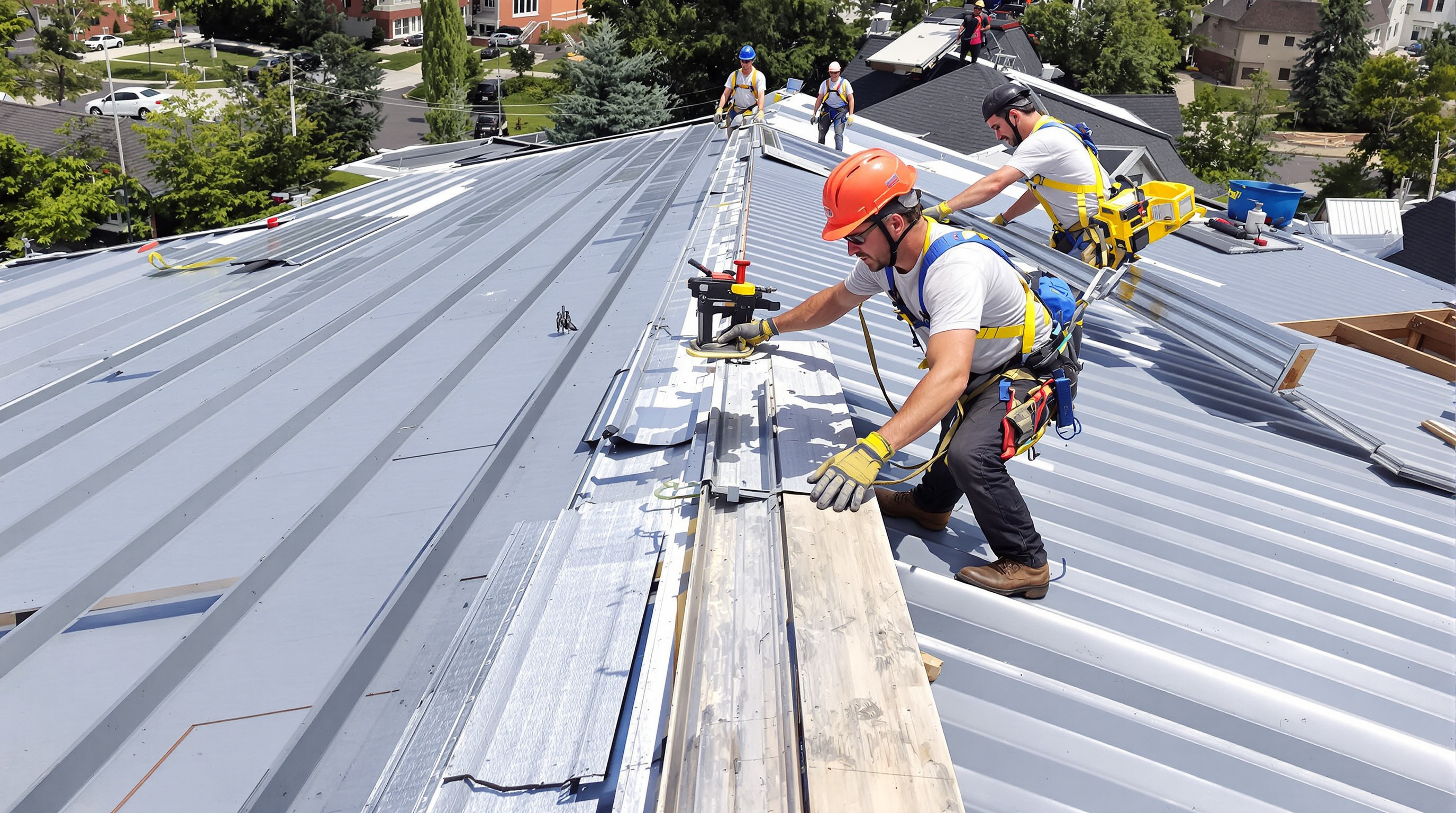
Days 2-5: Panel Installation
This is the main event — and the phase that varies most between systems.
Standing Seam Installation
Standing seam panels are installed one at a time, starting from one side of the roof plane. Each panel is positioned, clipped to the deck (through the underlayment) with concealed clipsConcealed clipA metal bracket that fastens to the roof deck and holds a standing-seam panel in place without penetrating the panel surface. The clip is hidden beneath the seam after panels are joined.Clip type (fixed vs. floating), material (stainless steel vs. galvanized), and spacing (12-24 inches on center) directly affect wind-uplift performance. Closer clip spacing = higher uplift rating.Why it matters: Clips allow panels to expand and contract with temperature changes (a 20-foot steel panel can move 1/4 inch across a 100°F swing). Without clips, thermal cycling causes oil canning, buckling, and fastener stress.Learn more →, and then the next panel's seam is engaged with the previous panel. The process is methodical:
- The first panel is positioned and aligned to the starter trim. Alignment of the first panel is critical — any deviation propagates across every subsequent panel. Experienced installers take extra time on the first panel.
- Clips are attached to the deck at specified spacing (typically 12-24 inches on center, depending on wind zone and manufacturer requirements). Clips are the connection between the panel and the structure — they must be correctly spaced and properly seated.
- The next panel's male seam engages the previous panel's female seam at the clip. For snap-lock panels, this is a press-fit that clicks into place. For mechanical-seam panels, the seams are crimped together with a powered or manual seaming tool after positioning.
- The process repeats across the roof plane. Each panel takes 15-30 minutes depending on length, complexity, and seaming method.
Mechanical seaming requires specialized equipment. A powered seamer walks along the seam, crimping the male and female legs together into a watertight, wind-resistant joint. Mechanical seaming produces the strongest connection and is preferred in high-wind zones. The seaming tool is expensive ($3,000-8,000), which is one reason standing seam installation requires specialized contractors.
Exposed-Fastener Installation
Exposed-fastener panels install faster than standing seam because the attachment method is simpler — panels are screwed directly through the face into the deck. An experienced crew can install exposed-fastener panels 30-50% faster than standing seam on the same roof. Each panel is positioned, overlapped with the previous panel, and screwed at manufacturer-specified spacing (typically 12-24 inches in the field and 6-12 inches at overlaps and eaves).
Screw placement accuracy matters. Each screw must hit the flat portion of the rib — not the raised rib or the valley between ribs. The screw must be driven straight (not angled) and to the correct depth — tight enough to compress the washer without over-driving (which mushrooms the washer and reduces seal life). Over-driven, under-driven, or angled screws are the most common installation defects on exposed-fastener roofs.
Days 5-7: Flashing, Trim, and Detail Work
After the field panels are installed, the detail work begins. This phase takes longer than most homeowners expect — often 1-3 days on a moderately complex roof — and it is the phase where installer skill is most apparent.
Ridge cap installation. The ridge is where the top edges of opposing roof planes meet. The ridge cap covers this joint, provides ventilation (if a vented ridge cap is used), and must be weathertight against wind-driven rain. Proper ridge cap installation on standing seam requires Z-bar closures, butyl sealant, and concealed fasteners.
Valley flashing. Valleys channel water and are high-volume flow paths during storms. Metal valley flashing must be wide enough to handle the flow volume, properly lapped with the field panels, and sealed against wind-driven rain infiltration. Improperly flashed valleys are the number one leak source on metal roofs.
Penetration flashing. Every pipe, vent, chimney, and skylight needs individual flashing. Each penetration is custom — the flashing must integrate with the panel profile and provide a weathertight seal that accommodates thermal expansion. This is hand work that requires skill and patience.
Sidewall and endwall flashing. Where the roof meets a vertical wall (common at dormers and second-story walls), step flashing or continuous flashing integrates the roof with the wall's weather-resistant barrier. This interface is a common leak point when done poorly.
Final Inspection and Walkthrough
After all panels, flashing, and trim are installed, a final inspection should occur. Walk the property with your contractor (or a knowledgeable third party) and check:
- Panel alignment. Panels should be straight and parallel across the roof plane. Visible waviness or misalignment indicates installation issues.
- Seam engagement. On standing seam, all seams should be fully engaged — no gaps, incomplete seams, or visible clips.
- Flashing completeness. Every penetration, valley, transition, and termination should have proper flashing. No raw cut edges exposed to weather.
- Fastener condition. On exposed-fastener systems, check for over-driven, under-driven, or missing screws. Washers should be uniformly compressed.
- Debris cleanup. Metal shavings, discarded trim scraps, and old roofing debris should be completely cleaned from the roof surface, gutters, and ground. Metal filings left on the roof will rust and stain the panels.
- Gutter reconnection. Gutters should be rehung properly and connected to the new drip edge. Water flow should be directed into the gutter, not behind it.
Metal roof installation takes longer than shingles, so something must be going wrong if it takes a week.
Reality: A 3-7 day installation timeline for metal roofing is normal and expected. Standing seam on a complex roof can take a full week. This is not inefficiency — it is the methodical process of clipping, seaming, and custom-flashing a system that will last 40-60+ years. Rushing metal installation leads to mistakes that are expensive to fix. Be suspicious of a crew that finishes too fast, not too slow.
During installation, you notice the crew using a circular saw to cut panels on the roof surface. What should you do?