Metal Shingles and Metal Tile: Stamped Metal Alternatives
The short version: Metal shingles are stamped metal panels that look like slate, cedar shake, or traditional shingles but deliver metal roof performance — 40-60 year lifespan, 110-150+ mph wind ratings, and Class A fire resistance. They cost $7-14/sq ft installed, which overlaps with the low end of standing seam. Metal shingles make the most sense on traditional homes where the homeowner wants metal performance without the standing-seam aesthetic, and in HOA communities that require a shingle or tile appearance. For a broader comparison, see our metal shingles vs stone-coated steel guide. Use our roof color and style visualizer to preview how metal shingle profiles look on different home styles.
What Are Metal Shingles?
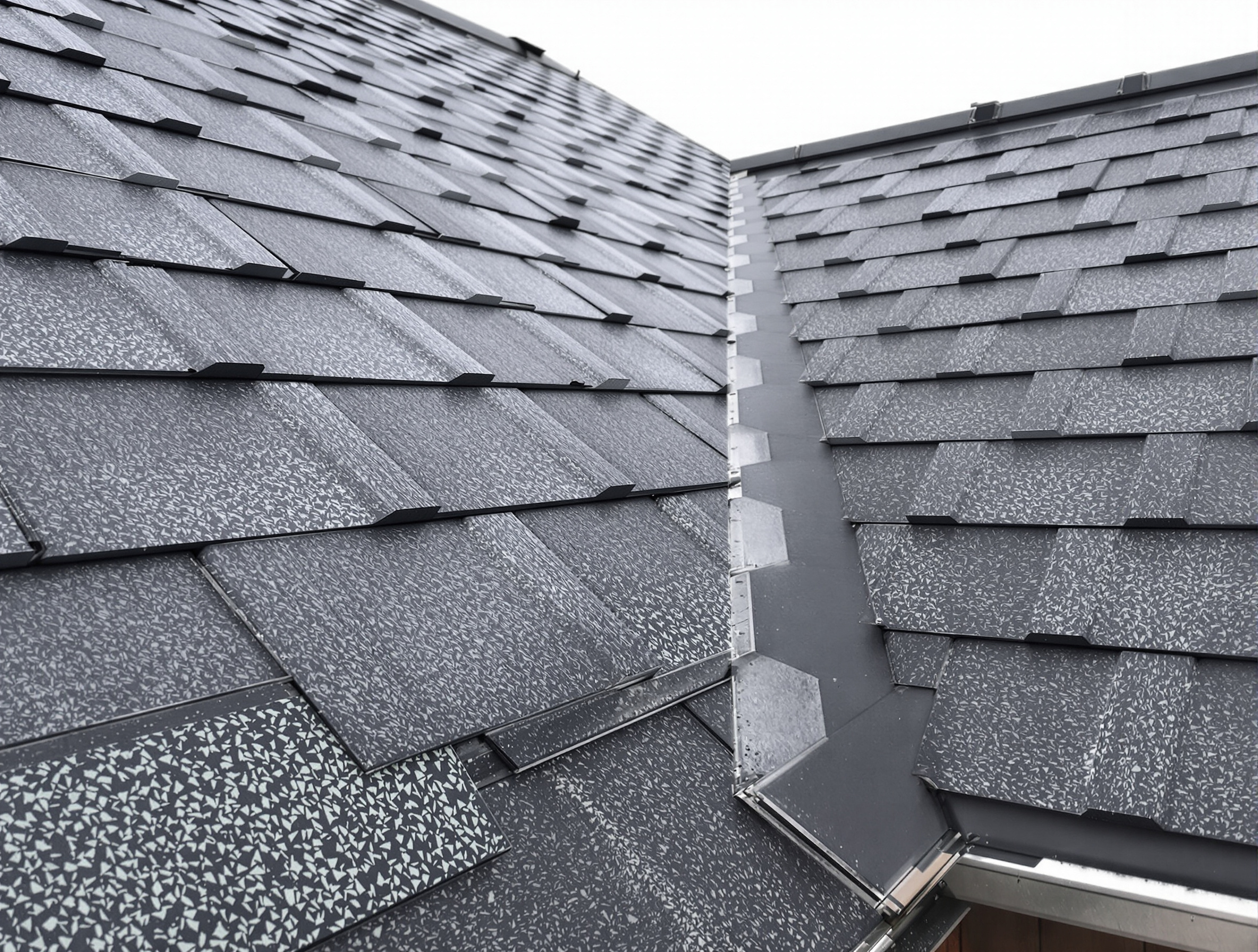
Metal shingles are individual stamped metal panels — typically 12-50 inches long and 6-15 inches tall — that are shaped by high-tonnage press dies to replicate the three-dimensional texture and shadow lines of traditional roofing materials. When installed in overlapping courses, they create a roof surface that looks like slate, wood shake, or dimensional asphalt shingles from normal viewing distances.
The key distinction from panel metal roofing: Standing seam and exposed-fastener panels run the full length of the roof slope as long, continuous sheets. Metal shingles install in courses (rows), like traditional shingles, with each course overlapping the one below. This means more pieces to install but easier handling around complex roof features like hips, valleys, dormers, and turrets.
Materials Used
- Galvalume steel: Most metal shingles use GalvalumeGalvalumeA steel coating consisting of 55% aluminum, 43.4% zinc, and 1.6% silicon by weight. Developed by Bethlehem Steel in 1972 and now the industry-standard substrate for painted metal roofing.Nearly all premium residential metal roof panels ship on a Galvalume substrate. Unpainted Galvalume should not be used within 1,500 feet of saltwater without a painted finish on top.Why it matters: Galvalume outlasts galvanized steel by 2-4x in atmospheric corrosion tests. The aluminum component provides barrier protection while zinc offers sacrificial (galvanic) protection at cut edges and scratches.Learn more → steel in 26-gauge26-gauge steelSteel substrate measuring 0.0179 inches (0.455 mm) thick. The most common gauge for residential metal roofing across all panel types.26-gauge is the default spec from most residential metal roofing manufacturers. Thinner than 24-gauge but significantly sturdier than 29-gauge.Why it matters: Balances cost and performance for most residential applications. Adequate for standing seam and exposed-fastener panels in moderate wind zones, though 24-gauge is preferred where wind or hail risk is high.Learn more → or 24-gauge24-gauge steelSteel substrate measuring 0.0239 inches (0.607 mm) thick. The heaviest gauge commonly used in residential metal roofing.Lower gauge number = thicker metal. 24-gauge is roughly 25% thicker than 26-gauge. Required by some standing-seam manufacturers for warranty coverage in hurricane zones.Why it matters: Thicker steel resists denting from hail and foot traffic, reduces oil canning, and holds fasteners more securely. It costs 15-20% more than 26-gauge but lasts longer in high-wind and coastal environments.Learn more →. The Galvalume coating provides corrosion protection, and a PVDFPVDF (polyvinylidene fluoride)A resin-based paint system containing 70% PVDF resin (by weight of total resin solids). The highest-performance paint coating available for metal roofing. Kynar 500 and Hylar 5000 are the two licensed PVDF formulations.A true PVDF coating must contain at least 70% PVDF resin. Some manufacturers use 50% blends and market them misleadingly. Always confirm the 70% specification.Why it matters: PVDF coatings resist chalking, fading, and chemical degradation far longer than SMP or acrylic. Expect 30-40 years of color retention in full Gulf Coast sun. This is what separates a premium metal roof from a budget one.Learn more → or SMPSMP (silicone-modified polyester)A mid-tier paint system for metal roofing that adds silicone to a polyester base for improved UV and chalk resistance compared to standard polyester. Less durable than PVDF.SMP is the standard coating on most exposed-fastener panels (R-panel, PBR, 5V-crimp). If a contractor quotes a standing-seam roof with SMP paint, ask why they are not using PVDF.Why it matters: SMP costs 15-25% less than PVDF and performs well for 15-20 years. Acceptable for budget-conscious projects, but expect earlier fading and chalking in intense Gulf Coast sun.Learn more → paint coating provides color and UV protection.
- Aluminum: Some manufacturers offer aluminum metal shingles for coastal installations within the salt zone. Aluminum shingles are lighter and more corrosion-resistant but cost 40-60% more than steel versions.
Attachment Methods
Metal shingles typically use concealed fasteners — nails or screws driven through a concealed nailing strip at the top of each shingle, which is then covered by the overlapping shingle course above. This means no exposed fasteners on the finished roof surface, eliminating the maintenance concern associated with exposed-fastener panel systems.
Most metal shingle systems also feature mechanical interlocks at the horizontal and vertical joints. These interlocks resist wind uplift and prevent water infiltration at the joints. The four-way interlock (top, bottom, left, right) is the hallmark of a well-engineered metal shingle system.
Profile Styles
Slate Profile
The most refined option. Slate-profile metal shingles replicate the layered, irregular edges and smooth face of quarried slate. Multi-tone color blends mimic the natural color variation of real slate. From 20+ feet away, high-quality slate-profile metal shingles are virtually indistinguishable from natural slate.
Best applications: Colonial, Tudor, Colonial Revival, and formal traditional homes where natural slate would be ideal but the weight (800-1,500 lb per square vs 100-200 lb for metal shingles) or cost ($20-40/sq ft for slate vs $7-14 for metal shingles) is prohibitive.
Shake Profile
Rustic warmth in metal. Shake-profile metal shingles have an irregular, textured face that replicates hand-split cedar shake. The stamped texture includes the grain pattern, edge irregularity, and thickness variation of real wood. Available in natural wood tones (cedar, weathered gray, aged bark) and conventional metal roof colors.
Best applications: Craftsman bungalows, mountain-influenced homes, rustic ranch homes, and any home where cedar shake would be the natural choice but fire resistance, longevity, or maintenance concerns rule out real wood.
Dimensional Shingle Profile
The mainstream option. These metal shingles replicate the look of architectural (dimensional) asphalt shingles — the most common residential roofing material in America. The stamped profiles include shadow lines, tab definition, and surface texture that mimic the layered look of premium asphalt shingles.
Best applications: Any traditional home in any neighborhood. Dimensional-profile metal shingles are the "stealth" metal roof — they deliver 40-60 year lifespan and hurricane-grade wind resistance while looking exactly like the asphalt shingle roof your neighbors have. In HOA communities, they pass architectural review without question.
Metal shingles look fake — you can always tell they are metal.
Reality: Early metal shingles had shallow stamping and unconvincing texture that gave them a plastic or artificial appearance. Modern metal shingles use deep-draw stamping dies that replicate genuine material texture at sub-millimeter detail. Multi-tone paint applications and surface treatments add to the realism. Most observers cannot identify a quality metal shingle roof as metal from normal street-level viewing distance. The tell, if there is one, is usually the uniformity — real slate and shake have more randomness than stamped metal.
Where Metal Shingles Outperform Other Options
Complex Roof Geometries
Metal shingles handle hips, valleys, dormers, and turrets more easily than standing-seam panels. The small panel size allows installers to work around complex intersections without the long panel lengths, seaming tools, and precise alignment that standing seam requires. On a roof with six hips, four valleys, three dormers, and multiple pitch changes, metal shingles can be more cost-effective than standing seam because the installation labor is simpler.
Traditional Neighborhood Context
In neighborhoods where every home has asphalt shingles or tile, a standing-seam metal roof stands out — sometimes in a welcome way, sometimes not. Metal shingles let you upgrade to metal performance without changing your home's visual character or clashing with the neighborhood aesthetic. This is especially valuable for resale — buyers in traditional neighborhoods expect a traditional roof appearance.
HOA Approval
HOA architectural committees that reject standing-seam metal roofing often approve metal shingles because they look like the traditional materials specified in the community's design standards. If your HOA requires a "shingle-style" or "tile-style" roof, metal shingles are the path to metal roof performance within those rules.
Cost Analysis
Metal shingles sit in the mid-to-upper range of residential roofing costs:
Metal Shingle Cost Comparison (per sq ft installed, 2,000 sq ft roof)
| Roofing System | Cost/sq ft | Expected Lifespan | 50-Year Cost |
|---|---|---|---|
| Asphalt Shingles | $4 - $7 | 15 - 25 years | $16,000 - $28,000 (2-3 installs) |
| Exposed-Fastener Metal | $4 - $8 | 25 - 40 years | $10,000 - $19,000 (1-2 installs) |
| Metal Shingles | $7 - $14 | 40 - 60 years | $14,000 - $28,000 (1 install) |
| Standing Seam | $10 - $18 | 40 - 60+ years | $20,000 - $36,000 (1 install) |
| Natural Slate | $20 - $40 | 75 - 100+ years | $40,000 - $80,000 (1 install) |
Costs are for Gulf Coast markets and include materials, labor, tear-off, and disposal. 50-year cost includes inflation-adjusted re-roofing where applicable.
The value proposition: Metal shingles cost less than standing seam and natural slate, last as long as or longer than both, and can be installed by a broader range of contractors. On complex roof geometries where standing-seam labor costs run high, metal shingles can actually be cheaper than standing seam while delivering comparable lifespan and wind performance.
A homeowner has a Craftsman bungalow with a complex hip roof, multiple dormers, and a steep pitch. Their HOA requires a 'traditional appearance' roof. Which option gives them the best combination of performance, cost, and HOA compliance?
Color Options for Metal Shingles
Metal shingles are available in the full range of standard metal roof colors plus multi-tone blends that replicate the color variation of natural materials. Most premium metal shingle manufacturers use PVDF coatingPVDF (polyvinylidene fluoride)A resin-based paint system containing 70% PVDF resin (by weight of total resin solids). The highest-performance paint coating available for metal roofing. Kynar 500 and Hylar 5000 are the two licensed PVDF formulations.A true PVDF coating must contain at least 70% PVDF resin. Some manufacturers use 50% blends and market them misleadingly. Always confirm the 70% specification.Why it matters: PVDF coatings resist chalking, fading, and chemical degradation far longer than SMP or acrylic. Expect 30-40 years of color retention in full Gulf Coast sun. This is what separates a premium metal roof from a budget one.Learn more → systems for long-term color retention.
Popular metal shingle colors for Gulf Coast homes:
- Weathered Wood: Multi-tone blend that mimics aged cedar. Perfect for Craftsman and rustic homes.
- Charcoal Slate: Multi-tone dark gray that replicates natural slate variation. Works on colonial and formal traditional homes.
- Dark Bronze: Warm neutral that complements brick and stone. Versatile across traditional architectural styles.
- Earth Blend: Multi-tone brown-gray that replicates weathered wood or stone. Natural, understated appearance.
- Burnished Slate: Warm dark gray that works with virtually every exterior palette.
Maintenance and Long-Term Care
Metal shingles are genuinely low-maintenance. With no exposed fasteners to inspect and no granule erosion (like asphalt shingles), the primary maintenance tasks are:
- Annual visual inspection after hurricane season for any lifted or damaged shingles
- Gutter and valley cleaning to prevent debris accumulation
- Touch-up any exposed metal from scratches or impacts with manufacturer-provided paint
- Check flashing sealants at penetrations (pipes, vents) every 5-7 years
Walking on metal shingles: Walk carefully, stepping on the lower portion of each shingle where it is supported by the course below. Avoid stepping on the unsupported upper portion, which can dent. Most metal shingle manufacturers recommend using soft-soled shoes and walking on the shingle profile ribs rather than the flat areas.
Frequently Asked Questions
What are metal shingles?
Stamped metal panels shaped to look like slate, cedar shake, or traditional shingles. Made from Galvalume steelGalvalumeA steel coating consisting of 55% aluminum, 43.4% zinc, and 1.6% silicon by weight. Developed by Bethlehem Steel in 1972 and now the industry-standard substrate for painted metal roofing.Nearly all premium residential metal roof panels ship on a Galvalume substrate. Unpainted Galvalume should not be used within 1,500 feet of saltwater without a painted finish on top.Why it matters: Galvalume outlasts galvanized steel by 2-4x in atmospheric corrosion tests. The aluminum component provides barrier protection while zinc offers sacrificial (galvanic) protection at cut edges and scratches.Learn more → or aluminum with PVDFPVDF (polyvinylidene fluoride)A resin-based paint system containing 70% PVDF resin (by weight of total resin solids). The highest-performance paint coating available for metal roofing. Kynar 500 and Hylar 5000 are the two licensed PVDF formulations.A true PVDF coating must contain at least 70% PVDF resin. Some manufacturers use 50% blends and market them misleadingly. Always confirm the 70% specification.Why it matters: PVDF coatings resist chalking, fading, and chemical degradation far longer than SMP or acrylic. Expect 30-40 years of color retention in full Gulf Coast sun. This is what separates a premium metal roof from a budget one.Learn more → or SMPSMP (silicone-modified polyester)A mid-tier paint system for metal roofing that adds silicone to a polyester base for improved UV and chalk resistance compared to standard polyester. Less durable than PVDF.SMP is the standard coating on most exposed-fastener panels (R-panel, PBR, 5V-crimp). If a contractor quotes a standing-seam roof with SMP paint, ask why they are not using PVDF.Why it matters: SMP costs 15-25% less than PVDF and performs well for 15-20 years. Acceptable for budget-conscious projects, but expect earlier fading and chalking in intense Gulf Coast sun.Learn more → paint coatings. They install in overlapping courses and last 40-60 years.
How much do metal shingles cost compared to standing seam?
Metal shingles cost $7-14/sq ft installed, overlapping with the lower end of standing seam ($10-18/sq ft). On complex roofs, metal shingles can be cheaper because the smaller panel size is easier to handle around hips, valleys, and dormers.
Do metal shingles work in hurricanes?
Yes. The four-way mechanical interlock prevents wind from prying up individual shingles. Most systems are rated for 110-150+ mph winds, and several carry Miami-Dade NOA approvals.
Can metal shingles be installed over existing asphalt shingles?
Some systems are approved for installation over one layer of existing asphalt shingles. At 1-2 lb/sq ft, the added weight is within the structural capacity of virtually all residential frames. Check manufacturer guidelines and local code requirements.