R-Panel, PBR Panel, 5V Crimp, Corrugated: Which Is Which
The four main exposed-fastenerExposed-fastener metal roofA metal roof system where panels are secured by screws driven through the panel face into the roof deck or purlins. The screw heads and neoprene washers remain visible on the surface.R-panel, PBR panel, corrugated, and 5V-crimp are all exposed-fastener systems. Common on agricultural buildings, shops, and budget residential roofs. A good choice when cost is the priority and the homeowner understands the maintenance commitment.Why it matters: Lower cost than standing seam (typically 30-50% less installed), but the exposed screws are a long-term maintenance liability. Neoprene washers degrade in UV light and can allow leaks within 15-20 years if not replaced.Learn more → panel profiles serve different applications. R-panelR-panelAn exposed-fastener metal panel with 1.25-inch-tall trapezoidal ribs on 12-inch centers. One of the most common commercial and agricultural metal roof profiles, also used on budget residential projects.R-panel can span purlins up to 5 feet apart, making it efficient for open-frame structures. For residential use over solid deck, it is functionally similar to PBR panel.Why it matters: R-panel is widely available, affordable, and structurally strong for its weight. However, as an exposed-fastener system, it requires periodic screw and washer maintenance. Typical material cost is $1.50-3.00 per square foot.Learn more → and PBRPBR panel (purlin-bearing rib)An exposed-fastener metal panel similar to R-panel but with a broader flat area at the base of each rib, providing a wider bearing surface on purlins. Rib height is typically 1.25 inches.PBR and R-panel are often confused. The main visual difference is the shape at the base of the rib: PBR has a wider flat landing, R-panel has a sharper angle. Both use the same fastening method.Why it matters: The wider bearing surface gives PBR slightly better pull-over resistance than R-panel at purlin connections. Performance difference is marginal for residential over solid deck, but meaningful for commercial purlin-frame buildings.Learn more → are high-rib trapezoidal profiles built for structural strength — common on commercial buildings, shops, and budget residential roofs. 5V-crimp5V-crimpA traditional metal roofing panel with V-shaped ribs spaced 5 inches apart across a 24-inch-wide panel. An exposed-fastener system with a lower-profile appearance than R-panel.Historically installed with galvanized steel and exposed nails. Modern 5V-crimp is available in Galvalume with PVDF paint and uses screws with neoprene washers. Popular in Florida and coastal Alabama/Mississippi.Why it matters: 5V-crimp has a classic Gulf Coast aesthetic that many homeowners prefer over the industrial look of R-panel. However, the shallow V-ribs provide less structural rigidity, and it is more vulnerable to oil canning.Learn more → is a low-profile traditional panel with the strongest residential aesthetic on the Gulf Coast. CorrugatedCorrugated metal roofingMetal panels formed with a repeating sinusoidal (wave-shaped) profile, typically with 2.67-inch or 1.25-inch wave spacing. One of the oldest and simplest metal roof profiles.Modern corrugated panels are available in Galvalume with painted finishes, a major upgrade over the bare galvanized sheets of past decades. Common for porches, sheds, and budget residential roofs.Why it matters: The wave shape gives corrugated panels good strength-to-weight ratio and natural water channeling. Inexpensive and easy to install, but the overlapping side laps and exposed fasteners limit weather resistance compared to standing seam.Learn more → is the simplest and most affordable profile, best for casual applications. All four are exposed-fastener systems that share the same maintenance requirements — periodic screw and washer inspection — but they differ in rib geometry, appearance, structural capacity, and cost.
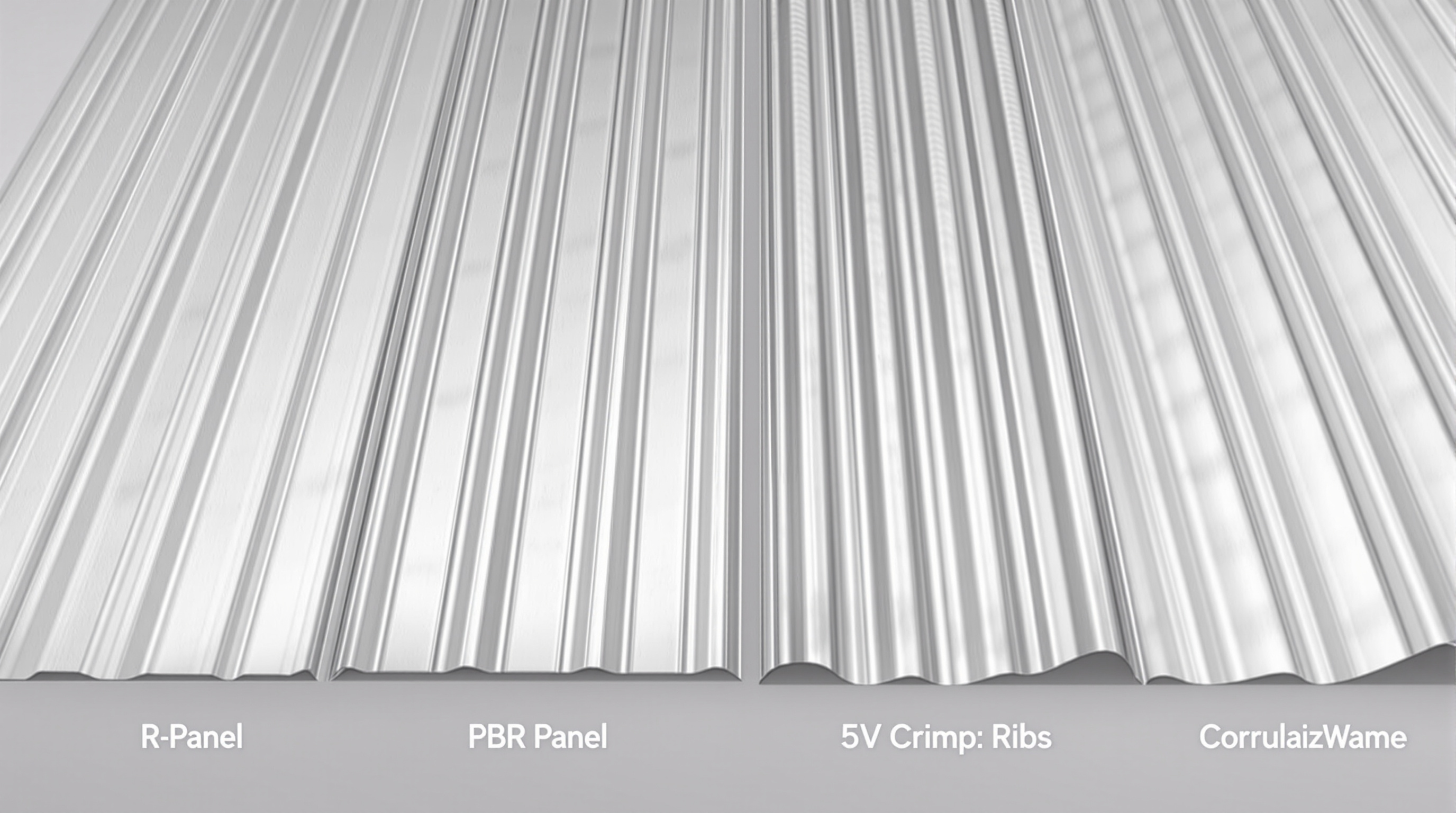
Exposed-Fastener Panel Type Comparison
| Criteria | R-Panel | PBR Panel | 5V-Crimp | Corrugated |
|---|---|---|---|---|
| Rib Profile | Trapezoidal ribs, 1.25" tall, sharp angles at base The ribs have a defined trapezoidal shape with relatively sharp transitions at the base. This geometry provides good structural rigidity. | Trapezoidal ribs, 1.25" tall, wider flat bearing at base Similar to R-panel but with a broader flat area where the rib meets the flat pan. This wider bearing surface sits better on purlins. | V-shaped crimps, ~0.5" tall, 5 per panel width Shallow V-shaped ridges spaced about 5 inches apart across a 24-inch panel. Much lower profile than R-panel or PBR. | Sinusoidal waves, 0.5–0.875" tall, continuous wave pattern The classic wave shape. Available in standard 2.67-inch wave spacing or tighter 1.25-inch wave spacing. |
| Structural Rigidity | ✓ High — can span purlins up to 5 feet apart The 1.25-inch trapezoidal ribs provide excellent cross-section stiffness. R-panel is used structurally on open-frame buildings. | ✓ High — similar to R-panel with slightly better purlin bearing The wider bearing surface distributes load better at purlin connections, providing marginally better pull-over resistance. | Moderate — requires solid deck or closely spaced purlins The shallow V-ribs provide less stiffness than the taller trapezoidal profiles. Maximum purlin spacing is typically 24 inches. | Moderate to low — best over solid deck The wave profile provides reasonable stiffness at standard gauge but less than trapezoidal profiles. Larger wave spacing (2.67-inch) is stiffer than smaller. |
| Residential Suitability | Functional but industrial appearance R-panel works on residential applications but reads as commercial/agricultural. Popular on modern farmhouse and industrial-chic designs. | Functional but industrial appearance Visually almost identical to R-panel from the ground. The same aesthetic considerations apply. | ✓ Excellent — traditional Gulf Coast residential look 5V-crimp has a long history on Gulf Coast homes and is considered a classic residential metal roof profile. It blends with traditional and coastal architecture. | Good for cottage, farmhouse, and coastal styles The wave profile has a softer, more informal character that works well on casual residential architecture. |
| Aesthetics | Bold, linear, industrial Prominent ribs create strong shadow lines. Works architecturally on modern and industrial designs. Can look out of place on traditional homes. | Bold, linear, industrial (nearly identical to R-panel) From ground level, PBR and R-panel are visually indistinguishable. The bearing surface difference is at the rib base, hidden from view. | ✓ Subtle, traditional, refined The low-profile V-crimps create gentle shadow lines that blend with residential architecture. Less visually dominant than trapezoidal profiles. | Informal, rustic, coastal The wave pattern reads as casual and traditional. Popular on beach cottages, porches, and covered patios. |
| Availability (Gulf Coast) | ✓ Excellent — stocked by nearly every metal supplier R-panel is the most widely manufactured and distributed exposed-fastener profile in the U.S. Available from every major metal building supplier on the Gulf Coast. | Good — most large suppliers carry it PBR is common but slightly less universally stocked than R-panel. Large suppliers carry both; smaller shops may stock only R-panel. | Good in FL, AL, MS — less common inland 5V-crimp has strong regional availability along the Gulf Coast, particularly in Florida. Less commonly stocked at inland suppliers. | Good — available from most suppliers Standard corrugated is widely available. Specialty small-wave corrugated may require ordering. |
| Material Cost (per sq ft) | $1.50–$3.00 At 26-gauge Galvalume with SMP coating. PVDF adds $0.50–1.00/sq ft. | $1.50–$3.25 Slightly higher than R-panel due to the additional forming required for the wider bearing surface. | $2.00–$3.50 The 24-inch coverage width and lighter gauge options keep material cost competitive. PVDF-coated 5V costs more. | ✓ $1.25–$2.75 Corrugated is the simplest profile to manufacture, making it the lowest-cost metal panel option. |
| Wind Performance | ✓ Good — 1.25" ribs resist uplift well with proper fastener schedule The tall trapezoidal ribs resist deformation under uplift. With screws at every rib in high-wind zones, R-panel can meet 130+ mph design wind speed requirements. | ✓ Good — marginally better pull-over resistance than R-panel The wider bearing at purlin connections reduces pull-over failure risk, giving PBR a slight edge in structural applications. | Moderate — shallow ribs offer less uplift resistance The 0.5-inch V-crimps provide less cross-section than 1.25-inch trapezoidal ribs. Wind performance depends heavily on fastener schedule and gauge. | Moderate — wave profile provides fair resistance The sinusoidal shape distributes stress well but the overall profile height is less than trapezoidal panels. Adequate for moderate wind zones with proper fastening. |
Rib Profile
Structural Rigidity
Residential Suitability
Aesthetics
Availability (Gulf Coast)
Material Cost (per sq ft)
Wind Performance
R-Panel: The Workhorse
R-panelR-panelAn exposed-fastener metal panel with 1.25-inch-tall trapezoidal ribs on 12-inch centers. One of the most common commercial and agricultural metal roof profiles, also used on budget residential projects.R-panel can span purlins up to 5 feet apart, making it efficient for open-frame structures. For residential use over solid deck, it is functionally similar to PBR panel.Why it matters: R-panel is widely available, affordable, and structurally strong for its weight. However, as an exposed-fastener system, it requires periodic screw and washer maintenance. Typical material cost is $1.50-3.00 per square foot.Learn more → is the most widely manufactured and used exposed-fastener metal panel in the United States. It was designed for commercial and agricultural buildings where structural spanning ability matters — the 1.25-inch trapezoidal ribs can span purlins up to 5 feet apart without intermediate support. This makes R-panel the default choice for metal buildings, warehouses, equipment sheds, and agricultural structures across the Gulf Coast.
The rib geometry creates strong shadow lines that read as industrial. The ribs are tall, angular, and closely spaced (typically 12 inches on center), producing a bold, linear appearance. On a commercial building or a modern farmhouse, this look works. On a traditional Colonial or Craftsman home, R-panel can look out of context.
R-panel is available in 26-gauge26-gauge steelSteel substrate measuring 0.0179 inches (0.455 mm) thick. The most common gauge for residential metal roofing across all panel types.26-gauge is the default spec from most residential metal roofing manufacturers. Thinner than 24-gauge but significantly sturdier than 29-gauge.Why it matters: Balances cost and performance for most residential applications. Adequate for standing seam and exposed-fastener panels in moderate wind zones, though 24-gauge is preferred where wind or hail risk is high.Learn more → and 24-gauge24-gauge steelSteel substrate measuring 0.0239 inches (0.607 mm) thick. The heaviest gauge commonly used in residential metal roofing.Lower gauge number = thicker metal. 24-gauge is roughly 25% thicker than 26-gauge. Required by some standing-seam manufacturers for warranty coverage in hurricane zones.Why it matters: Thicker steel resists denting from hail and foot traffic, reduces oil canning, and holds fasteners more securely. It costs 15-20% more than 26-gauge but lasts longer in high-wind and coastal environments.Learn more → GalvalumeGalvalumeA steel coating consisting of 55% aluminum, 43.4% zinc, and 1.6% silicon by weight. Developed by Bethlehem Steel in 1972 and now the industry-standard substrate for painted metal roofing.Nearly all premium residential metal roof panels ship on a Galvalume substrate. Unpainted Galvalume should not be used within 1,500 feet of saltwater without a painted finish on top.Why it matters: Galvalume outlasts galvanized steel by 2-4x in atmospheric corrosion tests. The aluminum component provides barrier protection while zinc offers sacrificial (galvanic) protection at cut edges and scratches.Learn more → with SMPSMP (silicone-modified polyester)A mid-tier paint system for metal roofing that adds silicone to a polyester base for improved UV and chalk resistance compared to standard polyester. Less durable than PVDF.SMP is the standard coating on most exposed-fastener panels (R-panel, PBR, 5V-crimp). If a contractor quotes a standing-seam roof with SMP paint, ask why they are not using PVDF.Why it matters: SMP costs 15-25% less than PVDF and performs well for 15-20 years. Acceptable for budget-conscious projects, but expect earlier fading and chalking in intense Gulf Coast sun.Learn more → or PVDFPVDF (polyvinylidene fluoride)A resin-based paint system containing 70% PVDF resin (by weight of total resin solids). The highest-performance paint coating available for metal roofing. Kynar 500 and Hylar 5000 are the two licensed PVDF formulations.A true PVDF coating must contain at least 70% PVDF resin. Some manufacturers use 50% blends and market them misleadingly. Always confirm the 70% specification.Why it matters: PVDF coatings resist chalking, fading, and chemical degradation far longer than SMP or acrylic. Expect 30-40 years of color retention in full Gulf Coast sun. This is what separates a premium metal roof from a budget one.Learn more → paint finishes. For residential use on the Gulf Coast, 26-gauge with SMP coating is the standard budget specification. For higher wind zones or longer service life, upgrading to 24-gauge and PVDF coating adds cost but significantly improves both wind performance and paint longevity. Material cost ranges from $1.50 to $3.00 per square foot, making it one of the most affordable metal roofing options available.
Wind performance depends entirely on the fastener schedule. R-panel itself has good structural rigidity, but the wind uplift resistance of the installed system is determined by screw spacing, screw size, and whether screws hit solid framing. With screws at every rib in edge and corner zones and every other rib in the field, R-panel can meet design wind speedDesign wind speedThe ultimate (3-second gust) wind speed used to calculate design wind pressures for a building at a specific location, per ASCE 7. Expressed in miles per hour (mph) for Risk Category II residential buildings.Design wind speed is not the same as sustained wind in a hurricane. The design speed is a statistical value (3-second gust with a 700-year return period for residential). Actual hurricane gusts can exceed this, which is why FORTIFIED and other above-code programs exist.Why it matters: This number drives every wind-related roofing specification: clip spacing, fastener count, panel gauge, and seam type. A home in a 150-mph design wind speed zone needs a substantially more robust roof system than one in a 115-mph zone.Learn more → requirements up to 130 mph or higher. Our screw pattern and spacing guide details how fastener placement drives wind resistance. The critical detail is the fastener connection — not the panel profile.
PBR Panel: The Structural Upgrade
PBR (purlin-bearing rib) panelPBR panel (purlin-bearing rib)An exposed-fastener metal panel similar to R-panel but with a broader flat area at the base of each rib, providing a wider bearing surface on purlins. Rib height is typically 1.25 inches.PBR and R-panel are often confused. The main visual difference is the shape at the base of the rib: PBR has a wider flat landing, R-panel has a sharper angle. Both use the same fastening method.Why it matters: The wider bearing surface gives PBR slightly better pull-over resistance than R-panel at purlin connections. Performance difference is marginal for residential over solid deck, but meaningful for commercial purlin-frame buildings.Learn more → is a close cousin of R-panel with one important structural improvement. The base of each trapezoidal rib has a wider flat landing surface that sits on the purlin. This wider bearing surface distributes the fastener load over a larger area, reducing the risk of screw pull-overFastener (roof screw)A self-drilling or self-tapping screw used to attach metal roof panels or clips to the roof deck or structural framing. Exposed-fastener panels use screws through the panel face; standing-seam systems use screws only at the clip.Fastener spacing is engineered: closer spacing in edge and corner zones, wider spacing in the field. Screws must hit solid wood or steel framing. A missed fastener that only catches plywood has almost no pull-out resistance in high wind.Why it matters: Fastener material matters: #12 or #14 screws with ZAC (zinc-aluminum) coating are standard; stainless steel (Type 304 or 316) is recommended within 2,500 feet of saltwater. Corroded or improperly driven fasteners are the leading cause of metal roof leaks.Learn more → — the failure mode where the screw head pulls through the panel under uplift.
From ground level, PBR and R-panel are virtually identical. The difference is at the base of the rib where it contacts the support structure — a detail hidden from view on a finished roof. A homeowner looking up at an installed roof cannot distinguish PBR from R-panel. The visual character, shadow lines, and overall appearance are the same.
The structural advantage of PBR matters most on purlin-frame buildings. When panels span between purlins (open framing without solid sheathing), the connection at the purlin is the critical structural point. PBR's wider bearing surface provides 10 to 15 percent better pull-over resistance at that connection compared to R-panel. For residential roofs installed over solid plywood or OSB sheathing, the difference is marginal because the panel is continuously supported.
Cost is slightly higher than R-panel. The additional forming required to create the wider bearing surface adds $0.10 to $0.25 per square foot. For a residential roof, this translates to a total increase of $200 to $500 — not a significant factor in the overall project budget.
5V-Crimp: The Gulf Coast Residential Classic
5V-crimp5V-crimpA traditional metal roofing panel with V-shaped ribs spaced 5 inches apart across a 24-inch-wide panel. An exposed-fastener system with a lower-profile appearance than R-panel.Historically installed with galvanized steel and exposed nails. Modern 5V-crimp is available in Galvalume with PVDF paint and uses screws with neoprene washers. Popular in Florida and coastal Alabama/Mississippi.Why it matters: 5V-crimp has a classic Gulf Coast aesthetic that many homeowners prefer over the industrial look of R-panel. However, the shallow V-ribs provide less structural rigidity, and it is more vulnerable to oil canning.Learn more → is the traditional metal roof panel of the Gulf Coast. Drive through any historic neighborhood in Pensacola, Mobile, New Orleans, or coastal Mississippi, and you will see 5V-crimp on homes that are 50 to 100 years old. The profile — five shallow V-shaped crimps evenly spaced across a 24-inch-wide panel — has been a regional standard for over a century. It is the one exposed-fastener profile that genuinely looks at home on residential architecture.
The V-crimps are shallow — approximately 0.5 inches tall — creating subtle shadow lines rather than bold ribs. This low profile produces a refined, traditional look that blends with cottage, Colonial, Creole, and coastal vernacular styles. Unlike R-panel and PBR, which announce themselves as metal from a distance, 5V-crimp reads as "roof" first and "metal" second. The visual subtlety is 5V-crimp's primary advantage for residential applications.
The trade-off is structural rigidity. The shallow V-crimps provide less cross-sectional stiffness than the 1.25-inch trapezoidal ribs of R-panel. 5V-crimp requires solid deck or closely spaced purlins (24-inch maximum). It is not a structural spanning panel. For residential installation over plywood or OSB sheathing, this is irrelevant — the deck provides continuous support. But 5V-crimp should not be used on open-frame structures.
Modern 5V-crimp is a different product than what was installed 50 years ago. Historical 5V-crimp was galvanized steelGalvanized steelSteel coated with a layer of pure zinc via hot-dip galvanizing (typically G90 at 0.90 oz/ft² of zinc). The original corrosion-protection method for steel roofing.G90 is the standard coating weight. G60 (lighter zinc) is cheaper but corrodes faster. In Gulf Coast salt air, galvanized steel without paint will show white rust within a few years.Why it matters: Less corrosion-resistant than Galvalume in most atmospheric exposures. Still used for certain corrugated and 5V-crimp panels, but Galvalume has largely replaced it for painted residential products.Learn more → with exposed nails. Modern 5V-crimp is GalvalumeGalvalumeA steel coating consisting of 55% aluminum, 43.4% zinc, and 1.6% silicon by weight. Developed by Bethlehem Steel in 1972 and now the industry-standard substrate for painted metal roofing.Nearly all premium residential metal roof panels ship on a Galvalume substrate. Unpainted Galvalume should not be used within 1,500 feet of saltwater without a painted finish on top.Why it matters: Galvalume outlasts galvanized steel by 2-4x in atmospheric corrosion tests. The aluminum component provides barrier protection while zinc offers sacrificial (galvanic) protection at cut edges and scratches.Learn more → substrate with PVDF or SMP paint finish, installed with screws and neoprene washersNeoprene washerA synthetic rubber gasket bonded to the underside of an exposed-fastener roofing screw head. Compresses against the panel to create a watertight seal around the screw penetration.EPDM washers last longer than standard neoprene but cost more. Some premium screws use a bonded EPDM washer with a metal cap to shield it from UV. On standing-seam roofs, this issue does not exist because fasteners are concealed.Why it matters: Neoprene degrades in UV sunlight, becoming brittle and cracking within 15-20 years. Once the washer fails, water infiltrates around the screw. This is the single biggest long-term maintenance issue with exposed-fastener metal roofs.Learn more →. The material is dramatically more durable, the paint holds color for 30-plus years, and the screw-and-washer attachment is more weather-tight than the nail-only attachment of past decades.
5V-crimp is regionally available along the Gulf Coast. It is stocked by most metal roofing suppliers in Florida, Alabama, Mississippi, and Louisiana. Availability decreases as you move inland. If you are in a coastal or near-coastal area and want an exposed-fastener panel that does not look commercial, 5V-crimp is likely the answer.
Corrugated: The Simple Standard
CorrugatedCorrugated metal roofingMetal panels formed with a repeating sinusoidal (wave-shaped) profile, typically with 2.67-inch or 1.25-inch wave spacing. One of the oldest and simplest metal roof profiles.Modern corrugated panels are available in Galvalume with painted finishes, a major upgrade over the bare galvanized sheets of past decades. Common for porches, sheds, and budget residential roofs.Why it matters: The wave shape gives corrugated panels good strength-to-weight ratio and natural water channeling. Inexpensive and easy to install, but the overlapping side laps and exposed fasteners limit weather resistance compared to standing seam.Learn more → metal roofing is the oldest and simplest metal panel profile. The repeating sinusoidal (wave-shaped) pattern has been manufactured since the mid-1800s. The wave shape provides a good strength-to-weight ratio — the curves distribute stress evenly across the panel — and the profile naturally channels water in the troughs between waves.
Standard corrugated has 2.67-inch wave spacing with a wave height of approximately 0.875 inches. The panels are typically 26 inches wide with a 24-inch net coverage width after the side lap. Side laps overlap by one or two corrugations and are fastened through both layers. This overlapping side lap is one of the weakest points in the corrugated system — wind-driven rain can penetrate the overlap under high wind pressure.
Corrugated's aesthetic is informal and rustic. The wave pattern reads as casual, agricultural, and traditional. It works well on beach cottages, covered porches, garden structures, and homes with a deliberate rustic or farmhouse character. On formal or upscale residential architecture, corrugated can look too casual.
Small-wave corrugated (1.25-inch or 7/8-inch wave spacing) is a specialty product with a tighter, more refined appearance. It is used on accent walls, soffits, and porch ceilings as much as on roofs. The smaller wave creates a finer visual texture that works well on modern and contemporary designs.
Material cost is the lowest of any metal panel profile. Corrugated panels start at $1.25 per square foot for galvanized steelGalvanized steelSteel coated with a layer of pure zinc via hot-dip galvanizing (typically G90 at 0.90 oz/ft² of zinc). The original corrosion-protection method for steel roofing.G90 is the standard coating weight. G60 (lighter zinc) is cheaper but corrodes faster. In Gulf Coast salt air, galvanized steel without paint will show white rust within a few years.Why it matters: Less corrosion-resistant than Galvalume in most atmospheric exposures. Still used for certain corrugated and 5V-crimp panels, but Galvalume has largely replaced it for painted residential products.Learn more → and range to $2.75 for Galvalume with painted finish. This makes corrugated the budget entry point for metal roofing, often used where the material choice is driven entirely by cost.
Gulf Coast Recommendations by Application
Primary Residence — Traditional Style
5V-crimp is the recommended exposed-fastener panel for traditional residential architecture on the Gulf Coast. Its low-profile V-crimps blend with historic and coastal home styles. Specify GalvalumeGalvalumeA steel coating consisting of 55% aluminum, 43.4% zinc, and 1.6% silicon by weight. Developed by Bethlehem Steel in 1972 and now the industry-standard substrate for painted metal roofing.Nearly all premium residential metal roof panels ship on a Galvalume substrate. Unpainted Galvalume should not be used within 1,500 feet of saltwater without a painted finish on top.Why it matters: Galvalume outlasts galvanized steel by 2-4x in atmospheric corrosion tests. The aluminum component provides barrier protection while zinc offers sacrificial (galvanic) protection at cut edges and scratches.Learn more → substrate with PVDFPVDF (polyvinylidene fluoride)A resin-based paint system containing 70% PVDF resin (by weight of total resin solids). The highest-performance paint coating available for metal roofing. Kynar 500 and Hylar 5000 are the two licensed PVDF formulations.A true PVDF coating must contain at least 70% PVDF resin. Some manufacturers use 50% blends and market them misleadingly. Always confirm the 70% specification.Why it matters: PVDF coatings resist chalking, fading, and chemical degradation far longer than SMP or acrylic. Expect 30-40 years of color retention in full Gulf Coast sun. This is what separates a premium metal roof from a budget one.Learn more → paint for maximum longevity in salt-air environments. Pair with 24-gauge24-gauge steelSteel substrate measuring 0.0239 inches (0.607 mm) thick. The heaviest gauge commonly used in residential metal roofing.Lower gauge number = thicker metal. 24-gauge is roughly 25% thicker than 26-gauge. Required by some standing-seam manufacturers for warranty coverage in hurricane zones.Why it matters: Thicker steel resists denting from hail and foot traffic, reduces oil canning, and holds fasteners more securely. It costs 15-20% more than 26-gauge but lasts longer in high-wind and coastal environments.Learn more → or heavy 26-gauge26-gauge steelSteel substrate measuring 0.0179 inches (0.455 mm) thick. The most common gauge for residential metal roofing across all panel types.26-gauge is the default spec from most residential metal roofing manufacturers. Thinner than 24-gauge but significantly sturdier than 29-gauge.Why it matters: Balances cost and performance for most residential applications. Adequate for standing seam and exposed-fastener panels in moderate wind zones, though 24-gauge is preferred where wind or hail risk is high.Learn more → for wind resistance.
Primary Residence — Modern or Farmhouse Style
R-panel or PBR panel works when the architectural intent is modern farmhouse, industrial, or contemporary. The bold rib lines become a design feature rather than a liability. Darker PVDF colors (charcoal, matte black, dark bronze) complement the modern aesthetic. Use our roof color and style visualizer to preview different colors on your home style. Consider upgrading to standing seamStanding-seam metal roofA metal roof system with vertical panels joined by raised seams (typically 1-1.5 inches tall) that lock together above the roof deck. Fasteners are hidden beneath the seam, not exposed to weather.Standing-seam panels come in snap-lock, mechanical-lock, and concealed-clip variants. Each attaches differently and has different wind-resistance ratings. Typical residential panel widths are 12, 16, or 18 inches.Why it matters: Concealed fasteners eliminate the #1 failure point on metal roofs: exposed screws that back out or lose their seal. Standing seam is the highest-performing metal roof system for wind resistance, water tightness, and longevity.Learn more → if budget allows — the concealed-fastener advantage is worth the premium on a primary residence.
Workshop, Garage, or Outbuilding
R-panel in 26-gauge with SMP coating is the standard specification. It is the lowest-cost option with adequate structural performance. The industrial appearance is appropriate for non-residential buildings. Use a proper fastenerFastener (roof screw)A self-drilling or self-tapping screw used to attach metal roof panels or clips to the roof deck or structural framing. Exposed-fastener panels use screws through the panel face; standing-seam systems use screws only at the clip.Fastener spacing is engineered: closer spacing in edge and corner zones, wider spacing in the field. Screws must hit solid wood or steel framing. A missed fastener that only catches plywood has almost no pull-out resistance in high wind.Why it matters: Fastener material matters: #12 or #14 screws with ZAC (zinc-aluminum) coating are standard; stainless steel (Type 304 or 316) is recommended within 2,500 feet of saltwater. Corroded or improperly driven fasteners are the leading cause of metal roof leaks.Learn more → schedule for the wind zoneWind zoneA geographic classification based on design wind speeds, used by building codes and insurers to determine roofing requirements. The Gulf Coast spans wind zones from 115 mph inland to 180 mph in coastal South Florida.ASCE 7-22 maps define ultimate design wind speeds (3-second gust) for every location. Coastal Mississippi, Alabama, and the Florida Panhandle are typically 140-160 mph zones. Check your exact address at the ASCE Hazard Tool.Why it matters: Your wind zone determines the minimum uplift rating, fastener schedule, and product approvals required for your roof. Higher wind zones require closer clip spacing, thicker gauge, and mechanical-lock seams.Learn more → — outbuildings fail in hurricanes just as spectacularly as homes when poorly fastened.
Porch, Carport, or Covered Patio
Corrugated or 5V-crimp are both appropriate depending on the architectural style. Corrugated has a casual, coastal character. 5V-crimp is more refined. Both work well on open structures where the underside of the panel is visible. If the underside will be exposed, consider a panel with a painted backer coat to protect against moisture from below and provide a finished appearance.
Coastal Location (Within 1,500 Feet of Saltwater)
Any exposed-fastener panel within the corrosion zoneCorrosion zoneA geographic classification based on proximity to saltwater and other corrosive environments. The most aggressive zone extends from the shoreline to approximately 1,500 feet inland, where airborne salt concentration is highest.ASHRAE and metal roofing manufacturers define corrosion zones at 1,500 feet, 2,500 feet, and beyond. Some manufacturers void their warranty within the most aggressive zone if their installation guidelines for coastal environments are not followed.Why it matters: Corrosion zone determines which metals and coatings will survive. Within 1,500 feet of the Gulf, aluminum or stainless-steel fasteners are essential, and Galvalume steel must have a high-quality PVDF paint system. Using the wrong materials leads to premature failure.Learn more → must use stainless steel or coated fasteners rated for salt exposure. Standard zinc-coated screws will corrode within 5 to 10 years in heavy salt air. The panel substrate should be Galvalume with PVDF coating or, for locations within 300 feet of the water, aluminumAluminumA lightweight, naturally corrosion-resistant metal used for roofing panels, typically in 0.032-inch or 0.040-inch thickness. Does not rust.Costs 1.5-2x more than steel panels. Softer than steel, so more prone to denting from hail. Common for standing-seam roofs on beachfront homes along the Gulf Coast.Why it matters: The best substrate choice within 1,500 feet of saltwater. Aluminum forms a stable oxide layer that resists salt-spray corrosion far better than any steel coating. Weighs about one-third as much as steel.Learn more → panels. 5V-crimp is available in aluminum from several Gulf Coast manufacturers. Use our corrosion risk guide to check material recommendations for your distance from the coast.
R-panel and PBR are the same thing with different names.
Reality: R-panel and PBR have the same rib height and general trapezoidal shape, but the base geometry is different. PBR has a wider flat bearing surface at the bottom of each rib, designed to distribute load over a larger area at purlin connections. This gives PBR 10–15% better pull-over resistance. The difference is meaningful on purlin-frame structures. On residential roofs over solid sheathing, the performance difference is marginal, and the visual difference is invisible from the ground.
A homeowner in Biloxi, Mississippi wants to install an exposed-fastener metal roof on their 1940s cottage. They want the roof to look historically appropriate. Which panel type is the best fit?
Frequently Asked Questions
Can I use R-panel or PBR on a residential roof?
Yes, both are commonly used on residential roofs. They meet building code requirements when installed with the correct fastener schedule for the wind zone. The primary consideration is aesthetic — R-panel and PBR have an industrial look that works on some home styles and clashes with others. If the look works for your architecture, the performance is fully adequate.
Which panel type has the best wind resistance?
R-panel and PBR, due to their taller ribs and structural rigidity. The 1.25-inch trapezoidal profile resists panel deformation under uplift better than the shallow profiles of 5V-crimp and corrugated. However, the fastener schedule is more important than the panel profile for wind resistance. Any of these panels can meet Gulf Coast wind requirements with the right screw pattern and spacing.
Is 5V-crimp more expensive than R-panel?
Slightly. 5V-crimp material costs $0.50 to $1.00 more per square foot than R-panel on average. For a 2,000-square-foot roof, that is $1,000 to $2,000 in additional material cost. Installation labor is comparable. The premium buys a significantly better residential aesthetic.
Can I mix panel types on the same building?
Yes, this is common. A typical approach is standing seam or 5V-crimp on the house and R-panel on the detached garage or workshop. Different panel types can also be used on different roof planes of the same building, though transitions between profiles require custom flashing.
Are all four panel types available in PVDF coating?
Yes, but availability varies by supplier. R-panel and PBR are widely available in both SMP and PVDF from large distributors. 5V-crimp in PVDF is available from several Gulf Coast manufacturers but may require ordering. Corrugated in PVDF is less commonly stocked but can be special-ordered. For any panel within 2,500 feet of the Gulf, PVDF coating is the recommended specification regardless of panel type.