Exposed-Fastener Metal Roofing: The Complete Guide
The short version: Exposed-fastener metal roofing uses screws driven through the panel face, sealed with neoprene washersNeoprene washerA synthetic rubber gasket bonded to the underside of an exposed-fastener roofing screw head. Compresses against the panel to create a watertight seal around the screw penetration.EPDM washers last longer than standard neoprene but cost more. Some premium screws use a bonded EPDM washer with a metal cap to shield it from UV. On standing-seam roofs, this issue does not exist because fasteners are concealed.Why it matters: Neoprene degrades in UV sunlight, becoming brittle and cracking within 15-20 years. Once the washer fails, water infiltrates around the screw. This is the single biggest long-term maintenance issue with exposed-fastener metal roofs.Learn more →, to attach panels directly to the roof deck. It costs 40-60% less than standing seamStanding-seam metal roofA metal roof system with vertical panels joined by raised seams (typically 1-1.5 inches tall) that lock together above the roof deck. Fasteners are hidden beneath the seam, not exposed to weather.Standing-seam panels come in snap-lock, mechanical-lock, and concealed-clip variants. Each attaches differently and has different wind-resistance ratings. Typical residential panel widths are 12, 16, or 18 inches.Why it matters: Concealed fasteners eliminate the #1 failure point on metal roofs: exposed screws that back out or lose their seal. Standing seam is the highest-performing metal roof system for wind resistance, water tightness, and longevity.Learn more →, installs faster, and has been protecting Gulf Coast buildings for decades. The tradeoff is maintenance: those washers degrade in UV light and need replacement every 15-20 years. If you understand that commitment, exposed-fastener is a legitimate, cost-effective roofing system. If you want zero maintenance, it is not the right choice.
How an Exposed-Fastener System Works
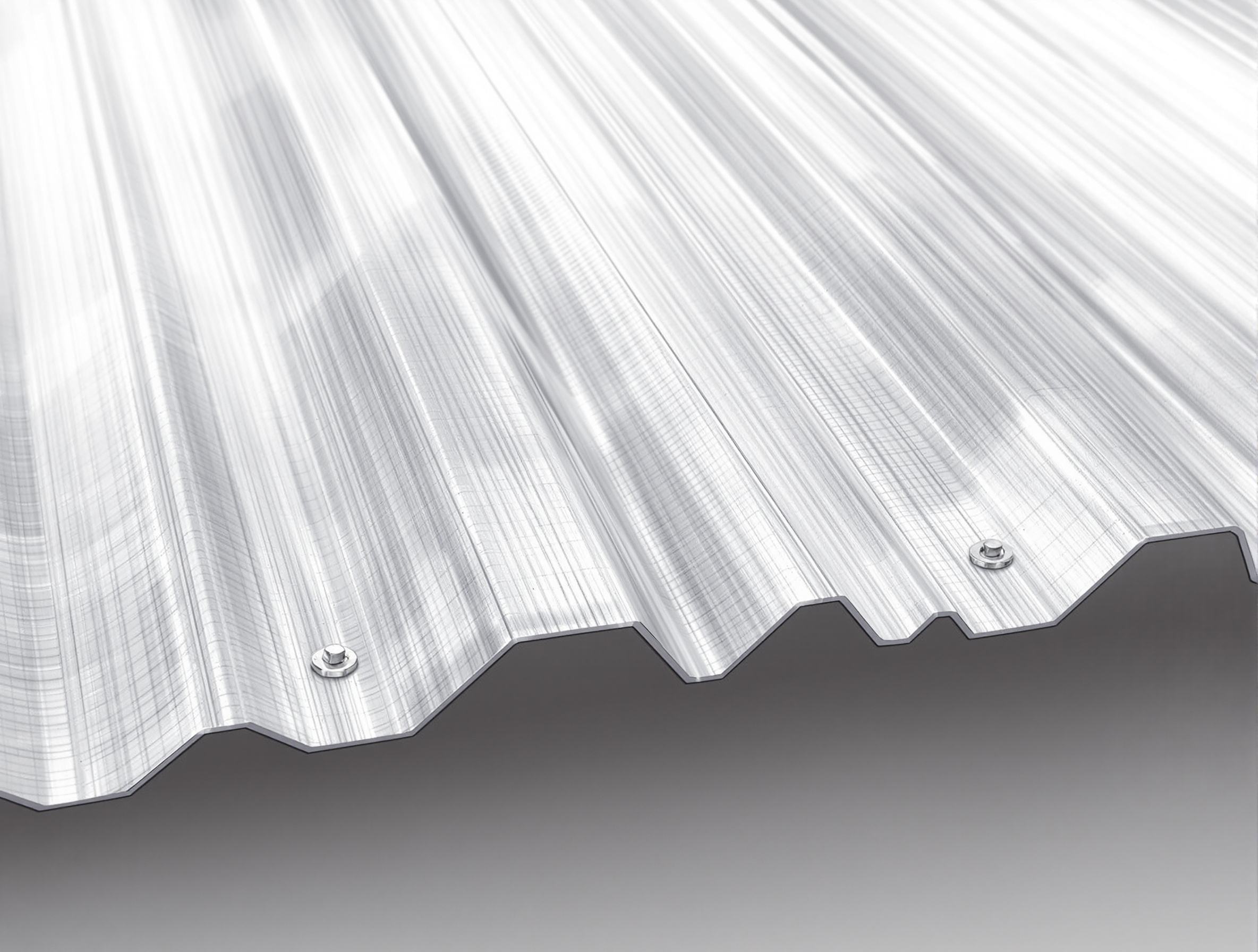
The name tells you everything. On an exposed-fastener metal roof, the screws that hold the panels down are visible on the panel surface. Each screw passes through the flat or rib of the panel, through a neoprene washerNeoprene washerA synthetic rubber gasket bonded to the underside of an exposed-fastener roofing screw head. Compresses against the panel to create a watertight seal around the screw penetration.EPDM washers last longer than standard neoprene but cost more. Some premium screws use a bonded EPDM washer with a metal cap to shield it from UV. On standing-seam roofs, this issue does not exist because fasteners are concealed.Why it matters: Neoprene degrades in UV sunlight, becoming brittle and cracking within 15-20 years. Once the washer fails, water infiltrates around the screw. This is the single biggest long-term maintenance issue with exposed-fastener metal roofs.Learn more → that compresses against the metal to form a seal, and into the roof deck or structural purlins below.
There are no clips. No concealed fastening systems. No mechanical seaming tools. The screw is the entire attachment mechanism. One screw, one washer, one point of contact between panel and structure. Multiply that by 70-80 screws per roofing square (100 square feet), and a typical 2,000 square foot roof has somewhere between 1,400 and 1,600 individual fastener penetrations.
That number is not inherently a problem. Each of those penetrations is sealed by the neoprene washer, which expands to fill the gap between the screw head and the panel surface. When properly driven — not too tight, not too loose — the washer creates a reliable water barrier. The system has worked on agricultural, commercial, and residential buildings across the Gulf Coast for over 50 years.
The engineering is straightforward: the screw provides pullout resistance against wind upliftUplift resistanceThe ability of a roof system to resist negative (suction) wind pressures that try to pull the roof off the building. Measured in pounds per square foot (psf) of pressure.Design uplift pressures are calculated from the local design wind speed, building height, roof slope, exposure category, and location on the roof (edge, corner, or field). An engineer uses ASCE 7 to determine required uplift resistance for each zone.Why it matters: Roofs fail in hurricanes primarily from uplift, not from being pushed down. Corners and edges experience 2-3x higher uplift than the field of the roof. A standing-seam system with proper clip spacing can resist 60-90+ psf of uplift.Learn more →, and the washer provides waterproofing at the penetration point. As long as both are intact, the system performs. The challenge is that neoprene is organic rubber, and organic rubber does not last forever under Gulf Coast sun.
Panel Types: Know What You Are Looking At
Not all exposed-fastener panels are the same. The profile shape, rib height, and panel width affect how the roof looks, how it performs structurally, and how it handles water. Here are the four profiles you will encounter on the Gulf Coast.
R-Panel
R-panelR-panelAn exposed-fastener metal panel with 1.25-inch-tall trapezoidal ribs on 12-inch centers. One of the most common commercial and agricultural metal roof profiles, also used on budget residential projects.R-panel can span purlins up to 5 feet apart, making it efficient for open-frame structures. For residential use over solid deck, it is functionally similar to PBR panel.Why it matters: R-panel is widely available, affordable, and structurally strong for its weight. However, as an exposed-fastener system, it requires periodic screw and washer maintenance. Typical material cost is $1.50-3.00 per square foot.Learn more → is the workhorse of exposed-fastener metal roofing. It has trapezoidal ribs standing 1.25 inches tall, spaced 12 inches apart on a 36-inch-wide panel. Originally designed for commercial and agricultural buildings, R-panel is now used extensively on residential projects where cost is the primary driver.
The tall ribs give R-panel good structural spanning capability — it can bridge purlins up to 5 feet apart on open-frame buildings. On residential projects over solid deck, that spanning strength is less relevant, but the rigid profile does resist denting and oil canning better than shallower profiles. The industrial appearance is the main drawback for residential use. R-panel looks like what it is: a commercial panel on a house.
PBR Panel
PBR (purlin-bearing rib) panelPBR panel (purlin-bearing rib)An exposed-fastener metal panel similar to R-panel but with a broader flat area at the base of each rib, providing a wider bearing surface on purlins. Rib height is typically 1.25 inches.PBR and R-panel are often confused. The main visual difference is the shape at the base of the rib: PBR has a wider flat landing, R-panel has a sharper angle. Both use the same fastening method.Why it matters: The wider bearing surface gives PBR slightly better pull-over resistance than R-panel at purlin connections. Performance difference is marginal for residential over solid deck, but meaningful for commercial purlin-frame buildings.Learn more → looks nearly identical to R-panel, and many homeowners cannot tell them apart. The difference is at the base of each rib, where PBR has a wider flat landing area. This gives the panel a broader bearing surface on purlins, which translates to slightly better pull-over resistance at the fastener point.
For residential applications over solid decking, the functional difference between R-panel and PBR is marginal. Both use the same gauge steel, the same coatings, and the same fastening pattern. PBR tends to be marginally more expensive due to the additional forming, but the price gap is typically less than $0.10 per square foot.
5V-Crimp
5V-crimp5V-crimpA traditional metal roofing panel with V-shaped ribs spaced 5 inches apart across a 24-inch-wide panel. An exposed-fastener system with a lower-profile appearance than R-panel.Historically installed with galvanized steel and exposed nails. Modern 5V-crimp is available in Galvalume with PVDF paint and uses screws with neoprene washers. Popular in Florida and coastal Alabama/Mississippi.Why it matters: 5V-crimp has a classic Gulf Coast aesthetic that many homeowners prefer over the industrial look of R-panel. However, the shallow V-ribs provide less structural rigidity, and it is more vulnerable to oil canning.Learn more → is the traditional Gulf Coast metal roof panel. The name comes from five V-shaped crimps across the 24-inch-wide panel, giving it a subtle, low-profile ribbed appearance. The ribs are much shallower than R-panel — about 0.5 inches — which creates a flatter, more residential look that blends well with cottages, ranch homes, and Craftsman-style houses.
That shallow rib profile is both the aesthetic advantage and the structural limitation. 5V-crimp does not span purlins as well as R-panel and is more prone to oil canning26-gauge steelSteel substrate measuring 0.0179 inches (0.455 mm) thick. The most common gauge for residential metal roofing across all panel types.26-gauge is the default spec from most residential metal roofing manufacturers. Thinner than 24-gauge but significantly sturdier than 29-gauge.Why it matters: Balances cost and performance for most residential applications. Adequate for standing seam and exposed-fastener panels in moderate wind zones, though 24-gauge is preferred where wind or hail risk is high.Learn more → (the visible waviness that appears in flat panel areas) because the shallow ribs do not provide as much stiffening. For residential installation over solid deck, the structural limitation matters less. The oil canning risk remains, particularly in wider panel sections and darker colors.
5V-crimp carries a certain Gulf Coast heritage. You see it on homes from Pensacola to Pass Christian to Panama City that have been standing for 30-40 years. It works. It just requires the same fastener maintenance commitment as every other exposed-fastener system.
Corrugated
Corrugated metal roofingCorrugated metal roofingMetal panels formed with a repeating sinusoidal (wave-shaped) profile, typically with 2.67-inch or 1.25-inch wave spacing. One of the oldest and simplest metal roof profiles.Modern corrugated panels are available in Galvalume with painted finishes, a major upgrade over the bare galvanized sheets of past decades. Common for porches, sheds, and budget residential roofs.Why it matters: The wave shape gives corrugated panels good strength-to-weight ratio and natural water channeling. Inexpensive and easy to install, but the overlapping side laps and exposed fasteners limit weather resistance compared to standing seam.Learn more → is the oldest metal roofing profile still in production. The repeating sinusoidal (wave-shaped) pattern provides good strength-to-weight ratio and channels water naturally. Modern corrugated panels are available in GalvalumeGalvalumeA steel coating consisting of 55% aluminum, 43.4% zinc, and 1.6% silicon by weight. Developed by Bethlehem Steel in 1972 and now the industry-standard substrate for painted metal roofing.Nearly all premium residential metal roof panels ship on a Galvalume substrate. Unpainted Galvalume should not be used within 1,500 feet of saltwater without a painted finish on top.Why it matters: Galvalume outlasts galvanized steel by 2-4x in atmospheric corrosion tests. The aluminum component provides barrier protection while zinc offers sacrificial (galvanic) protection at cut edges and scratches.Learn more → with factory-applied paint, a substantial improvement over the bare galvanized sheets that rusted out on barns and sheds in previous generations.
Corrugated panels overlap at the side laps, and those laps are sealed with sealant tape or butyl caulk plus fasteners through both layers. This creates additional penetration points and relies on sealant longevity for side-lap waterproofing. In heavy Gulf Coast rain, side-lap leaks can occur if the sealant degrades or if the lap is not properly compressed.
For residential roofing, corrugated is most commonly used on porches, carports, and secondary structures. It can be used on primary roofs, but the side-lap water management is less reliable than the interlocking side laps on R-panel and PBR.
Key Specifications at a Glance
| Specification | Typical Range | Gulf Coast Recommendation |
|---|---|---|
| Gauge (thickness) | 26-gauge or 29-gauge | 26-gauge minimum for residential; avoid 29-gauge on the coast |
| Substrate | GalvalumeGalvalumeA steel coating consisting of 55% aluminum, 43.4% zinc, and 1.6% silicon by weight. Developed by Bethlehem Steel in 1972 and now the industry-standard substrate for painted metal roofing.Nearly all premium residential metal roof panels ship on a Galvalume substrate. Unpainted Galvalume should not be used within 1,500 feet of saltwater without a painted finish on top.Why it matters: Galvalume outlasts galvanized steel by 2-4x in atmospheric corrosion tests. The aluminum component provides barrier protection while zinc offers sacrificial (galvanic) protection at cut edges and scratches.Learn more → or galvanizedGalvanized steelSteel coated with a layer of pure zinc via hot-dip galvanizing (typically G90 at 0.90 oz/ft² of zinc). The original corrosion-protection method for steel roofing.G90 is the standard coating weight. G60 (lighter zinc) is cheaper but corrodes faster. In Gulf Coast salt air, galvanized steel without paint will show white rust within a few years.Why it matters: Less corrosion-resistant than Galvalume in most atmospheric exposures. Still used for certain corrugated and 5V-crimp panels, but Galvalume has largely replaced it for painted residential products.Learn more → | Galvalume for all painted panels; aluminumAluminumA lightweight, naturally corrosion-resistant metal used for roofing panels, typically in 0.032-inch or 0.040-inch thickness. Does not rust.Costs 1.5-2x more than steel panels. Softer than steel, so more prone to denting from hail. Common for standing-seam roofs on beachfront homes along the Gulf Coast.Why it matters: The best substrate choice within 1,500 feet of saltwater. Aluminum forms a stable oxide layer that resists salt-spray corrosion far better than any steel coating. Weighs about one-third as much as steel.Learn more → within 1,500 ft of saltwater |
| Paint system | SMPSMP (silicone-modified polyester)A mid-tier paint system for metal roofing that adds silicone to a polyester base for improved UV and chalk resistance compared to standard polyester. Less durable than PVDF.SMP is the standard coating on most exposed-fastener panels (R-panel, PBR, 5V-crimp). If a contractor quotes a standing-seam roof with SMP paint, ask why they are not using PVDF.Why it matters: SMP costs 15-25% less than PVDF and performs well for 15-20 years. Acceptable for budget-conscious projects, but expect earlier fading and chalking in intense Gulf Coast sun.Learn more → or PVDFPVDF (polyvinylidene fluoride)A resin-based paint system containing 70% PVDF resin (by weight of total resin solids). The highest-performance paint coating available for metal roofing. Kynar 500 and Hylar 5000 are the two licensed PVDF formulations.A true PVDF coating must contain at least 70% PVDF resin. Some manufacturers use 50% blends and market them misleadingly. Always confirm the 70% specification.Why it matters: PVDF coatings resist chalking, fading, and chemical degradation far longer than SMP or acrylic. Expect 30-40 years of color retention in full Gulf Coast sun. This is what separates a premium metal roof from a budget one.Learn more → | PVDF (Kynar) for maximum color retention; SMP acceptable for budget projects |
| Attachment method | Exposed screws with neoprene washers | Stainless steel screws within 2,500 ft of saltwater |
| Fastener density | 70-80 per square (100 sq ft) | Increase in edge and corner wind zones per engineering |
| Installed cost | $4-8 per sq ft | Higher end for PVDF-coated, 26-gauge, stainless fasteners |
| Expected lifespan | 25-40 years | Dependent on fastener maintenance at 15 and 25 year marks |
The Advantages — and They Are Real
Affordability. This is the primary reason exposed-fastener metal roofing exists in the residential market. At $4-8 per square foot installed, it costs roughly half of what standing seam costs. For a 2,000 square foot roof, that is a $10,000-20,000 difference. That is not trivial. It is the difference between affording a metal roof and not affording one for many Gulf Coast homeowners.
Simpler installation. Exposed-fastener panels do not require specialized seaming tools, clip systems, or the same level of installer training that standing seam demands. A competent crew can install an exposed-fastener roof in 2-3 days on a typical residential home. Standing seam takes 4-7 days. Less labor time means lower labor cost, which is a significant portion of the total project price.
Wide availability. Every metal roofing supplier on the Gulf Coast stocks R-panel, PBR, and 5V-crimp. Many can roll-form panels on-site to custom lengths, eliminating the need for horizontal seams on long roof runs. You are never waiting 6 weeks for a specialty order. Panels are available today.
Proven performance. Exposed-fastener metal roofs have been on Gulf Coast buildings through Hurricanes Katrina, Ivan, Michael, Sally, and every named storm for the past 50 years. They work. The panels do not blow off when properly fastened. The screws hold. The system performs — as long as the washers are maintained and the installation was done right in the first place.
Easy repairs. If a panel is damaged — by a fallen tree limb, hail, or foot traffic — you can replace individual panels without disturbing the rest of the roof. Remove the screws, pull the damaged panel, slide in a new one, re-screw. A standing-seam replacement involves un-seaming and re-seaming adjacent panels, which is significantly more complex.
Color and profile options. Exposed-fastener panels are available in the same KynarKynar 500A brand name for 70% PVDF resin manufactured by Arkema. Licensed to coil coaters who apply it to metal roofing substrates. Kynar 500 and Hylar 5000 (by Solvay) are the only two licensed PVDF resins.'Kynar' and 'PVDF' are often used interchangeably in the roofing industry. The key spec is 70% PVDF resin content regardless of brand name.Why it matters: Kynar is the industry gold standard for color retention and weathering resistance. A Kynar-coated metal roof typically carries a 30-35 year paint warranty against fading and chalking.Learn more →/PVDF color palette as standing seam. You are not giving up color choice by choosing exposed-fastener. The profile options (R-panel, PBR, 5V-crimp, corrugated) also give you more variety in how the roof looks, from industrial-modern to traditional Gulf Coast cottage.
The Limitations — Honestly
Every roofing system has tradeoffs. The honest limitations of exposed-fastener metal roofing are not reasons to avoid it — they are reasons to go in with open eyes.
Neoprene washer degradation. This is the big one. NeopreneNeoprene washerA synthetic rubber gasket bonded to the underside of an exposed-fastener roofing screw head. Compresses against the panel to create a watertight seal around the screw penetration.EPDM washers last longer than standard neoprene but cost more. Some premium screws use a bonded EPDM washer with a metal cap to shield it from UV. On standing-seam roofs, this issue does not exist because fasteners are concealed.Why it matters: Neoprene degrades in UV sunlight, becoming brittle and cracking within 15-20 years. Once the washer fails, water infiltrates around the screw. This is the single biggest long-term maintenance issue with exposed-fastener metal roofs.Learn more → is a synthetic rubber compound that performs well when new but breaks down under prolonged UV exposure. On the Gulf Coast, where direct sun intensity is among the highest in the continental U.S., neoprene washers typically last 15-20 years before they harden, crack, and lose their seal. When the seal fails, water enters around the screw shaft. This is not a defect — it is the expected lifecycle of the material. Our exposed-fastener maintenance guide details the full degradation timeline and inspection schedule.
Fastener maintenance is required, not optional. At the 15-year mark, you need to budget for a fastener maintenance cycle. A roofer walks the roof, inspects every screw, re-drives any that have backed out, and replaces washers that show cracking or hardening. This costs $1,500-3,000 for a typical residential roof, depending on access difficulty and roof size. If you skip this step, you will get leaks. Period.
Thermal stress on screw holes. Metal panels expand and contract with temperature changes. A 20-foot steel panel can grow and shrink by roughly 1/4 inch across a 100-degree temperature swing. On a standing-seam roof, floating clipsConcealed clipA metal bracket that fastens to the roof deck and holds a standing-seam panel in place without penetrating the panel surface. The clip is hidden beneath the seam after panels are joined.Clip type (fixed vs. floating), material (stainless steel vs. galvanized), and spacing (12-24 inches on center) directly affect wind-uplift performance. Closer clip spacing = higher uplift rating.Why it matters: Clips allow panels to expand and contract with temperature changes (a 20-foot steel panel can move 1/4 inch across a 100°F swing). Without clips, thermal cycling causes oil canning, buckling, and fastener stress.Learn more → accommodate this movement. On an exposed-fastener roof, the screws are fixed in place, and the panel moves around them. Over thousands of thermal cycles, the screw holes can elongate slightly, loosening the washer compression. This is another reason fastener inspection matters.
Lower wind-uplift resistance compared to standing seam. Exposed fasteners provide good uplift resistanceUplift resistanceThe ability of a roof system to resist negative (suction) wind pressures that try to pull the roof off the building. Measured in pounds per square foot (psf) of pressure.Design uplift pressures are calculated from the local design wind speed, building height, roof slope, exposure category, and location on the roof (edge, corner, or field). An engineer uses ASCE 7 to determine required uplift resistance for each zone.Why it matters: Roofs fail in hurricanes primarily from uplift, not from being pushed down. Corners and edges experience 2-3x higher uplift than the field of the roof. A standing-seam system with proper clip spacing can resist 60-90+ psf of uplift.Learn more →, but they rely on screw pullout strength from the deck. Standing-seam systems with engineered clip spacing achieve higher uplift ratings per square foot. In extreme wind zonesWind zoneA geographic classification based on design wind speeds, used by building codes and insurers to determine roofing requirements. The Gulf Coast spans wind zones from 115 mph inland to 180 mph in coastal South Florida.ASCE 7-22 maps define ultimate design wind speeds (3-second gust) for every location. Coastal Mississippi, Alabama, and the Florida Panhandle are typically 140-160 mph zones. Check your exact address at the ASCE Hazard Tool.Why it matters: Your wind zone determines the minimum uplift rating, fastener schedule, and product approvals required for your roof. Higher wind zones require closer clip spacing, thicker gauge, and mechanical-lock seams.Learn more → (150+ mph design wind speed), standing seam with mechanical-lock seams is the stronger system. Exposed-fastener systems can be engineered for high-wind zones by increasing screw count in edge and corner zones, but there are limits. See our exposed-fastener wind performance analysis for tested uplift data by screw pattern.
Aesthetic perception. Some homeowners and HOAs view exposed-fastener roofing as a commercial or agricultural product. Visible screw heads across the panel surface do create a different look than the clean lines of standing seam. Whether that matters depends on the house, the neighborhood, and the homeowner. 5V-crimp minimizes this concern better than R-panel.
The Fastener Lifecycle: What Actually Happens Over Time
Understanding how fasteners age is the key to owning an exposed-fastener roof without frustration. Here is the progression, year by year, on a Gulf Coast installation.
Years 1-5: New condition. The neoprene washer is flexible, compressed evenly against the panel surface, and fully sealed. The screw head sits flush. No water entry. No maintenance needed beyond a visual inspection after major storms. This is the honeymoon period, and it is genuinely trouble-free.
Years 5-10: Early aging. UV exposure begins to affect the surface of the neoprene. You might notice slight discoloration — the washer changes from its original black to a grayish tone. The rubber is still flexible and still sealing, but the molecular structure is beginning to cross-link and stiffen. No action needed yet, but this is a good time to do your first close-up inspection to establish a baseline.
Years 10-15: Hardening phase. The neoprene has stiffened noticeably. If you press on a washer with your fingernail, it does not spring back the way it did when new. Some washers on the south-facing and west-facing slopes (highest UV exposure) may show hairline surface cracks. The seal is still mostly intact, but the safety margin is shrinking. This is the early warning zone. Some proactive homeowners schedule their first maintenance cycle at year 12-15.
Years 15-20: Critical window. This is when maintenance becomes essential. Neoprene washers on sun-exposed faces are cracked, hardened, and no longer compressing against the panel with enough force to resist wind-driven rain. Some screws may have backed out 1/8 to 1/4 inch due to thermal cycling and vibration from wind events. Water is finding its way past the worst washers on every heavy rain. This is not catastrophic failure — it is a trickle, not a flood — but the underlaymentUnderlaymentA secondary water-resistant layer installed on the roof deck beneath metal panels. Types include synthetic (polypropylene), felt (asphalt-saturated), and self-adhering (peel-and-stick) membranes.Synthetic underlayment (like GAF FeltBuster or Sharkskin) is the modern standard. It does not absorb water, resists tearing, and provides a slip-resistant surface during installation. For standing seam, a high-temperature synthetic is recommended to handle heat buildup.Why it matters: Underlayment is your backup waterproofing if wind-driven rain gets past the metal panels. Florida Building Code requires underlayment on all steep-slope metal roofs. In the Enhanced Hurricane Protection Area, self-adhering underlayment is required.Learn more → is now doing the waterproofing that the washers should be doing. Schedule the maintenance cycle now.
Years 20-30: Post-maintenance life. After a proper fastener maintenance cycle at year 15-20 (new washers, re-driven screws, replaced damaged fasteners), the clock resets. The panels themselves are fine — Galvalume steel with PVDF paint is still going strong. You get another 10-15 years before the next washer cycle. If you did two maintenance cycles (year 15 and year 25), the panels can carry you to 35-40 years.
Years 30-40: End of economic life. The panels are thinning at the washer holes from repeated screw removal and replacement. The coating may be showing age on the most exposed areas. A third fastener cycle is possible but starts to approach the cost of a new roof. Most homeowners replace the roof at this point rather than investing in a third round of maintenance on aging panels.
Gulf Coast Considerations
The Gulf Coast environment presents specific challenges that affect exposed-fastener roofing differently than it affects standing seam.
Salt Air and Fasteners
Standard zinc-aluminum coated (ZAC) roof screws perform well inland, but they corrode rapidly in salt-laden coastal air. Within 1 mile of the shoreline, you will see rust streaks from corroding screw heads within 3-5 years if standard fasteners were used. The fix is simple but non-negotiable: specify stainless steel fasteners (Type 304 minimum, Type 316 preferred) for any exposed-fastener installation within 2,500 feet of saltwater. Our coastal fastener guide covers material recommendations by distance from saltwater.
Stainless steel screws cost 3-4 times more than standard ZAC screws, but screws are a small fraction of total roof cost. Upgrading to stainless on a 2,000 square foot roof adds $300-600 to the material cost. Failing to upgrade can result in every screw on the roof corroding and losing clamping force within a decade — a far more expensive problem to fix after the fact.
Panel Substrate Selection Near the Coast
Within 1,500 feet of saltwater, the corrosion zoneCorrosion zoneA geographic classification based on proximity to saltwater and other corrosive environments. The most aggressive zone extends from the shoreline to approximately 1,500 feet inland, where airborne salt concentration is highest.ASHRAE and metal roofing manufacturers define corrosion zones at 1,500 feet, 2,500 feet, and beyond. Some manufacturers void their warranty within the most aggressive zone if their installation guidelines for coastal environments are not followed.Why it matters: Corrosion zone determines which metals and coatings will survive. Within 1,500 feet of the Gulf, aluminum or stainless-steel fasteners are essential, and Galvalume steel must have a high-quality PVDF paint system. Using the wrong materials leads to premature failure.Learn more → is aggressive enough that even GalvalumeGalvalumeA steel coating consisting of 55% aluminum, 43.4% zinc, and 1.6% silicon by weight. Developed by Bethlehem Steel in 1972 and now the industry-standard substrate for painted metal roofing.Nearly all premium residential metal roof panels ship on a Galvalume substrate. Unpainted Galvalume should not be used within 1,500 feet of saltwater without a painted finish on top.Why it matters: Galvalume outlasts galvanized steel by 2-4x in atmospheric corrosion tests. The aluminum component provides barrier protection while zinc offers sacrificial (galvanic) protection at cut edges and scratches.Learn more → steel panels need premium coatings. Bare or unpainted Galvalume will show white rust (aluminum oxide corrosion) within a few years in this zone. PVDF-painted Galvalume performs well, but aluminum panelsAluminumA lightweight, naturally corrosion-resistant metal used for roofing panels, typically in 0.032-inch or 0.040-inch thickness. Does not rust.Costs 1.5-2x more than steel panels. Softer than steel, so more prone to denting from hail. Common for standing-seam roofs on beachfront homes along the Gulf Coast.Why it matters: The best substrate choice within 1,500 feet of saltwater. Aluminum forms a stable oxide layer that resists salt-spray corrosion far better than any steel coating. Weighs about one-third as much as steel.Learn more → are the safest choice for direct coastal exposure. Aluminum does not rust at all — it forms a stable passive oxide layerPassive oxide layerA thin, stable, self-forming metal oxide film that protects certain metals from further corrosion. Aluminum forms aluminum oxide (Al₂O₃); stainless steel forms chromium oxide (Cr₂O₃).Steel does not form a stable passive oxide; iron oxide (rust) is porous and flakes off, exposing more steel. This is why bare steel always needs a coating or plating, while aluminum and stainless steel can perform uncoated.Why it matters: This natural oxide layer is why aluminum roofing does not rust and why stainless-steel fasteners resist corrosion in salt air. If the oxide layer is scratched, it reforms almost immediately in the presence of oxygen. No maintenance required.Learn more → that protects against salt indefinitely.
The cost premium for aluminum panels is roughly 50-80% over Galvalume steel. For a beachfront property, the math works: you avoid the risk of substrate corrosion under the paint, and you get a panel that will not degrade from salt exposure regardless of coating condition. For properties 1,500 to 2,500 feet from saltwater, PVDF-coated Galvalume with stainless fasteners is generally sufficient.
Wind Patterns and Fastener Loads
Gulf Coast design wind speedsDesign wind speedThe ultimate (3-second gust) wind speed used to calculate design wind pressures for a building at a specific location, per ASCE 7. Expressed in miles per hour (mph) for Risk Category II residential buildings.Design wind speed is not the same as sustained wind in a hurricane. The design speed is a statistical value (3-second gust with a 700-year return period for residential). Actual hurricane gusts can exceed this, which is why FORTIFIED and other above-code programs exist.Why it matters: This number drives every wind-related roofing specification: clip spacing, fastener count, panel gauge, and seam type. A home in a 150-mph design wind speed zone needs a substantially more robust roof system than one in a 115-mph zone.Learn more → range from 115 mph inland to 160+ mph on the immediate coast. Exposed-fastener systems handle wind loads through direct screw pullout resistance. The holding power of each screw depends on what it is driven into: screws into solid wood decking (typically 7/16" or 5/8" OSB over rafters) develop 200-400 pounds of pullout resistance per screw. Screws into steel purlins develop more.
In high-wind zones, the screw pattern must be engineered, not guessed. Edge zones (within 2-4 feet of the roof edge) and corner zones (where two edges intersect) experience 2-3 times the uplift pressure of the center field. An engineer specifies additional screws in these zones — sometimes doubling the fastener count — to resist the increased suction.
Humidity and Underlayment
Gulf Coast humidity sits above 70% for much of the year. Under an exposed-fastener panel, condensation can form on the underside of the metal on clear nights when the panel temperature drops below the dew point. This condensation drips onto the underlaymentUnderlaymentA secondary water-resistant layer installed on the roof deck beneath metal panels. Types include synthetic (polypropylene), felt (asphalt-saturated), and self-adhering (peel-and-stick) membranes.Synthetic underlayment (like GAF FeltBuster or Sharkskin) is the modern standard. It does not absorb water, resists tearing, and provides a slip-resistant surface during installation. For standing seam, a high-temperature synthetic is recommended to handle heat buildup.Why it matters: Underlayment is your backup waterproofing if wind-driven rain gets past the metal panels. Florida Building Code requires underlayment on all steep-slope metal roofs. In the Enhanced Hurricane Protection Area, self-adhering underlayment is required.Learn more → and, over time, can degrade felt-based underlayment.
Always specify synthetic underlayment under exposed-fastener metal roofing on the Gulf Coast. Synthetic does not absorb water, does not rot, and does not lose tensile strength when wet. For coastal installations in Florida, self-adhering ice-and-water shieldIce-and-water shieldA self-adhering, rubberized-asphalt membrane that bonds directly to the roof deck. Originally designed for ice-dam protection in cold climates, it is used on the Gulf Coast at valleys, eaves, penetrations, and as full-deck underlayment in hurricane zones.Products include Grace Ice & Water Shield, GAF StormGuard, and CertainTeed WinterGuard. Surface temperature during installation matters: most require deck temps above 40°F for proper adhesion (rarely an issue on the Gulf Coast).Why it matters: Self-adhering membrane seals around nail and screw penetrations, providing a watertight backup even if the metal panels are compromised. Florida's High Velocity Hurricane Zone (Miami-Dade, Broward) requires it across the entire deck.Learn more → may be required by the Florida Building CodeFlorida Building Code (FBC)The statewide building code for Florida, one of the most stringent in the U.S. for wind and hurricane resistance. Requires product approvals (FL numbers or Miami-Dade NOAs), specific underlayment, and testing per TAS protocols.The FBC has two tiers: the base code (statewide) and the High Velocity Hurricane Zone (HVHZ) code for Miami-Dade and Broward counties. HVHZ requires Miami-Dade NOA approvals and full self-adhering underlayment. Both are more demanding than the International Building Code.Why it matters: Any metal roof installed in Florida must comply with FBC. This means the exact panel, clip, and fastener combination must have a valid Florida product approval. Unapproved products cannot legally be installed, and insurance will not cover them.Learn more →, particularly in the Enhanced Hurricane Protection Area.
Cost: What You Will Actually Pay
Exposed-fastener metal roofing on the Gulf Coast typically costs $4-8 per square foot installed, which translates to $8,000-16,000 for a typical 2,000 square foot roof. Here is how that breaks down.
| Component | Budget Spec | Premium Spec |
|---|---|---|
| Panels | 29-ga galvanized, SMP paint — $1.50-2.50/sq ft | 26-ga Galvalume, PVDF paint — $3.00-4.50/sq ft |
| Fasteners | ZAC-coated — $0.10-0.15/sq ft | Stainless steel — $0.30-0.45/sq ft |
| Underlayment | Synthetic felt — $0.25-0.40/sq ft | Self-adhering membrane — $0.75-1.25/sq ft |
| Trim and flashing | $0.50-1.00/sq ft | $0.75-1.50/sq ft |
| Labor | $1.50-2.50/sq ft | $2.50-4.00/sq ft |
| Tear-off (if needed) | $0.50-1.00/sq ft | $0.50-1.00/sq ft |
| Total installed | $4.00-7.50/sq ft | $7.50-12.50/sq ft |
The wide range reflects the enormous specification difference between a budget installation (29-gauge galvanized with SMP paint) and a premium installation (26-gauge Galvalume with PVDF paint and stainless steel fasteners). Both are "exposed-fastener metal roofing," but they are not the same product any more than a base-model pickup truck is the same as the fully loaded version.
For Gulf Coast residential use, the sweet spot is typically 26-gauge Galvalume with SMP or PVDF paint and ZAC-coated fasteners, landing in the $5-8 per square foot installed range. Add stainless fasteners for coastal installations. Our exposed-fastener cost breakdown covers how each specification choice affects the installed price.
Who This System Is For
Exposed-fastener metal roofing makes strong financial and practical sense for specific situations.
- Shops, barns, and outbuildings where maximum weather protection at minimum cost is the goal
- Rental properties where the owner needs a durable, low-cost roof and will manage maintenance scheduling
- Budget-conscious homeowners who want metal's durability and energy benefits but cannot afford standing seam
- Homeowners who plan to sell in 10-15 years — the roof will still be in its pre-maintenance honeymoon period
- Projects where aesthetics are secondary to performance and cost
- Additions, covered porches, and carports where matching an existing roof is not a concern
- Rural properties where the agricultural aesthetic is a natural fit
Who This System Is NOT For
There are situations where exposed-fastener is the wrong call, and suggesting otherwise would be dishonest.
- Beachfront homes within 1,500 feet of saltwater — unless you specify aluminum panels with stainless fasteners, and even then, standing seam or aluminum shingles are better options in the severe marine zone
- Homeowners who want zero-maintenance roofing — if you are not willing to schedule fastener inspection and maintenance, exposed-fastener will eventually leak and you will be frustrated with the system
- HOA-restricted neighborhoods where exposed-fastener panels may not be architecturally approved
- Low-slope roofs below 3:12 pitch — exposed-fastener systems are not appropriate for low slopes because water moves too slowly across the panel surface and can back up under side laps and around fastener penetrations
- High-end homes where resale value is a priority — standing seam adds more to home value than exposed-fastener in the residential real estate market
Exposed-fastener roofs always leak.
Reality: A properly installed exposed-fastener roof with maintained fasteners can be watertight for 25-40 years. The 'leaky metal roof' reputation comes from roofs where fasteners were never maintained, washers were allowed to crack and harden, and nobody re-drove the screws that backed out over time. It also comes from poor original installation — overdriven screws that crushed the washer, off-center hits that missed the framing, and insufficient screws in the edge zones. The system does not leak. Neglect and bad installation leak.
Why do neoprene washers on exposed-fastener roofs need to be replaced every 15-20 years?
Frequently Asked Questions
How long does an exposed-fastener metal roof last on the Gulf Coast?
With proper installation and maintenance, 25-40 years. The panels themselves can last 40+ years, but the neoprene washers degrade in 15-20 years and must be replaced to prevent leaks. Homeowners who stay on top of fastener maintenance get the full lifespan. Those who ignore it often face leaks by year 18-22.
Do exposed-fastener roofs leak more than standing seam?
Not inherently. A properly installed exposed-fastener roof with maintained fasteners can be watertight for decades. The difference is that exposed-fastener systems require periodic maintenance, while standing-seam systems have no exposed penetrations to maintain. Leaks happen when homeowners neglect maintenance or when installers overdrive or underdrive screws during installation.
What is the cost difference between exposed-fastener and standing-seam metal roofing?
Exposed-fastener costs $4-8 per square foot installed versus $10-18 for standing seam — roughly 50-60% less upfront. Over 30 years, factor in one or two fastener maintenance cycles ($1,500-3,000 each) to calculate true lifetime cost. For a 2,000 square foot roof, expect $8,000-16,000 for exposed-fastener versus $20,000-36,000 for standing seam.
Can I use an exposed-fastener metal roof near the coast?
Yes, with modifications. Within 1,500 feet of saltwater, use stainless-steel fasteners (Type 304 or 316) and aluminum or PVDF-coated Galvalume panels. Standard zinc-coated screws will corrode within 3-5 years in the salt zone. Beyond 2,500 feet from saltwater, standard fastener materials are fine. Between 1,500 and 2,500 feet, stainless steel fasteners are still recommended.
How often should I inspect the fasteners on my exposed-fastener metal roof?
Inspect annually, particularly after hurricane season. Walk the roof or use binoculars from the ground to look for backed-out screws, cracked washers, or rust streaks around fastener heads. Plan for a full fastener maintenance cycle at the 15-year mark, and again around year 25-30 if you intend to keep the roof past 30 years.
What is the best exposed-fastener panel type for a home on the Gulf Coast?
For residential use, 5V-crimp and PBR panel are the most popular. 5V-crimp has a traditional Gulf Coast aesthetic and a lower profile many homeowners prefer. PBR offers slightly better structural performance with its wider purlin-bearing rib. Both should be specified in 26-gauge26-gauge steelSteel substrate measuring 0.0179 inches (0.455 mm) thick. The most common gauge for residential metal roofing across all panel types.26-gauge is the default spec from most residential metal roofing manufacturers. Thinner than 24-gauge but significantly sturdier than 29-gauge.Why it matters: Balances cost and performance for most residential applications. Adequate for standing seam and exposed-fastener panels in moderate wind zones, though 24-gauge is preferred where wind or hail risk is high.Learn more → Galvalume with a PVDF paint finish for coastal longevity. Avoid 29-gauge29-gauge steelSteel substrate measuring 0.0141 inches (0.358 mm) thick. The thinnest gauge used in residential metal roofing, typically for exposed-fastener panels.Common on agricultural buildings and budget residential projects. Many standing-seam manufacturers do not offer 29-gauge panels. If a quote seems unusually cheap, check whether 29-gauge is spec'd.Why it matters: The lowest-cost option but the most vulnerable to denting, oil canning, and fastener pull-through in high winds. Not recommended for coastal or hurricane-prone areas along the Gulf Coast.Learn more → for any coastal application.