Metal Roofing Near the Coast: The Complete Corrosion and Material Guide
Yes, metal roofing works near the coast — but the wrong specification can fail within 5-10 years. Distance from saltwater determines everything: your substrate, coating, and fastener choices. This guide covers the corrosion science, the material options, and the specific recommendations for every distance zone along the Gulf Coast.
What Salt Air Actually Does to Metal
The Gulf of Mexico is warm, humid, and generates a constant supply of airborne salt particles. When wind carries salt-laden moisture inland, those microscopic sodium chloride crystals settle on every exposed surface — including your roof. What happens next depends entirely on what your roof is made of.
Corrosion is an electrochemical process. When salt crystals dissolve in moisture (rain, dew, coastal fog), they create an electrolyte solution on the metal surface. This electrolyte accelerates the natural tendency of metals to return to their oxide state. Iron wants to become iron oxide (rust). Zinc wants to become zinc oxide (white rust). The chloride ions in salt water are particularly aggressive because they penetrate and destabilize the protective films that metals form on their surfaces.
Three specific corrosion mechanisms matter for metal roofing on the Gulf Coast:
Uniform atmospheric corrosion is the steady, surface-wide degradation that occurs when salt-laden moisture contacts unprotected metal. The rate depends on salt concentration, time of wetness (how long the surface stays damp), and temperature. Gulf Coast conditions are among the most aggressive in the continental United States because of high humidity, warm temperatures, and persistent onshore winds.
Galvanic corrosionGalvanic corrosionAccelerated corrosion that occurs when two dissimilar metals are in direct electrical contact in the presence of an electrolyte (moisture). The more reactive (anodic) metal corrodes preferentially.The galvanic series ranks metals from anodic (corrodes first) to cathodic (protected). Zinc and aluminum are anodic to steel. Copper is cathodic to most metals. Always use fasteners of the same metal as the panel, or use stainless steel, which is compatible with both.Why it matters: A common installation mistake: using plain steel fasteners on aluminum panels, or copper flashing touching a steel roof. The dissimilar metals create a battery effect, and one metal rapidly corrodes. In Gulf Coast humidity, this happens fast.Learn more → occurs when two dissimilar metals are in contact in the presence of an electrolyte. In roofing, this typically happens when the wrong fastener material is paired with the panel substrate. A carbon-steel screw in an aluminum panel creates a galvanic cell where the aluminum corrodes preferentially around the fastener hole — exactly the worst place for material loss. In salt air, this process accelerates dramatically.
Crevice corrosion develops in tight gaps where moisture gets trapped but oxygen is limited — under lap joints, around fastener washers, and at panel-to-flashing connections. Salt concentration inside crevices can reach 10 times the level on exposed surfaces because evaporation concentrates the chlorides while fresh salt spray keeps adding more. This is why exposed-fastener panels are more vulnerable to coastal corrosion than standing-seam systems: every screw penetration is a potential crevice site. Our coastal fastener guide covers the material specifications that prevent this failure mode.
Corrosion Zone Classification for the Gulf Coast
Metal roofing manufacturers and building scientists classify coastal environments into corrosion zonesCorrosion zoneA geographic classification based on proximity to saltwater and other corrosive environments. The most aggressive zone extends from the shoreline to approximately 1,500 feet inland, where airborne salt concentration is highest.ASHRAE and metal roofing manufacturers define corrosion zones at 1,500 feet, 2,500 feet, and beyond. Some manufacturers void their warranty within the most aggressive zone if their installation guidelines for coastal environments are not followed.Why it matters: Corrosion zone determines which metals and coatings will survive. Within 1,500 feet of the Gulf, aluminum or stainless-steel fasteners are essential, and Galvalume steel must have a high-quality PVDF paint system. Using the wrong materials leads to premature failure.Learn more → based on distance from saltwater. These zones are not arbitrary — they reflect measured differences in airborne salt concentration that directly affect how long different materials will last.
Along the Gulf Coast from South Mississippi through South Alabama and the Florida Panhandle, three zones define your material requirements:
Severe Corrosion Zone: Within 1,500 Feet of Saltwater
This is the most demanding environment for any building material. Airborne salt concentrations within 1,500 feet of the Gulf shoreline are high enough to cause visible corrosion on unprotected steel within months, not years. Homes on the beach, on barrier islands, or along coastal bayous with saltwater influence fall in this zone.
Requirements in the severe zone:
- AluminumAluminumA lightweight, naturally corrosion-resistant metal used for roofing panels, typically in 0.032-inch or 0.040-inch thickness. Does not rust.Costs 1.5-2x more than steel panels. Softer than steel, so more prone to denting from hail. Common for standing-seam roofs on beachfront homes along the Gulf Coast.Why it matters: The best substrate choice within 1,500 feet of saltwater. Aluminum forms a stable oxide layer that resists salt-spray corrosion far better than any steel coating. Weighs about one-third as much as steel.Learn more → substrate is required. Steel substrates — even GalvalumeGalvalumeA steel coating consisting of 55% aluminum, 43.4% zinc, and 1.6% silicon by weight. Developed by Bethlehem Steel in 1972 and now the industry-standard substrate for painted metal roofing.Nearly all premium residential metal roof panels ship on a Galvalume substrate. Unpainted Galvalume should not be used within 1,500 feet of saltwater without a painted finish on top.Why it matters: Galvalume outlasts galvanized steel by 2-4x in atmospheric corrosion tests. The aluminum component provides barrier protection while zinc offers sacrificial (galvanic) protection at cut edges and scratches.Learn more → — cannot reliably withstand the salt concentration at this distance. Aluminum forms a stable passive oxide layerPassive oxide layerA thin, stable, self-forming metal oxide film that protects certain metals from further corrosion. Aluminum forms aluminum oxide (Al₂O₃); stainless steel forms chromium oxide (Cr₂O₃).Steel does not form a stable passive oxide; iron oxide (rust) is porous and flakes off, exposing more steel. This is why bare steel always needs a coating or plating, while aluminum and stainless steel can perform uncoated.Why it matters: This natural oxide layer is why aluminum roofing does not rust and why stainless-steel fasteners resist corrosion in salt air. If the oxide layer is scratched, it reforms almost immediately in the presence of oxygen. No maintenance required.Learn more → that resists chloride attack and self-heals when scratched.
- PVDFPVDF (polyvinylidene fluoride)A resin-based paint system containing 70% PVDF resin (by weight of total resin solids). The highest-performance paint coating available for metal roofing. Kynar 500 and Hylar 5000 are the two licensed PVDF formulations.A true PVDF coating must contain at least 70% PVDF resin. Some manufacturers use 50% blends and market them misleadingly. Always confirm the 70% specification.Why it matters: PVDF coatings resist chalking, fading, and chemical degradation far longer than SMP or acrylic. Expect 30-40 years of color retention in full Gulf Coast sun. This is what separates a premium metal roof from a budget one.Learn more → coating is required. The 70% PVDF resin system (Kynar 500 or Hylar 5000) provides the chemical resistance and UV stability needed in direct coastal exposure. SMPSMP (silicone-modified polyester)A mid-tier paint system for metal roofing that adds silicone to a polyester base for improved UV and chalk resistance compared to standard polyester. Less durable than PVDF.SMP is the standard coating on most exposed-fastener panels (R-panel, PBR, 5V-crimp). If a contractor quotes a standing-seam roof with SMP paint, ask why they are not using PVDF.Why it matters: SMP costs 15-25% less than PVDF and performs well for 15-20 years. Acceptable for budget-conscious projects, but expect earlier fading and chalking in intense Gulf Coast sun.Learn more → coatings will chalk and degrade within 8-12 years at this distance.
- Stainless steel fasteners are required. Type 304 stainless at minimum; Type 316 stainless is preferred for its molybdenum content, which specifically resists chloride pitting.
- All flashing and trim must be aluminum or stainless steel. A single piece of galvanized flashing can create a galvanic corrosion point that streaks rust across an otherwise perfect roof.
Moderate Corrosion Zone: 1,500 Feet to 1 Mile from Saltwater
Salt concentration drops significantly beyond 1,500 feet, but it remains elevated compared to inland locations. Vegetation, buildings, and topography between your home and the water provide some buffering, but onshore winds can carry meaningful salt loads to this distance — especially during storms.
Requirements in the moderate zone:
- Galvalume substrate is acceptable. The aluminum-zinc alloy coating provides adequate barrier and sacrificial protection at this distance when combined with a quality paint system. Aluminum remains the premium option for maximum longevity.
- PVDF coating is strongly recommended. While some manufacturers allow SMP at this distance, PVDF provides meaningfully better chalking and chemical resistance in elevated salt environments. The 15-25% cost premium for PVDF is worth it for 10-15 additional years of color retention.
- Stainless or high-quality coated fasteners. Type 304 stainless is ideal. Premium ZAC-coated (zinc-aluminum-ceramic) fasteners are acceptable if budget is constrained, but they will not last as long as stainless in this zone.
Standard Zone: 1 Mile or More Inland
Beyond one mile from saltwater, airborne salt concentration drops to levels that standard metal roofing specifications can handle comfortably. Gulf Coast humidity and rainfall still create a more demanding environment than arid inland regions, but material selection is not as constrained.
Standard zone specifications:
- Galvalume substrate is standard. The industry-standard substrate for painted metal roofing performs well at this distance with any quality paint system.
- SMP coating is acceptable. SMP provides good performance for 15-20 years at standard coastal distances. PVDF remains the better long-term value for homeowners planning to stay in the home.
- Standard coated fasteners are acceptable. ZAC-coated or mechanically galvanized fasteners provide adequate corrosion resistance beyond one mile from saltwater. Stainless remains a quality upgrade but is not essential.
Corrosion Timeline Simulator
Select your conditions, then scrub the timeline to see how the panel degrades over 30 years.
Substrate Comparison: Aluminum vs Galvalume vs Galvanized
The substrate — the base metal beneath the paint — is the foundation of your roof's corrosion resistance. No coating lasts forever, and when it eventually wears thin, the substrate determines whether your roof develops surface staining or structural failure.
Coastal Metal Roof Substrate Comparison
| Criteria | Aluminum | Galvalume | Galvanized Steel |
|---|---|---|---|
| Corrosion Resistance | ✓ Excellent — naturally forms protective oxide Aluminum oxide (Al2O3) is stable and self-healing. Even deep scratches re-passivate within hours in normal atmosphere. | Very good — aluminum-zinc barrier + sacrificial protection The 55% aluminum / 43.4% zinc / 1.6% silicon alloy provides dual protection: barrier coating plus galvanic self-healing at cut edges. | Moderate — zinc sacrificial layer only Pure zinc coating (G90 = 0.90 oz/ft2) corrodes preferentially to protect steel, but depletes faster in salt-laden environments. |
| Cost (per sq ft installed) | $7.50 - $12.00 Premium pricing reflects raw material cost and limited panel availability. Standing-seam aluminum panels run 50-100% more than equivalent steel. | ✓ $4.50 - $8.00 The most cost-effective option for mid-range and premium installations. Widely available in all panel profiles. | $3.00 - $5.50 Lowest upfront cost, but shorter lifespan in coastal environments can make total cost of ownership higher. |
| Weight (26-gauge equivalent) | ✓ ~0.5 lb/ft2 One-third the weight of steel panels. Ideal for older structures or where reducing dead load matters. | ~1.1 lb/ft2 Standard weight for residential metal roofing. No structural concerns on any properly framed roof. | ~1.2 lb/ft2 Slightly heavier due to thicker zinc coating weight. Still lighter than asphalt shingles (2-4 lb/ft2). |
| Structural Strength | Lower — softer, dent-prone Aluminum is about 1/3 as strong as steel at the same thickness. More susceptible to hail denting and foot-traffic damage during installation. | ✓ High — steel core Full structural strength of carbon steel. Resists denting, foot traffic, and wind-pressure deflection. | ✓ High — steel core Same steel core strength as Galvalume. The zinc coating does not affect structural properties. |
| Severe Coastal Zone (< 1,500 ft) | ✓ Required Within 1,500 feet of saltwater, aluminum substrate is the only material most manufacturers will warranty without restriction. | Not recommended Galvalume can corrode at cut edges in severe salt exposure. Some manufacturers void coastal warranties within 1,500 feet. | Will fail prematurely Pure zinc coatings deplete rapidly in concentrated salt air. Expect visible corrosion within 5-10 years. |
| Moderate Coastal Zone (1,500 ft - 1 mi) | ✓ Excellent — best option | Acceptable with PVDF coating Galvalume performs well at this distance when protected by a high-quality 70% PVDF paint system. Must use stainless or premium coated fasteners. | Poor — not recommended Zinc depletion still accelerated at this distance. Higher risk of red rust within 10-15 years. |
| Availability | Limited — special order Most roll formers stock steel, not aluminum. Lead times of 2-4 weeks are common for aluminum panels. | ✓ Widely available Standard inventory at virtually all metal roofing suppliers. Available in every panel profile and color. | Available Stocked by most suppliers, though declining in popularity for residential applications as Galvalume has become the standard. |
Corrosion Resistance
Cost (per sq ft installed)
Weight (26-gauge equivalent)
Structural Strength
Severe Coastal Zone (< 1,500 ft)
Moderate Coastal Zone (1,500 ft - 1 mi)
Availability
Aluminum is the clear winner for severe coastal exposure. It does not rely on a sacrificial coating for corrosion protection — the metal itself forms a stable, self-healing aluminum oxide layer that resists chloride attack. The tradeoffs are cost (50-100% more than steel) and softness (more susceptible to hail denting). For beachfront homes, those tradeoffs are worth it.
Galvalume is the workhorse of residential metal roofing. Its 55% aluminum / 43.4% zinc / 1.6% silicon alloy coating provides dual protection: the aluminum component acts as a barrier, while the zinc provides sacrificial protection at cut edges and scratches. Combined with a PVDF paint system, Galvalume performs well from about 1,500 feet from the coast and beyond. It is the best value for most Gulf Coast homeowners who are not directly on the waterfront.
Galvanized steelGalvanized steelSteel coated with a layer of pure zinc via hot-dip galvanizing (typically G90 at 0.90 oz/ft² of zinc). The original corrosion-protection method for steel roofing.G90 is the standard coating weight. G60 (lighter zinc) is cheaper but corrodes faster. In Gulf Coast salt air, galvanized steel without paint will show white rust within a few years.Why it matters: Less corrosion-resistant than Galvalume in most atmospheric exposures. Still used for certain corrugated and 5V-crimp panels, but Galvalume has largely replaced it for painted residential products.Learn more → relies entirely on its zinc coating for corrosion protection. In salt air, zinc depletes faster than it can protect the underlying steel. For coastal Gulf Coast applications, galvanized steel is the weakest option. It still has a place on agricultural buildings and inland budget projects, but it should not be specified for homes within 5 miles of saltwater unless the homeowner fully understands the shorter expected life. Our complete substrate comparison covers the detailed performance data for each material.
Coating Performance: PVDF vs SMP in Coastal Conditions
The paint system is your roof's first line of defense against salt air, UV radiation, and moisture. Two coating technologies dominate residential metal roofing:
PVDF (polyvinylidene fluoride) coatings contain at least 70% PVDF resin, sold under the brand names Kynar 500Kynar 500A brand name for 70% PVDF resin manufactured by Arkema. Licensed to coil coaters who apply it to metal roofing substrates. Kynar 500 and Hylar 5000 (by Solvay) are the only two licensed PVDF resins.'Kynar' and 'PVDF' are often used interchangeably in the roofing industry. The key spec is 70% PVDF resin content regardless of brand name.Why it matters: Kynar is the industry gold standard for color retention and weathering resistance. A Kynar-coated metal roof typically carries a 30-35 year paint warranty against fading and chalking.Learn more → (Arkema) and Hylar 5000 (Solvay). PVDF's carbon-fluorine bonds are among the strongest in organic chemistry, giving it exceptional resistance to UV degradation, chemical attack, and chalking. In coastal environments, PVDF resists salt-spray degradation for 4,000+ hours in accelerated testing (ASTM B117). On real Gulf Coast roofs, PVDF coatings routinely maintain their color and gloss for 25-35 years. See our PVDF vs SMP coating comparison for the complete weathering timeline.
SMP (silicone-modified polyester) coatings add silicone to a polyester base for improved UV resistance compared to standard polyester. SMP costs 15-25% less than PVDF and performs adequately for 15-20 years in standard coastal environments (1+ miles from saltwater). However, in elevated salt exposure, SMP's polyester backbone degrades faster. Chalking becomes visible by year 8-12 in moderate coastal zones, and the coating's ability to protect the substrate diminishes accordingly.
The decision is straightforward for coastal homes: Use PVDF within 5 miles of saltwater. The cost difference on a typical 2,000 sq ft roof is $800-1,500 — a small fraction of total project cost for potentially 10-15 additional years of coating life.
Fastener Material: The Weakest-Link Problem
A metal roof is a system, and every system is only as durable as its weakest component. On too many coastal homes, the weakest component is the fastener.
Standard roofing fasteners are carbon steel with a zinc or ZAC (zinc-aluminum-ceramic) coating. These coatings are thin — typically 5-15 microns — and deplete quickly in salt air. Within 1,500 feet of saltwater, standard coated fasteners can show visible rust within 3-5 years. At that point, you have rust streaks running down an otherwise perfect roof, and every corroding fastener is losing clamping force and creating a potential leak point.
Stainless steel fasteners solve this problem permanently. Type 304 stainless steel contains 18% chromium, which forms a chromium oxide passive layer similar to aluminum's protective oxide. Type 316 stainless adds 2-3% molybdenum for enhanced resistance to chloride pitting — the specific corrosion mechanism that salt air causes.
The cost premium for stainless fasteners is modest in the context of a full roof installation. A typical standing-seam roof uses 200-400 clips and associated screws; upgrading to stainless adds $200-600 to the project. An exposed-fastener roof uses 2,000-4,000 screws; stainless adds $400-1,200. Relative to a $15,000-30,000 roof, this is a 1-4% cost increase for a component that prevents the single most visible corrosion failure.
Fastener material also matters for galvanic compatibilityGalvanic corrosionAccelerated corrosion that occurs when two dissimilar metals are in direct electrical contact in the presence of an electrolyte (moisture). The more reactive (anodic) metal corrodes preferentially.The galvanic series ranks metals from anodic (corrodes first) to cathodic (protected). Zinc and aluminum are anodic to steel. Copper is cathodic to most metals. Always use fasteners of the same metal as the panel, or use stainless steel, which is compatible with both.Why it matters: A common installation mistake: using plain steel fasteners on aluminum panels, or copper flashing touching a steel roof. The dissimilar metals create a battery effect, and one metal rapidly corrodes. In Gulf Coast humidity, this happens fast.Learn more →. A carbon-steel fastener in an aluminum panel creates a galvanic couple that accelerates corrosion at the hole. Stainless steel is galvanically compatible with both aluminum and steel panels, making it the safest universal choice in coastal environments.
Recognizing Early Corrosion: What to Look For
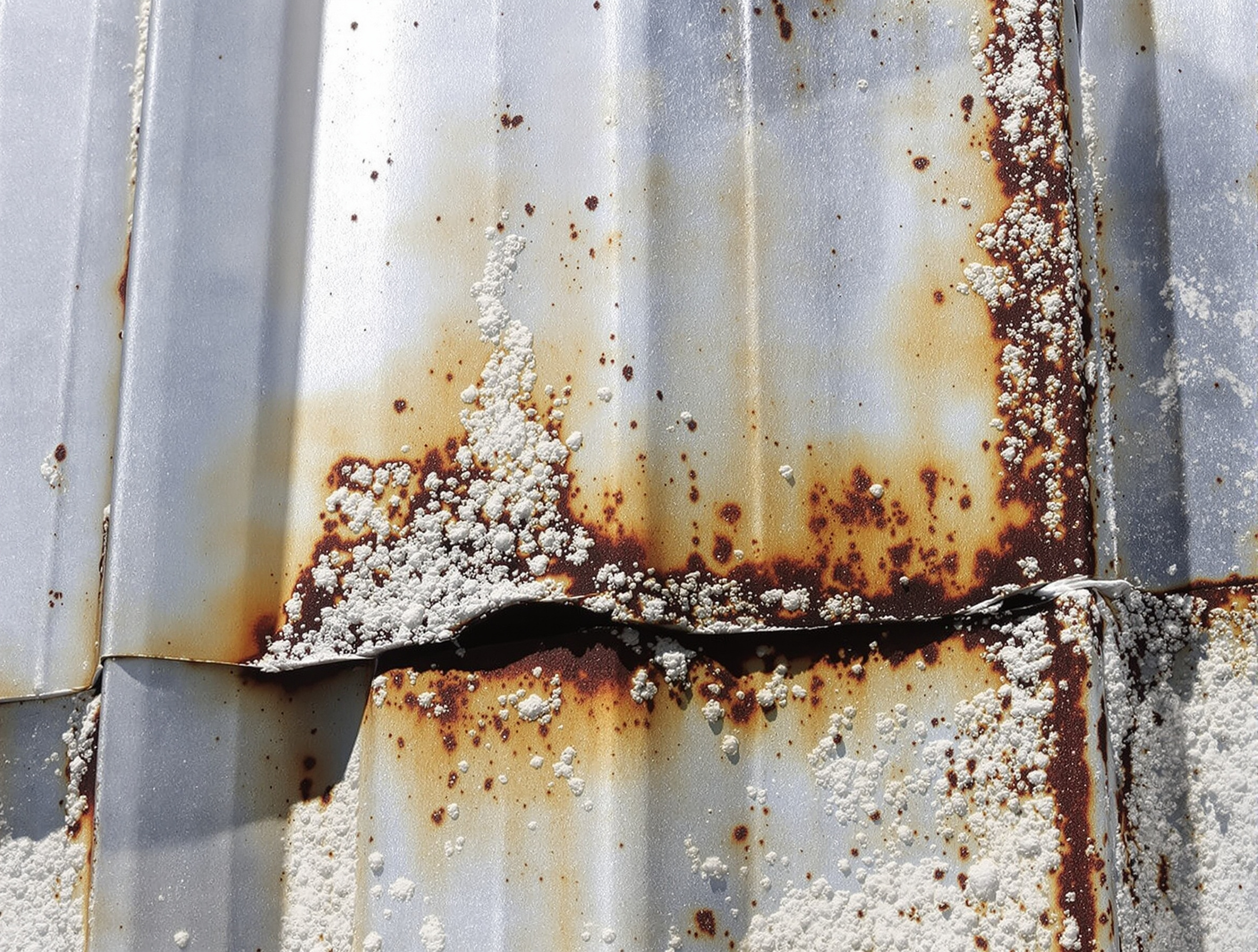
Catching corrosion early is the difference between a minor touch-up and a major repair. Here is what to look for on a coastal metal roof, roughly in order of severity:
White haze or powder on the surface (chalking). This is the earliest visible sign of coating degradation. Run a finger across the panel — if white residue comes off, the coating's topcoat resin is breaking down. Mild chalking after 15-20 years on SMP is normal. Chalking within 5-10 years indicates premature coating failure, possibly from salt exposure beyond the coating's capability.
Rust streaks from fastener heads. Long before panels corrode, fastener coatings fail. Brown or orange streaks running downslope from screw heads are the telltale sign. The panels may be fine, but the fasteners are failing. On a roof less than 10 years old, this indicates the wrong fastener material was used for the corrosion zone.
White rust on unpainted edges. Zinc oxide (white rust) at panel cut edges, trim pieces, or scratch marks indicates the zinc component of Galvalume or galvanized coating is actively sacrificing itself. Some white rust at cut edges is normal and expected — it means the zinc is doing its job. Excessive or widespread white rust means the zinc is depleting faster than expected.
Red-brown rust spots or blisters. This is serious. Red rust means the steel substrate is exposed and actively corroding. On a Galvalume roof, red rust means the aluminum-zinc coating has been breached or depleted at that location. On a galvanized roof, it means the zinc layer is gone. At this stage, spot repairs with touchup paint can slow the process, but the affected area will need attention.
Bubbling or flaking paint. Corrosion products forming beneath the paint push the coating off the substrate. This typically starts at edges, scratches, or fastener penetrations and spreads outward. Once paint is lifting, the exposed substrate corrodes rapidly.
Maintenance for Coastal Metal Roofs
Annual rinse. The single most effective maintenance for a coastal metal roof is rinsing it with fresh water once or twice a year. Salt crystals accumulate during dry periods and concentrate corrosive chlorides on the surface. A garden hose rinse dissolves and removes this accumulated salt. Focus on areas that do not get regular rain washing: under overhangs, behind dormers, and in valleys.
Semi-annual inspection of fasteners, flashings, and trim. Binoculars from the ground are adequate for spotting rust streaks. If you see staining, a closer inspection will determine whether it is cosmetic (surface staining) or structural (fastener failure). Address corroding fasteners immediately — each one is a potential leak point and a cosmetic problem that will only grow.
Touch-up paint on scratches and damage. Carry touch-up paint that matches your roof. When you see bare metal from a scratch, branch fall, or installation damage, clean the area and apply touch-up paint within days. In severe coastal zones, bare steel or even bare Galvalume can begin to corrode within weeks.
Warranty Implications: What Manufacturers Cover Near the Coast
Metal roof warranties are not one-size-fits-all, and coastal proximity is one of the biggest factors that changes coverage. Here is what most major manufacturers specify — though you must always read the specific warranty document for your product:
Within 1,500 feet of saltwater: Many Galvalume steel panel warranties are voided entirely. Manufacturers that do offer coverage within this zone typically require aluminum substrate and PVDF coating. Paint warranties may be shortened from 30-35 years to 20-25 years even on aluminum. Some manufacturers exclude this zone altogether for steel products.
1,500 feet to 2,500 feet: Galvalume steel with PVDF coating is typically warrantable, but with reduced terms. A 40-year substrate warranty may drop to 25 years. A 30-year paint warranty may drop to 20 years. SMP coatings are excluded by some manufacturers at this distance.
2,500 feet to 5 miles: Most standard warranties apply with minor exclusions. PVDF is recommended but SMP may be warrantable. Substrate warranties typically remain at full term. Manufacturers may require documentation of distance from saltwater to process warranty claims.
Beyond 5 miles: Full standard warranty terms apply. Coastal exclusions do not typically affect properties beyond this distance.
Critical point: Warranty coverage also depends on proper installation. Using the wrong fastener type, skipping required sealants, or failing to provide adequate ventilation can void the warranty at any distance. Keep all installation documentation and purchase receipts.
Specification Summary: Zone-by-Zone Recommendations
| Corrosion Zone | Substrate | Coating | Fasteners | Expected Life |
|---|---|---|---|---|
| Severe < 1,500 ft | Aluminum (0.032" or 0.040") | PVDF (Kynar 500) 70% PVDF resin required | 316 Stainless All clips, screws, trim | 40-50+ years |
| Moderate 1,500 ft - 1 mi | Galvalume or Aluminum | PVDF recommended SMP acceptable with caution | 304 Stainless or premium ZAC coated | 30-40 years |
| Standard 1 - 5 mi | Galvalume | PVDF or SMP | ZAC coated or stainless | 25-40 years |
| Inland 5+ mi | Galvalume | PVDF or SMP | Standard coated | 30-50 years |
All metal roofs rust near the coast.
Reality: With proper specification — aluminum substrate, PVDF coating, and stainless steel fasteners — metal roofing outperforms asphalt shingles, wood, and most other roofing materials in coastal environments. The failures people associate with 'metal roofs rusting at the beach' are almost always caused by using the wrong substrate or fastener material for the distance from saltwater, not an inherent weakness of metal roofing.
Which substrate is required within 1,500 feet of saltwater?
Frequently Asked Questions
Can you put a metal roof on a house near the beach?
Yes, but the specification must match your distance from saltwater. Within 1,500 feet, use aluminum panels with PVDF coating and stainless steel fasteners. Between 1,500 feet and one mile, Galvalume steel with PVDF coating and stainless or premium coated fasteners is acceptable. Beyond one mile, standard Galvalume with SMP or PVDF coating works well. The wrong specification can lead to premature failure within 5-10 years.
How far from the coast does salt air affect a metal roof?
Salt air has measurable corrosive effects up to 5 miles inland, though the most severe impact occurs within 1,500 feet of saltwater. Between 1,500 feet and 1 mile, salt concentration is elevated but manageable with proper material selection. Beyond 1 mile, salt exposure drops significantly and standard coastal-grade specifications are adequate. Prevailing wind direction, elevation, and vegetation barriers also affect salt deposition at any given location.
What is the best metal roof for a coastal home on the Gulf Coast?
For homes within 1,500 feet of the Gulf, aluminum standing-seam panels with PVDF (Kynar 500) coating and stainless steel fasteners provide the best long-term performance. For homes 1,500 feet to 5 miles from the water, Galvalume steel standing-seam panels with PVDF coating are an excellent and more affordable choice. The panel profile (standing seam vs. exposed fastener) matters too: concealed-fastener systems eliminate exposed screw penetrations that can become corrosion entry points.
Do metal roof manufacturers warranty coastal installations?
Most manufacturers offer reduced or conditional warranties for coastal installations. Within 1,500 feet of saltwater, many manufacturers exclude standard Galvalume products entirely or require aluminum substrate. Between 1,500 feet and 2,500 feet, PVDF coating is typically required for warranty coverage. Beyond 2,500 feet, standard warranty terms usually apply. Always read the manufacturer's coastal environment exclusions before purchasing, and get the warranty terms in writing.
How long does a metal roof last near the Gulf of Mexico?
With the correct specification, a metal roof near the Gulf can last 30-50 years. Aluminum panels with PVDF coating routinely exceed 40 years even in severe coastal zones. Galvalume with PVDF coating lasts 25-40 years at moderate coastal distances (1,500 feet to 5 miles). However, an incorrect specification — such as galvanized steel or SMP coating too close to saltwater — can fail in as few as 5-10 years. Material selection is the single biggest factor in coastal metal roof longevity.
Why do stainless steel fasteners matter for coastal metal roofs?
A metal roof is only as durable as its weakest component. Standard carbon steel fasteners with zinc or ZAC coatings can corrode in salt air within 5-15 years, creating rust streaks, weakened attachments, and leak points — even if the panels themselves are fine. Stainless steel fasteners (Type 304 or 316) resist salt-air corrosion for the full life of the roof. Type 316 stainless contains molybdenum for additional chloride resistance and is the preferred choice within 1 mile of saltwater.
Is a metal roof better than shingles for a coastal home?
In most coastal applications, yes. A properly specified metal roof outlasts asphalt shingles by 2-4x in salt-air environments and provides superior wind resistance (130-180 mph vs. 110-130 mph for premium shingles). Metal roofs also resist moisture-driven algae growth that plagues shingles in Gulf Coast humidity. The key caveat is proper specification: a cheap metal roof with the wrong substrate or coating near the coast can actually fail faster than quality asphalt shingles.